

Business Expense Categories and Profit Monitoring Software for SMEs
Business expense category profit software SMEs is a serious management topic for shops, SMEs, distributors, service companies, branches and growing businesses that want cleaner records, faster decisions and better accountability. Rather than repeating keywords, Prosoft Africa develops software content based on real business operations across Cameroon and Africa. In this guide, SME owners, shop managers, distributors, accountants, cashiers, sales teams and branch supervisors will learn what the software should organize, which mistakes to avoid and how to prepare for a successful implementation.
For many organizations, the challenge is not only the absence of software. Instead, important information is often scattered across notebooks, spreadsheets, phones, receipt books and verbal updates. As a result, managers spend too much time asking for explanations and too little time improving service quality. A reliable system converts daily activities into structured records that are easy to search, verify and report.
In this context, expense categorization helps owners understand where money goes and whether sales truly generate profit after costs. Furthermore, the best approach is to connect this process to a complete business management software strategy. Such a strategy includes sales, invoices, receipts, inventory, purchases, suppliers, customers, expenses, staff permissions and dashboards. Consequently, the organization avoids buying an isolated tool. Instead, it builds a management platform that supports growth, additional users, new branches and more reliable reporting.

Why this topic matters for daily operations
Daily operations generate many small decisions every hour. For example, staff record transactions, approve payments, move stock, follow up with customers, review reports and validate corrections. When these decisions are not stored in one system, the organization depends on memory. Initially, memory may seem sufficient for a small team. However, it quickly becomes unreliable as business activity increases.
A strong digital workflow helps employees follow the same procedures even during busy periods. As a result, confusion decreases because every role knows what to enter, approve and review. In addition, managers can distinguish normal delays from genuine operational risks. Therefore, software should be viewed as a management improvement rather than simply another computer purchase.
Organizations in Cameroon and across Africa also need practical deployment. Because internet availability, staff experience, language requirements, hardware budgets and branch locations vary, the software must remain flexible. Therefore, a useful solution should be easy to learn, simple to use and adaptable. At the same time, it should strengthen discipline while respecting existing workflows.
The strongest sign of a successful implementation is not a long feature list. Instead, it is the moment when users no longer ask where information is stored because the workflow naturally guides them to the correct record. Ultimately, this is the level of organization that SME owners, shop managers, distributors, accountants, cashiers, sales teams and branch supervisors should expect.
Common problems this software should solve
One common problem is that expenses are recorded without categories. At first, the issue may seem minor, especially when experienced staff remember the details. However, repeated mistakes gradually become management weaknesses. The software should clearly connect every expense to the correct person, transaction and history.
Another common issue is that owners report strong sales while cash balances remain low. Although this may appear normal at first, recurring situations usually indicate weak financial control. Therefore, the system should provide complete transaction histories that explain every movement.
A further challenge is that petty expenses are recorded without supporting receipts. Consequently, managers struggle to verify transactions or justify reports. A reliable solution should permanently link every expense to the appropriate documentation.
Profit calculations are often completed too late. As a result, owners lose valuable opportunities to correct financial problems early. The software should calculate results continuously and provide updated financial information.
Branch managers may also classify expenses differently. Because of this, financial reports become inconsistent across locations. Standardized software ensures every branch follows the same procedures and reporting structure.
Another challenge is that managers frequently receive summaries without supporting details. A total may appear correct while its source remains unclear. Therefore, reliable software should allow administrators to move from summary reports to supporting records such as receipts, invoices, balances, orders, attendance records, inventory movements and service notes.
Finally, corrections are sometimes made informally. Every serious organization must correct mistakes. However, every correction should remain controlled. The system should identify who made the change, explain why it was necessary and confirm whether a supervisor approved it. As a result, both the organization and honest staff members remain protected.
Key features to look for
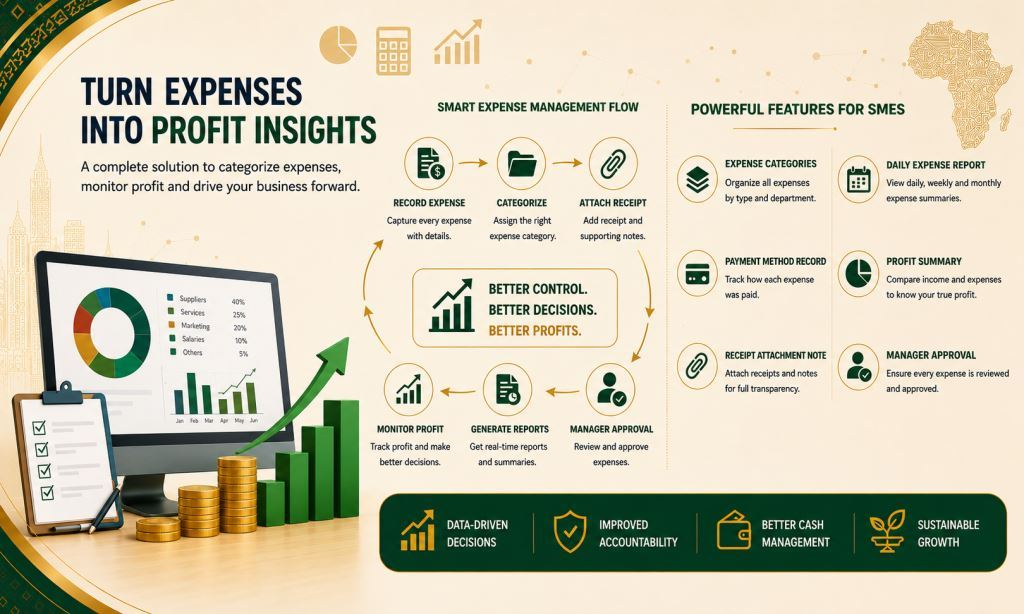
Expense categories
Expense categories should remain simple for daily users while providing the level of control managers need. In practice, this feature connects expenses with sales, invoices, receipts, inventory, purchases, suppliers, customers, staff access and dashboards. As a result, the organization avoids creating isolated records. When configured properly, staff enter information once, verify it quickly and reuse it across reports, receipts and dashboards.
Payment method record
Payment method records should be easy for employees to use and reliable for managers to monitor. Moreover, this feature connects payment information with sales, invoices, receipts, inventory, purchases, suppliers, customers, expenses and dashboards. Consequently, every payment remains linked to the appropriate transaction. Proper configuration also improves reporting accuracy and financial transparency.
Reliable expense management also depends on properly organized invoices, receipts and quotations. Read our article Invoice, Receipt And Quotation Management Software For African Businesses to learn how structured business documents strengthen financial control, simplify payment verification and improve reporting accuracy.
Receipt attachment note
Receipt attachment functionality should support daily operations without adding unnecessary complexity. For example, users can attach supporting documents directly to expense records. Therefore, managers can verify transactions more quickly. In addition, complete documentation improves reporting quality and simplifies future audits.
Daily expense report
Daily expense reporting should provide accurate information without increasing staff workload. At the same time, it connects expenses with sales, invoices, purchases, suppliers, customers and dashboards. As a result, management receives consistent financial information throughout the day. Well-configured reports also help identify unusual spending patterns earlier.
Profit summary
Profit summary tools should provide a clear overview of business performance. Furthermore, they combine sales, expenses, inventory costs and other financial records into meaningful reports. Consequently, owners can evaluate profitability more accurately. They can also make better business decisions based on reliable financial data.
Manager approval
Manager approval should remain straightforward for daily users while ensuring strong administrative control. Finally, this feature connects approvals with sales, invoices, receipts, inventory, purchases, suppliers, customers, expenses, staff permissions and dashboards. Therefore, important information remains centralized. After approval, users can quickly verify the records before using them in reports, dashboards and follow-up activities.
These features should never be activated without careful planning. Instead, the correct configuration depends on the organization’s size, the number of users, reporting requirements and management controls. For this reason, Prosoft Africa recommends mapping the workflow before implementation. As a result, every feature supports a real business process instead of becoming an unused option.
Benefits for owners, managers, staff and users
The first benefit is visibility. Owners and managers no longer depend on scattered verbal updates. Instead, they access structured business information immediately. Furthermore, visibility does not mean monitoring employees unnecessarily. Rather, it helps management detect problems early, support departments effectively and make informed decisions.
The second benefit is accountability. When every user has an assigned role and every important action is connected to a user account, responsibility becomes much clearer. As a result, honest employees are protected from unsupported accusations. Meanwhile, managers can distinguish isolated mistakes from recurring process failures.
The third benefit is speed. Employees should not move from office to office searching for paper records. Instead, search tools, filters, dashboards and record histories provide immediate access to information. Therefore, customer service improves while managers obtain daily performance information much faster.
Effective expense monitoring becomes even more valuable when businesses can analyze customer purchases and sales performance together. Explore our article Sales Tracking And Customer Management Software Africa For SMEs to discover how integrating sales, customer records and financial data helps improve profitability and business decision-making.
The fourth benefit is better planning. With reliable business data, managers identify busy periods, slow-moving products, recurring balances, staff workload, branch performance and revenue trends. Consequently, organizations can prepare for future challenges before they become urgent.
How to implement without confusing the team
Start with a workflow audit. First, identify current tasks, existing records, required management reports and the processes where mistakes occur most frequently.
Next, clean the most important data before launch. However, there is no need to import every historical file immediately. Active records, user accounts, opening balances and key categories should receive priority.
Then define user roles carefully. For example, cashiers, teachers, receptionists, managers, warehouse staff and branch supervisors should not receive identical permissions. Therefore, proper access control improves both security and usability.
After that, train users with realistic examples. For instance, use sample payments, invoices, orders, customer visits and inventory movements that closely resemble daily work. As a result, employees become confident much faster.
Finally, review the first weeks after deployment. During this period, managers should verify report accuracy, data quality and the gradual disappearance of manual processes.
Implementation should always remain progressive. Instead of enabling every module immediately, launch the essential workflow first. Later, the organization can introduce advanced reports, branch controls, customer communication, inventory analysis, dashboards and additional modules as staff become more comfortable.
Available across Cameroon and Africa
Prosoft Africa provides software installation, training and technical support for shops, SMEs, distributors, service companies, agencies and growing businesses throughout Cameroon. In addition, services are available in Douala, Yaounde, Buea, Bamenda, Limbe, Bafoussam, Garoua, Maroua, Ngaoundere, Bertoua and many other locations. This approach highlights the service area naturally without unnecessary keyword repetition.
Organizations outside Cameroon can also request online demonstrations, remote installation assistance, staff training and continuous technical support. Furthermore, businesses across Africa can implement a structured management solution while receiving practical guidance during configuration, user adoption and reporting.
Discover how our business management software helps SMEs organize expense categories and improve profit tracking in one integrated system.
Frequently asked questions
Who should use business expense category profit software SMEs?
This solution is ideal for SME owners, shop managers, distributors, accountants, cashiers, sales teams and branch supervisors. It helps improve organization, strengthen reporting accuracy and reduce dependence on manual record keeping.
Should every feature be used on the first day?
No. Instead, organizations usually achieve better results by implementing the essential workflow first. Additional modules can then be introduced as users become comfortable with the system.
Can Prosoft Africa support teams with limited computer experience?
Yes. In fact, Prosoft Africa provides practical, role-based training followed by ongoing support. This approach helps users master the tasks they perform every day.
Conclusion
Choosing business expense category profit software SMEs should be viewed as an important management decision. Rather than simply digitizing records, the right solution improves organization, strengthens reporting and supports better business decisions. Ultimately, the greatest results come from combining software, staff training and consistent management practices.
Prosoft Africa helps shops, SMEs, distributors, service companies, agencies and growing businesses throughout Cameroon and across Africa evaluate their requirements, configure suitable modules, train users and support successful implementation. To get started, request a demonstration, prepare your current workflow questions and discover how the solution can be adapted to your daily business operations.
Explore more expert articles on business management software, business process automation, digital transformation, and enterprise technology across Cameroon and Africa to deepen your understanding.
Stay connected with Prosoft Africa on Facebook, Instagram, LinkedIn, X (Twitter) and TikTok to discover innovative business management solutions, live demos, customer success stories, and the latest updates helping businesses across Africa improve productivity, streamline operations, and accelerate growth.
