

Sales Tracking and Customer Management Software for SMEs in Africa
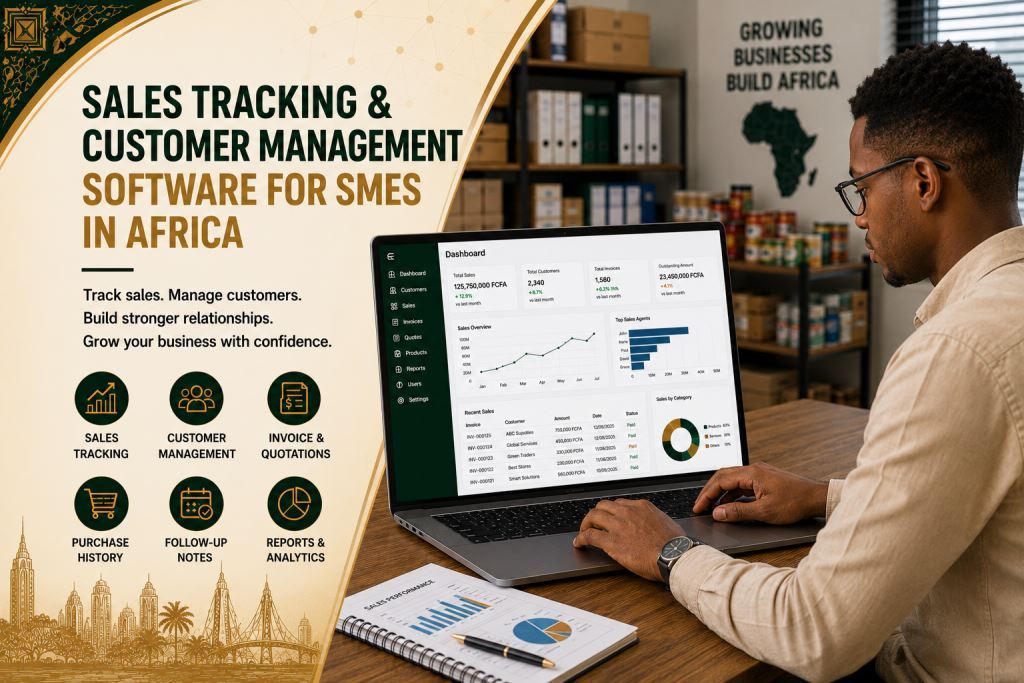
Sales tracking and customer management software Africa is becoming essential for SMEs, retail shops, wholesalers, distributors, service businesses and growing companies that want to organize their daily operations without depending only on paper records, WhatsApp messages or scattered spreadsheets. Prosoft Africa helps SME owners, managers, accountants, sales teams, inventory staff, purchasing teams and branch supervisors use digital tools to improve record keeping, reporting and accountability across Cameroon and Africa.
Businesses gain more value from sales information when they connect it to customer history, follow-up notes and the employees responsible for each transaction.
This article explains how sales tracking and customer management software Africa fits into a complete business management software strategy. It focuses on practical implementation, staff adoption, reporting, system setup and ongoing support. As a result, business owners and decision makers can better understand what to look for before selecting a software solution.
Why This Topic Matters for Daily Operations
Many organizations begin facing challenges when employees manage stock records, sales, invoices, quotations, customer information, supplier records, expenses, user access, branch activities and management reports in different notebooks, mobile phones, spreadsheets or through verbal communication. Although the business may continue operating, it becomes difficult to determine which records are accurate, who entered the information and whether management is receiving reliable reports on time.
Common warning signs include stock records that no longer match physical inventory, manually prepared invoices, inconsistent customer follow-up and uncontrolled business expenses. At first, these problems may seem minor. However, they become much more costly as the organization grows, employees change roles or management requires reliable information for important decisions.
A good digital system reduces confusion without making daily work more complicated. It should not replace professional judgment or local experience. Instead, it should provide a structured workflow that allows every employee to follow the same process while giving business owners clear visibility into daily operations.
Many organizations in Cameroon and across Africa also require software that accommodates different levels of computer experience. For this reason, an effective solution should offer simple screens, clear workflows, user permissions, practical training and ongoing support that matches the pace of the organization.
Discover our Business Management Software and simplify sales tracking, customer management, inventory control, purchasing, invoicing and business reporting.
Key Features to Look For
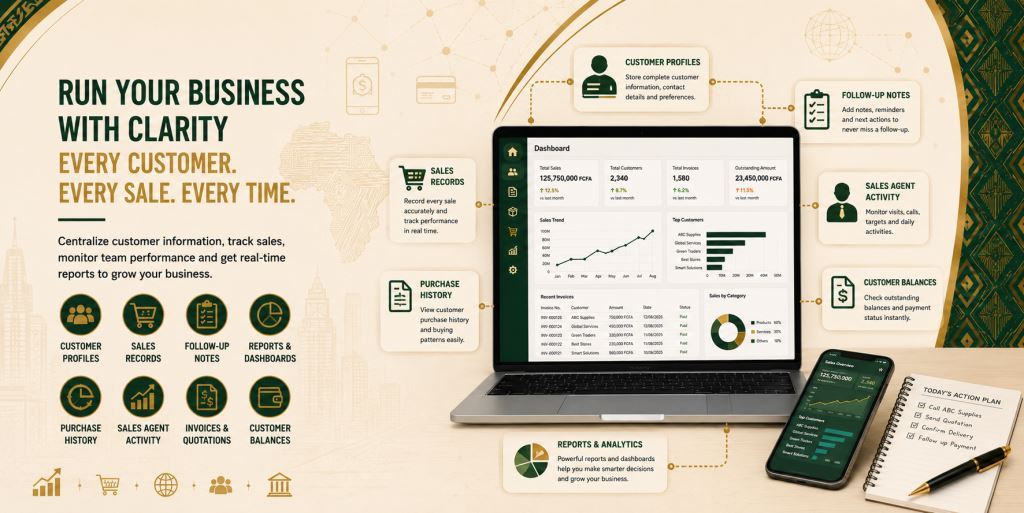
1. Sales Records
Sales records should be easy for authorized employees to use during everyday business activities, not only when preparing end-of-month reports. In practice, this feature should help the organization capture accurate information once, store it correctly and make it available whenever a manager, accountant or supervisor needs it.
For SMEs, retail shops, wholesalers, distributors, service businesses and growing companies across Cameroon and Africa, this reduces duplicate work while improving daily follow-up. When administrators configure sales records properly within sales tracking and customer management software Africa, staff spend less time searching for information and more time serving owners, managers, sales agents, accountants, customers, suppliers, inventory teams and branch supervisors with confidence.
2. Customer Profiles
Customer profiles should provide a complete history of every client while remaining simple for authorized employees to update during normal operations. Instead of searching through paper files or multiple spreadsheets, staff can quickly retrieve customer information whenever they need it.
For SMEs, retail shops, wholesalers, distributors, service businesses and growing companies in Cameroon and Africa, organized customer profiles improve communication and strengthen customer relationships. When organizations configure customer profiles properly inside sales tracking and customer management software Africa, teams work more efficiently while providing faster and more consistent customer service.
To strengthen customer relationship management even further, explore our CRM & Customer Follow-Up Software for Service Businesses. This solution centralizes customer records, communication history, follow-up activities, and sales opportunities, helping businesses improve customer satisfaction while increasing sales performance and long-term customer loyalty.
3. Purchase History
Purchase history allows businesses to maintain complete records of customer transactions without relying on manual filing systems. Authorized employees should be able to review previous purchases quickly whenever questions arise or additional sales opportunities appear.
For SMEs, retail shops, wholesalers, distributors, service businesses and growing companies, accurate purchase history reduces repeated data entry and improves customer follow-up. When businesses configure the purchase history feature correctly within sales tracking and customer management software Africa, managers, accountants, sales teams and customer service staff gain faster access to reliable information that supports better decision-making.
4. Follow-Up Notes
Follow-up notes help businesses record conversations, customer requests and future actions in one organized location. Authorized users should be able to update these notes during normal daily work instead of relying on memory or handwritten reminders.
For organizations throughout Cameroon and Africa, well-managed follow-up notes improve communication between departments and reduce missed opportunities. When organizations integrate follow-up notes into sales tracking and customer management software Africa, employees spend less time searching for information and more time delivering professional customer service.
5. Sales Agent Activity
Sales agent activity enables managers to monitor daily sales work, customer visits and completed tasks through organized digital records. Instead of depending only on verbal updates, supervisors can review accurate activity reports whenever necessary.
For SMEs, retail shops, wholesalers, distributors, service businesses and growing companies, this feature strengthens accountability while improving sales management. When sales agent activity is configured effectively within sales tracking and customer management software Africa, organizations gain better visibility into staff performance and customer engagement.
6. Customer Balance Reports
Customer balance reports provide clear information about outstanding balances, completed payments and customer account status. Authorized employees should be able to generate these reports quickly whenever management or accounting teams require them.
For businesses across Cameroon and Africa, customer balance reports reduce manual calculations while improving financial monitoring. When customer balance reports are properly implemented within sales tracking and customer management software Africa, owners, managers, accountants and branch supervisors can make faster decisions based on accurate financial information.
To improve customer payment management, explore our Credit Sales & Customer Balance Tracking Software for SMEs. This solution helps businesses monitor credit sales, track outstanding customer balances, manage payment collections, and improve cash flow through accurate customer receivable management.
Benefits for Owners, Managers, Staff and Customers
The first benefit is greater visibility. Instead of depending only on verbal updates or handwritten records, owners and managers can review structured reports whenever they need them. These reports show what happened during the day. They also help managers identify delayed activities, monitor pending approvals and determine which department or branch requires immediate attention.
Another important benefit is accountability. When every user logs into the system with an individual account and assigned permissions, managers can easily identify who created, modified or approved each record. As a result, the organization protects both its information and its employees. Accurate records support decisions instead of memory.
The software also improves speed. Employees no longer need to move from one office to another while searching for paper files or asking colleagues for information. Instead, search tools, filters, dashboards and record histories allow users to locate information quickly. This advantage becomes especially valuable during busy periods when customers expect fast and professional service.
Good records also improve planning. Managers can identify trends that are difficult to recognize with manual processes. For example, they can analyze busy periods, slow sales days, recurring delays and stock movements. They can also review customer buying habits, outstanding balances and branch performance. These insights help business leaders decide what to improve. They also help managers decide what to purchase, where additional training is required and which investments should receive priority.
How to Implement It Without Confusing the Team
Successful implementation begins with a workflow audit. Before installing any software, the organization should identify the records it manages. It should also identify the reports it requires, the employees who need access and the daily challenges that reduce efficiency. This preparation allows Prosoft Africa to configure the software around real business operations instead of making assumptions.
The next step is preparing existing data. Historical records do not need to be perfect before digitalization begins. However, the organization should decide which information will be imported, archived or entered as new records. During this stage, many SMEs, retail shops, wholesalers, distributors, service businesses and growing companies discover duplicate customer names, incorrect balances, outdated product lists and inconsistent manual practices.
Staff training follows data preparation. Training should always be practical and adapted to each employee’s responsibilities. For example, cashiers should learn cashier functions. Administrators should focus on reports and user permissions. Managers should understand dashboards and performance reports. Inventory controllers should learn stock movement procedures. This role-based approach helps employees learn faster because they focus only on the features they use every day.
The final stage is post-launch support. During the first few weeks after implementation, managers should monitor how employees enter information. They should review the accuracy of reports and ensure that old manual habits do not return. Regular follow-up sessions with Prosoft Africa help answer questions, adjust system settings and improve user adoption. These sessions also help the organization become more comfortable with the software.
Available Across Cameroon and Africa
Prosoft Africa provides software setup, training and ongoing support for SMEs, retail shops, wholesalers, distributors, service businesses and growing companies throughout Cameroon. The company serves organizations in Douala, Yaounde, Buea, Bamenda, Limbe, Bafoussam, Garoua, Maroua, Ngaoundere and Bertoua.
Instead of creating repetitive city-specific content, the article presents the service area naturally. At the same time, it remains focused on genuine operational challenges faced by businesses.
Organizations outside Cameroon can also request online demonstrations, remote installation, virtual staff training and continuous technical support. This approach benefits businesses across Africa. It also supports organizations that need structured management software and want a partner who understands local realities. These realities include varying internet connectivity, different levels of computer experience, multi-branch operations and practical reporting requirements.
Decision Checklist Before Requesting a Demo
Before requesting a demonstration, organizations should prepare a list of the records they want the system to manage. They should also determine which employees need permission to create, edit, approve or simply view each type of information.
Next, management should identify the reports they expect the software to generate. These may include daily sales summaries, branch performance comparisons, customer balances, stock movement reports, staff activity reports or financial dashboards. Defining these expectations early makes software configuration more efficient.
It is also advisable to select a small implementation team. This group can test the workflow, identify improvement opportunities, ask practical questions during training and later assist other employees as they begin using the system.
Finally, organizations should confirm how support will continue after installation. This is especially important when staff members change roles, new branches are opened or additional software modules need to be introduced in the future.
Frequently Asked Questions
Who Should Use Sales Tracking and Customer Management Software Africa?
Sales tracking and customer management software Africa is designed for SME owners, managers, accountants, sales teams, inventory staff, purchasing teams and branch supervisors who want better control over their daily operations. It helps organizations maintain accurate records, generate reliable reports and improve accountability without increasing administrative complexity.
Can the Software Support Users with Limited Computer Experience?
Yes. The software should be implemented with practical, role-based training that matches each employee’s daily responsibilities. Instead of overwhelming users with every available feature, the training focuses on the tasks they perform most often. Ongoing support also helps employees build confidence as they become familiar with the system.
Should Every Feature Be Activated on the First Day?
No. Many organizations achieve better results by introducing the software gradually. They usually begin with the most important workflows, such as sales, customer management or inventory control. Once employees become comfortable with those modules, additional features can be introduced without disrupting daily operations.
Conclusion
Choosing sales tracking and customer management software Africa should be viewed as an important business management decision rather than simply purchasing another software application.
The right solution helps organizations organize stock records, sales transactions, invoices, quotations, customer information, supplier records, expenses, user permissions, branch activities and management reports within one structured system. It also keeps daily workflows simple and practical for the people who use the software every day.
As businesses grow, organized digital records become increasingly valuable. Managers gain faster access to accurate information. Employees spend less time searching for documents. Decision-makers can also rely on real-time reports instead of incomplete manual records. Consequently, organizations improve efficiency, accountability and customer service while reducing errors and duplicated work.
Prosoft Africa supports organizations throughout Cameroon and across Africa by reviewing operational requirements, configuring suitable software modules and providing practical staff training. The company also delivers continuous technical support after implementation. Businesses that are ready to improve their operations should request a demonstration. They should also prepare a clear list of the daily challenges they want the software to solve first.
Explore more expert articles on business management, digital transformation and business software across Cameroon and Africa to deepen your understanding.
Stay connected with Prosoft Africa on Facebook, Instagram, LinkedIn, X (Twitter), and TikTok to discover innovative business software solutions, live demos, customer success stories, expert insights, and updates transforming businesses across Africa.
