

Invoice, Receipt and Quotation Management Software for African Businesses
Invoice and quotation management software Africa is becoming important for SMEs, retail shops, wholesalers, distributors, service businesses, and growing companies that want to organize their daily operations without depending only on paper, WhatsApp messages, or scattered spreadsheets. Prosoft Africa helps SME owners, managers, accountants, sales teams, inventory staff, purchasing teams, and branch supervisors use digital tools for better records, clearer reports, and practical accountability across Cameroon and Africa.
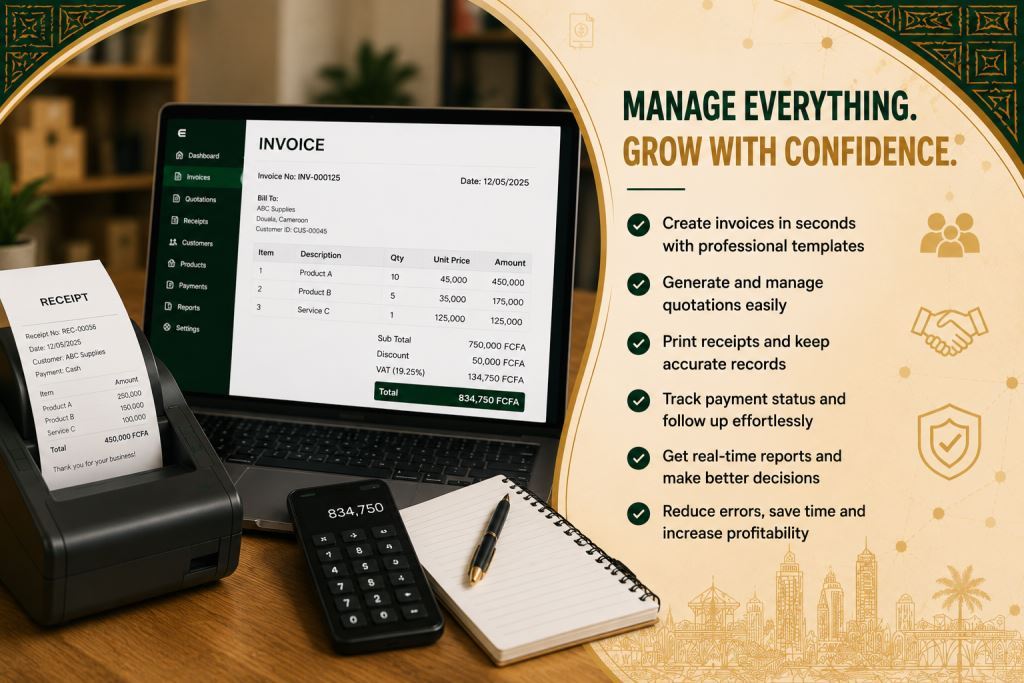
Clean invoices, receipts, and quotations make a business look professional. They also protect important records for customer follow-up and accounting.
This article explains how invoice and quotation management software Africa fits into a complete business management software strategy. It focuses on practical use, staff adoption, reporting, setup, and support. As a result, decision makers can understand what to look for before choosing a platform.

Why This Topic Matters for Daily Operations
The problem usually begins when businesses manage stock, sales, invoices, quotations, customers, suppliers, expenses, user access, branches, and management reports in different notebooks, phones, spreadsheets, or verbal instructions.
A business may continue operating every day. However, staff often struggle to identify the latest record. Managers may also find it difficult to know who entered the information or whether reports reflect the current situation.
Common warning signs include stock records that do not match shelf quantities, manual invoices, weak customer follow-up, and uncontrolled expenses. At first, these issues may seem small. However, they become expensive as the business grows, employees change roles, or managers need reliable information to make important decisions.
A digital system should reduce confusion without making the team feel lost. It should support professional judgment instead of replacing it. The system gives staff a shared structure for daily work while providing business owners with a reliable view of daily operations.
Many organizations in Cameroon and across Africa also need a solution that supports different levels of computer experience. Therefore, a good platform should provide simple screens, clear workflows, user permissions, practical training, and ongoing support that matches the team’s pace.
Key Features to Look For
1. Invoice Templates
Authorized staff should use invoice templates easily during normal daily work. The feature should not be limited to end-of-month reporting.
In practical terms, invoice templates help businesses capture the correct information once. They store the information in the correct record and make it available whenever a manager, accountant, or supervisor needs it.
For SMEs, retail shops, wholesalers, distributors, service businesses, and growing companies across Cameroon and Africa, this approach reduces repeated writing and improves everyday follow-up.
When teams configure invoice templates correctly in invoice and quotation management software Africa, they spend less time searching for information. As a result, they spend more time supporting owners, managers, sales teams, accountants, customers, suppliers, inventory staff, and branch supervisors.
2. Quotation Records
Authorized staff should use quotation records easily during their daily work. The feature should not be reserved only for end-of-month reporting.
Quotation records allow businesses to capture information once, keep it organized, and retrieve it whenever managers, accountants, or supervisors need it.
For SMEs, retail shops, wholesalers, distributors, service businesses, and growing companies across Cameroon and Africa, this reduces duplicate work and improves operational efficiency.
When organizations configure quotation records correctly in invoice and quotation management software Africa, staff spend less time looking for information. Consequently, they spend more time serving customers, suppliers, managers, accountants, sales teams, inventory staff, and business owners.
3. Receipt Printing
Authorized staff should use receipt printing easily during their daily work. The feature should not be reserved only for end-of-month reporting.
In practical terms, receipt printing helps businesses capture the correct information once. It stores the information in the correct record and makes it available whenever a manager, accountant, or supervisor needs it.
For SMEs, retail shops, wholesalers, distributors, service businesses, and growing companies across Cameroon and Africa, this approach reduces repeated writing and improves everyday follow-up.
When organizations configure receipt printing correctly in invoice and quotation management software Africa, staff spend less time searching for information. As a result, they spend more time assisting owners, managers, sales teams, accountants, customers, suppliers, inventory staff, and branch supervisors.
4. Payment Status Tracking
Authorized staff should use payment status tracking easily during normal daily operations. The feature should support everyday work instead of being limited to end-of-month reporting.
Payment status tracking allows businesses to record information once, store it correctly, and retrieve it whenever managers, accountants, or supervisors need it.
For SMEs, retail shops, wholesalers, distributors, service businesses, and growing companies across Cameroon and Africa, this process reduces duplicate work and improves daily follow-up.
When organizations configure payment status tracking correctly in invoice and quotation management software Africa, employees spend less time searching for information. Consequently, they spend more time supporting customers, suppliers, managers, accountants, sales teams, inventory staff, and business owners.
5. Customer Balance History
Authorized staff should access customer balance history easily during their daily work. The feature should support normal operations instead of serving only end-of-month reporting.
Customer balance history keeps financial records organized. It stores accurate information and makes it available whenever managers, accountants, or supervisors need it.
For SMEs, retail shops, wholesalers, distributors, service businesses, and growing companies across Cameroon and Africa, this feature reduces repeated work and improves customer follow-up.
When organizations configure customer balance history correctly in invoice and quotation management software Africa, teams spend less time looking for information. Therefore, they spend more time serving customers, suppliers, managers, accountants, sales teams, inventory staff, and business owners.
Managing invoices and quotations becomes even more effective when customer accounts, supplier information, and business expenses are managed together. Explore our article Customer, Supplier And Expense Management Software For SMEs to discover how integrating these records improves financial visibility, customer follow-up, and daily business operations.
6. Tax and Numbering Discipline
Authorized staff should manage tax and numbering discipline easily during their daily work. The feature should support everyday operations instead of being used only for monthly reporting.
Tax and numbering discipline helps businesses record information correctly the first time. It stores every record in the proper location and makes it available whenever managers, accountants, or supervisors need it.
For SMEs, retail shops, wholesalers, distributors, service businesses, and growing companies across Cameroon and Africa, this approach reduces repeated writing and strengthens everyday record management.
When organizations configure tax and numbering discipline correctly in invoice and quotation management software Africa, staff spend less time searching for information. As a result, they spend more time supporting owners, managers, sales teams, accountants, customers, suppliers, inventory staff, and branch supervisors.
Discover our Business Management Software and see how invoice and quotation management software Africa helps businesses improve invoicing, quotations, and daily operations.
Benefits for Owners, Managers, Staff and Customers
Better Visibility
The first benefit is better visibility. Owners and managers no longer rely only on verbal summaries. Instead, they review structured reports that provide accurate information.
They can quickly see what happened during the day, what tasks are delayed, what requires approval, and which department or branch needs attention.
Better Accountability
The second benefit is better accountability. Every user signs into the system with an assigned role. This makes it easier to identify who created a record, who edited it, and who approved it.
As a result, the organization protects its information while also protecting honest employees because every action is supported by recorded evidence instead of memory.
Faster Daily Operations
The third benefit is faster daily operations. Employees no longer move from office to office looking for paper records.
Search tools, filters, dashboards, and activity histories make information easier to find. Therefore, staff respond more quickly when customers are waiting or when urgent decisions must be made.
Better Planning
The fourth benefit is better planning. Well-organized records reveal patterns that are difficult to identify manually.
Managers can identify busy periods, slow business days, recurring delays, stock movements, customer balances, purchasing trends, and branch performance.
These insights help business leaders make better decisions about purchasing, staffing, customer service, inventory management, and future investments.
How to Implement It Without Confusing the Team
Implementation should begin with a simple workflow audit.
Before setting up the software, the organization should list the records it keeps, the reports it needs, the users who require access to information, and the mistakes that currently waste time. This review helps Prosoft Africa configure the solution around real operational needs instead of assumptions.
Data Preparation
The second step is data preparation.
Old records do not need to be perfect before digitalization begins. However, the team should decide which information to import, archive, or recreate.
For many SMEs, retail shops, wholesalers, distributors, service businesses, and growing companies, this stage identifies duplicate names, missing balances, unclear product lists, and outdated manual practices. As a result, the organization starts with cleaner and more reliable data.
Staff Training
The third step is staff training.
Training should be practical and based on user roles.
For example, cashiers learn the cashier workflow. Administrators learn reports and user permissions. Managers work with dashboards, while stock controllers learn inventory movements.
This approach ensures that every employee learns only the features needed for daily work. Consequently, staff gain confidence without becoming overwhelmed by unnecessary functions.
Post-Launch Support
The fourth step is post-launch support.
During the first weeks after implementation, managers should verify that users enter information correctly. They should also review reports regularly and confirm that employees no longer rely on outdated manual processes.
Regular follow-up sessions with Prosoft Africa help answer questions, adjust system settings, and improve user adoption.
Available Across Cameroon and Africa
Prosoft Africa provides software setup, training, and ongoing support for SMEs, retail shops, wholesalers, distributors, service businesses, and growing companies throughout Cameroon.
The company supports businesses in Douala, Yaoundé, Buea, Bamenda, Limbe, Bafoussam, Garoua, Maroua, Ngaoundéré, and Bertoua.
Rather than creating separate pages for every city, this article focuses on real operational challenges while naturally explaining the service area.
Organizations outside Cameroon can also request online demonstrations, remote installation guidance, staff training, and continuous support.
As a result, businesses across Africa benefit from structured management software backed by a partner that understands local realities, including mixed internet connectivity, different staff skill levels, multi-branch operations, and practical reporting requirements.
Decision Checklist Before Requesting a Demo
Before requesting a demonstration, identify the records your organization wants to manage in the system. Then decide which users should create, edit, approve, or only view each type of record.
Prepare sample reports you expect to receive. These may include daily sales summaries, branch comparisons, customer balances, stock movements, appointment schedules, staff activity reports, and financial dashboards.
This preparation makes the demonstration more practical and helps ensure that it matches your organization’s operational needs.
Choose a small implementation team to test the workflow, ask questions, and support other employees after training.
Finally, confirm how the software will be supported after installation, especially when staff change roles, new branches open, or additional modules become necessary.
Frequently Asked Questions
Who Should Use Invoice and Quotation Management Software Africa?
Invoice and quotation management software Africa is ideal for SME owners, managers, accountants, sales teams, inventory staff, purchasing teams, and branch supervisors who want cleaner records, faster reporting, and better control of their daily operations.
In addition, the software helps businesses organize invoices, quotations, receipts, and customer records more efficiently while improving overall operational control.
Can the Software Support Users with Limited Computer Experience?
Yes. The implementation includes simple role-based training, practical examples, and continuous support.
As a result, users learn the tasks they perform every day without feeling overwhelmed. This practical approach encourages faster software adoption throughout the organization.
Should Every Feature Be Activated on the First Day?
No.
Many organizations achieve better results by starting with the most important workflows first. As staff become more comfortable with the software, they can gradually introduce additional modules.
This step-by-step approach reduces confusion, improves user confidence, and supports long-term adoption.
Conclusion
Choosing invoice and quotation management software Africa should be treated as a business management decision rather than simply an IT purchase.
The right solution brings structure to stock management, sales, invoices, quotations, customer records, supplier management, expenses, user access, branch operations, and management reporting. It also simplifies daily work while giving managers reliable information for better decision-making.
Furthermore, Prosoft Africa helps organizations across Cameroon and Africa evaluate their operational needs, configure the appropriate modules, train their teams, and support successful software adoption after implementation. Businesses achieve even greater efficiency when invoicing is fully integrated with stock management, sales tracking, and receipt generation. Read our article Business Software For Stock, Sales, Invoices And Receipts to learn how an integrated business management solution simplifies daily operations and improves overall business performance.
Request a demo today and prepare a list of the daily operational challenges you want the software to solve first.
Explore more expert articles on business management software, digital transformation, inventory management, invoicing, and business technology across Cameroon and Africa to deepen your understanding.
Stay connected with Prosoft Africa on Facebook, Instagram, LinkedIn, X (Twitter), and TikTok to discover innovative business management software solutions, live demonstrations, customer success stories, practical business tips, and the latest updates helping organizations across Cameroon and Africa improve efficiency.
