
School ERP Training Plan for Bursars, Teachers and Secretaries
School ERP training Cameroon is a serious management topic for schools, colleges, bilingual institutions, training centers and education groups. These organisations want cleaner records, faster decisions and stronger accountability. In this context, Prosoft Africa builds content based on real operations in Cameroon and across Africa. The goal of this article is to help school owners, principals, bursars, accountants, secretaries, teachers and education groups understand what the system should organise. It also explains the mistakes to avoid and how to prepare a practical deployment.
However, for many organisations, the challenge is not only the absence of software. The deeper issue is that important information is scattered across notebooks, spreadsheets, phones, receipt books and verbal updates. When teams rely on separate records, managers spend too much time requesting clarifications. As a result, they have less time to improve service quality. A good system transforms daily work into structured, searchable and verifiable records.
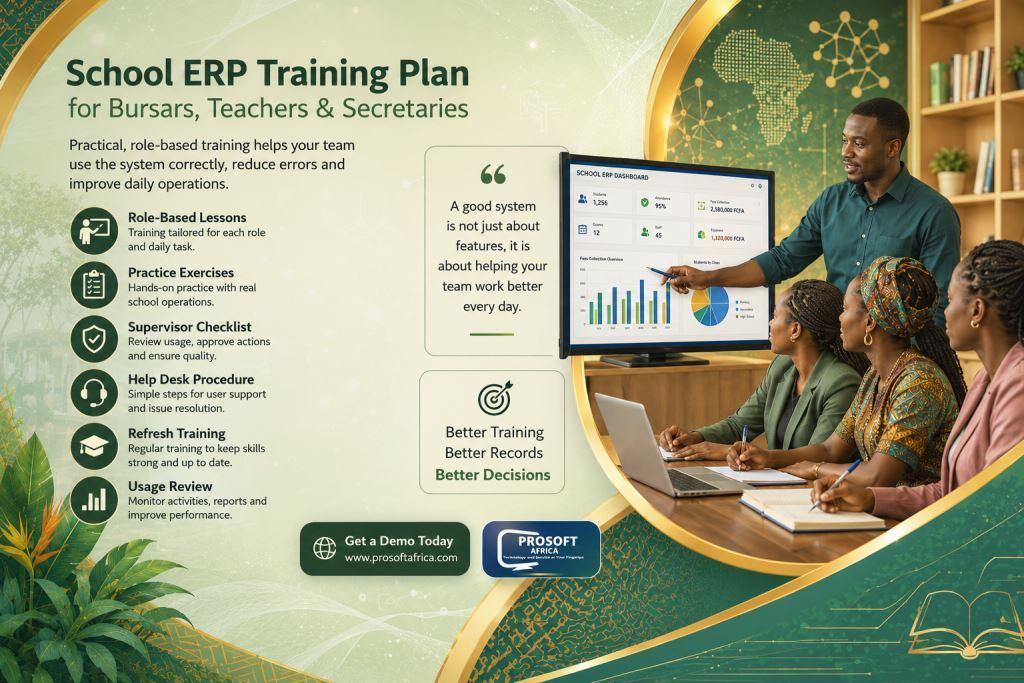
In this context, School ERP training Cameroon should be practical, role-based and repeated enough for each department to use the system correctly. The best approach is to connect training to a complete school management software strategy. This includes student records, school fees, receipts, exams, report cards, attendance, parent communication and administrative reports. Thus, the organisation does not rely on a single isolated tool. Instead, it builds a strong management foundation that supports growth, new users, additional branches and more reliable reporting over time.

Why School ERP Training Cameroon Matters
Daily operations involve many small decisions every hour. Staff must know who entered a record, which payment was accepted, which stock item moved, which person requires follow-up, which report must be checked and which manager must approve a correction. When these actions are not recorded in a single system, the organisation relies on memory. Memory may work in small teams. However, it quickly becomes unreliable as activity increases.
In addition, a strong digital workflow helps staff follow the same steps even during busy periods. It reduces confusion because each role clearly knows what to enter, what to validate and what to review. It also helps managers distinguish between normal delays and real operational risks. This is why software should be seen as a management improvement, not just a simple IT purchase.
Furthermore, organisations in Cameroon and other African markets require realistic deployment conditions. Internet availability, staff computer skills, language needs, hardware budgets and branch distance can vary widely. A useful system must therefore be clear, easy to learn and adaptable. At the same time, it should align with real working habits while gradually improving discipline and data quality.
Finally, the strongest sign of successful implementation is not a long list of features. It is when users no longer ask where information is stored because the workflow naturally guides them to the correct record. At this stage, school owners, principals, bursars, accountants, secretaries, teachers and education groups experience better organisation and efficiency.
To understand how every department works together within a single digital platform, explore our Complete Guide to School Management Software in Cameroon and Africa. It explains how admissions, academics, finance, attendance, communication, and reporting are integrated to improve school management and long-term efficiency.
Common Problems School ERP Training Cameroon Solves
A frequent problem is that staff members receive little or no training before using the ERP system. At first, this may not seem serious. However, different users quickly develop different working methods. School ERP training Cameroon helps every user follow the same procedures and use the system correctly from the beginning.
Another common problem is repeated errors caused by a lack of practical knowledge. Users may enter incorrect information, skip important steps or misunderstand key features. Proper School ERP training Cameroon improves user confidence, reduces mistakes and increases the accuracy of daily operations.
A third problem occurs when new employees begin using the ERP system without guidance. They often spend more time searching for information or asking colleagues for help. School ERP training Cameroon gives new users the skills they need to work independently, follow established procedures and contribute more effectively to the organisation.
School ERP Training Cameroon Planning and Skills Validation
Another issue appears when schools introduce an ERP system without preparing users properly. At first, skipping training may seem faster. However, it often leads to confusion, inconsistent procedures and avoidable mistakes. School ERP training Cameroon helps users understand their responsibilities before they begin working with the system.
In some cases, staff members struggle to adapt because they are unfamiliar with digital workflows. At first, this hesitation is normal. However, regular practical sessions help users become more confident. School ERP training Cameroon also encourages teams to follow the same procedures and use the software more effectively.
Another challenge occurs when users understand only basic functions. As a result, they may overlook important reports, financial records, attendance information or student data. Practical training teaches them how to use every feature required for their daily responsibilities.
Finally, organisations should evaluate user skills after training. Managers need to confirm that staff can complete everyday tasks correctly and follow established procedures. School ERP training Cameroon strengthens user confidence, improves data accuracy and supports long-term success.
Key features to look for
Data preparation and cleaning
Data audit: this feature should be simple for daily users and powerful enough for managers. In practice, it connects student records, school fees, receipts, exams, report cards, attendance, parent communication and administrative reports. Thus, the organisation avoids creating isolated records. When properly configured, staff enter data once. Then, they can verify it quickly and reuse it in reports and dashboards.
Student list cleaning: this feature helps correct duplicates and errors before migration. In addition, it improves data quality by removing inconsistencies. It also links information to student records and administrative data. As a result, schools work with cleaner and more reliable data before import.
Fee balance preparation: this feature helps structure financial data before migration. Moreover, it connects school fees, receipts and balances to student records. Therefore, financial errors are reduced before the system goes live.
Testing and go-live preparation
Archive plan: this feature helps organise paper documents before digitisation. Furthermore, it improves classification and retrieval after migration. It links documents to student files and administrative data. Thus, information becomes easier to access and manage.
Import testing: this step checks data before full migration. However, it helps detect errors and inconsistencies early. It ensures each record is correctly linked. As a result, managers maintain better control over imported data.
Go-live validation: this step confirms that the migration is successful. Finally, it synchronises student records, fees, exams, report cards and attendance. Thus, users start working with reliable data from day one.
These features should not be activated blindly. Indeed, configuration depends on organisation size, number of users and reporting needs. Before deployment, Prosoft Africa can analyse the workflow. This ensures each feature matches a real operational need and avoids unnecessary complexity. School ERP training Cameroon also helps users adopt the system correctly and work more efficiently.
Benefits for owners, managers, staff and users
The first benefit is visibility. Owners and managers no longer rely on scattered verbal updates. Instead, they access structured and reliable data. In fact, visibility does not mean monitoring staff. It means identifying issues early, supporting departments and making better decisions.
The second benefit is accountability. When each user has a defined role and every action is recorded, transparency improves. Thus, staff are protected from unverified accusations. Managers can also distinguish between isolated mistakes and recurring problems.
Faster operations and better organisation
The third benefit is speed. Users no longer need to search for paper records across different offices. On the contrary, search tools, filters and dashboards make information easier to access. As a result, daily operations become faster and more efficient.
The fourth benefit is planning. With reliable data, managers can identify important trends such as peak periods, recurring balances, workload distribution, branch performance and financial movements. In this way, they can anticipate problems and improve decision-making.
Discover how our school management software supports effective school ERP training for administrators, teachers, and staff.
How To Implement School ERP Training Cameroon
Start with a workflow audit. Identify the tasks performed daily, the records created, the reports required by management and the common points where errors occur.
Next, clean the most important data before deployment. The system does not need all historical files on day one. However, active records, user names, opening balances and key categories must be carefully prepared.
Then, clearly define user roles. A cashier, teacher, receptionist, manager, stock keeper or branch supervisor should not have the same permissions. Thus, access control becomes simpler, safer and more structured.
In addition, train users with real-life examples. Training should include payments, registrations, stock movements and invoices that reflect daily operations. Users understand faster when examples match their real tasks.
After go-live, monitor the first weeks closely. Managers should check report accuracy, data entry quality and whether old manual habits are still used.
Finally, adopt a progressive rollout. It is better to launch the essential workflow correctly than to activate all modules at once. Once users are comfortable, the organisation can gradually add advanced reports, branch controls, parent communication and dashboards.
For a more detailed step-by-step deployment guide, explore our School Management Software Implementation Checklist. It covers the essential planning, data preparation, testing, and go-live best practices needed for a smooth implementation and successful user adoption.
Available across Cameroon and Africa
Prosoft Africa provides installation, training and support for schools, colleges, bilingual institutions, training centres and education groups across Cameroon. This includes Douala, Yaoundé, Buea, Bamenda, Limbe, Bafoussam, Garoua, Maroua, Ngaoundere, Bertoua and other locations. This approach is intentional. It presents coverage naturally without overloading the text with city names.
In addition, organisations outside Cameroon can request online demos, remote installation support, training sessions and ongoing assistance. Thus, schools across Africa can benefit from structured onboarding, smooth configuration and continuous support during usage.
Frequently asked questions
Who should use school ERP training Cameroon?
It is designed for school owners, principals, bursars, accountants, secretaries, teachers and education groups. It helps them understand and use the ERP system correctly in daily operations.
Should all features be used on day one?
No. On the contrary, it is better to start with essential functions first. Advanced modules can be added gradually once users are comfortable.
Can Prosoft Africa support teams with limited computer skills?
Yes. Training is practical, role-based and easy to follow. Thus, users quickly learn how to perform their daily tasks in the system.
Investing in School ERP training Cameroon helps schools achieve faster adoption and better long-term results.
Conclusion
Choosing school ERP training Cameroon is a management decision. A good training approach improves system adoption, reduces errors and strengthens daily operations. Thus, schools achieve better structure and efficiency.
Finally, Prosoft Africa supports schools across Cameroon and Africa with training, implementation and follow-up. To get started, request a demo and define your training needs clearly.
Expand your knowledge with expert articles on school management software, digital transformation, and education technology across Cameroon and Africa. Explore practical insights, industry trends, and innovative solutions on our blog.
Stay connected with Prosoft Africa on Facebook, Instagram, LinkedIn, X (Twitter), and TikTok for expert tips, live demos, customer success stories, and the latest innovations transforming education across Africa.
