
Medical Records Management Software In Cameroon: The Digital Solution Transforming Healthcare In Africa
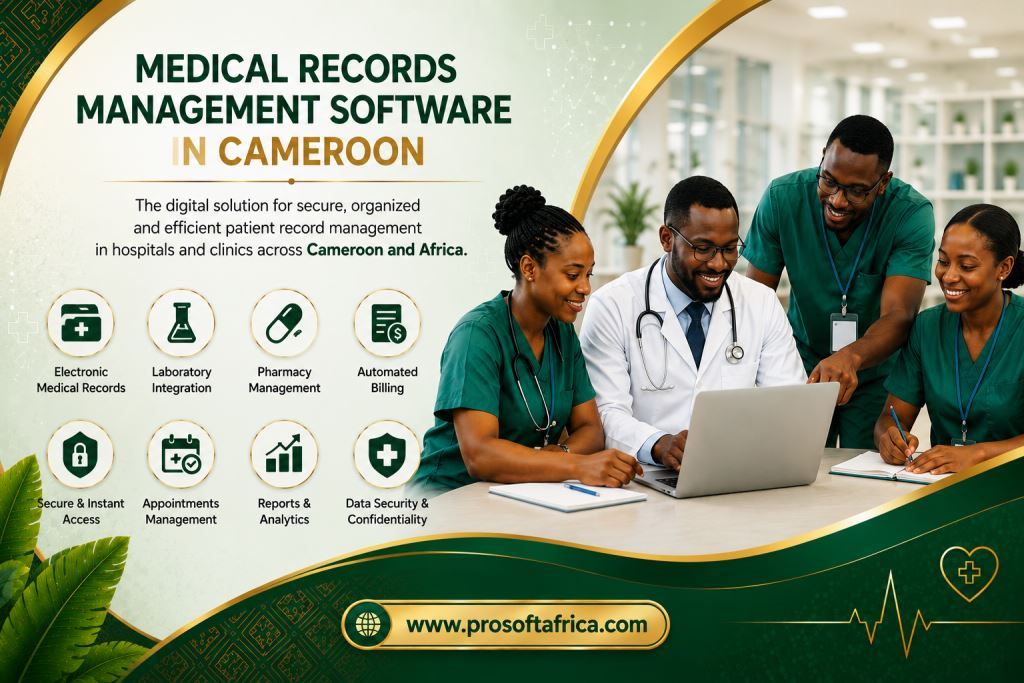
Healthcare facilities across Cameroon and Africa are embracing digital technologies to improve patient care, streamline operations, and enhance efficiency. Among the most important innovations is Medical Records Management Software, which enables hospitals, clinics, medical centers, and healthcare professionals to securely manage patient information from a centralized digital platform.
In Cameroon, particularly in cities such as Douala, Yaoundé, Bafoussam, Garoua, Maroua, Limbe, Buea, Bertoua, Kribi, Bamenda, and Ngaoundéré, healthcare providers are increasingly replacing paper records with electronic medical records to improve the quality of care while reducing administrative burdens.
Prosoft Africa, a trusted provider of healthcare software solutions, offers a comprehensive Medical Records Management Software specifically developed to meet the needs of hospitals and clinics throughout Cameroon and across Africa. The software centralizes patient information, simplifies consultations, improves collaboration between departments, strengthens data security, and supports healthcare professionals in delivering faster and more accurate medical services.
This article explores why Medical Records Management Software in Cameroon has become an essential investment, the challenges it solves, the features to look for, its benefits for healthcare facilities, and how hospitals can successfully implement a modern electronic medical records system.
Why Medical Records Management Software Has Become Essential
Many hospitals and clinics across Cameroon still rely on paper files, handwritten notes, or multiple disconnected systems. While these methods may have worked in the past, they become increasingly difficult to manage as patient numbers continue to grow.
Healthcare professionals often spend valuable time searching for patient files instead of focusing on patient care. Missing records, incomplete medical histories, and delayed information sharing can significantly slow medical services.
Common challenges include:
- Lost or damaged patient files
- Slow access to medical histories
- Incomplete patient information
- Communication gaps between departments
- Medical prescription errors
- Duplicate patient records
- Difficulty generating accurate reports
- Limited data security
These issues affect hospitals in both large cities like Douala and Yaoundé as well as smaller healthcare facilities throughout Cameroon and Africa.
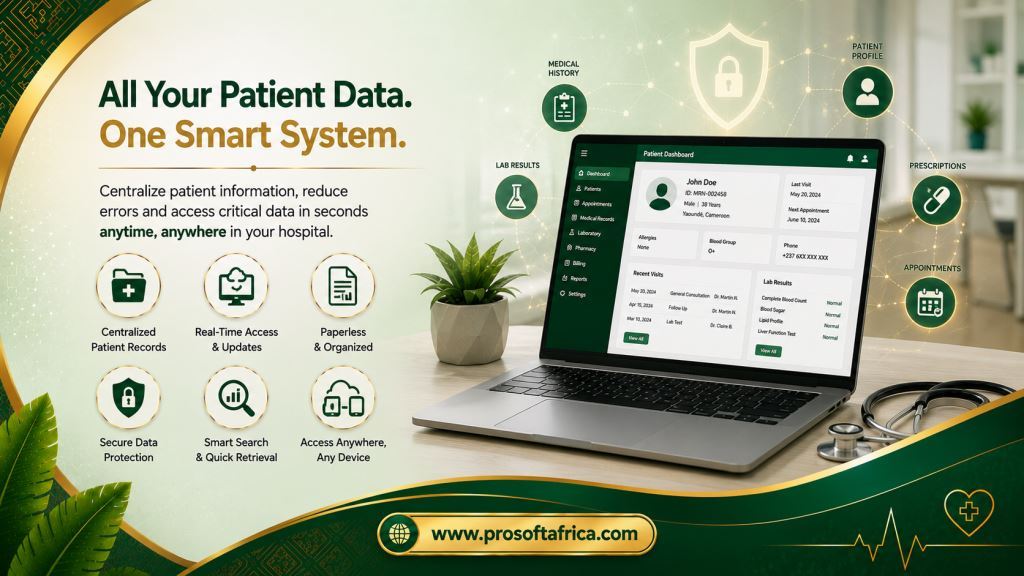
Medical Records Management Software addresses these challenges by storing every patient’s information within a secure electronic database. Authorized healthcare professionals can instantly retrieve medical histories, laboratory results, prescriptions, imaging reports, and consultation records whenever they are needed.
As a result, hospitals improve efficiency, reduce waiting times, minimize errors, and provide safer healthcare services.
Common Problems Solved By Medical Records Management Software
Healthcare institutions that continue using manual systems face numerous operational challenges every day.
One major issue is the inability to quickly retrieve patient information. Medical staff often spend several minutes searching through paper folders, especially when patients have visited the facility multiple times.
Another common problem involves incomplete patient histories. Missing information can delay diagnosis and affect treatment decisions.
Communication between departments also becomes more complicated. Laboratory staff, pharmacists, physicians, nurses, and administrative personnel may all maintain separate records, increasing the risk of inconsistencies.
Paper documentation also increases the possibility of:
- Lost laboratory reports
- Duplicate registrations
- Prescription errors
- Billing inconsistencies
- Delayed consultations
- Poor statistical reporting
- Reduced patient satisfaction
Medical Records Management Software eliminates these inefficiencies by creating one centralized electronic patient record that every authorized department can access securely.
Doctors immediately view previous consultations.
Laboratory results become available electronically.
Pharmacists receive digital prescriptions.
Administrative teams process patient information faster.
Consequently, hospitals deliver more coordinated, efficient, and accurate healthcare services.
Essential Features To Look For In Medical Records Management Software
1. Electronic Medical Records Management
Electronic Medical Records (EMR) form the foundation of every modern healthcare information system.
Instead of storing information inside paper folders, the software creates secure electronic patient records that remain accessible throughout the patient’s medical journey.
Healthcare professionals can record:
- Patient demographics
- Consultation notes
- Medical history
- Allergies
- Diagnoses
- Prescriptions
- Treatment plans
- Hospital admissions
- Follow-up appointments
Because every record is stored digitally, authorized staff can retrieve patient information within seconds regardless of the department.
Electronic Medical Records also improve collaboration between physicians, nurses, laboratory technicians, pharmacists, and hospital administrators.
Healthcare facilities therefore benefit from improved organization, better continuity of care, and stronger patient safety.
To learn more about electronic patient record management, explore our Medical Records Management Software In Cameroon solution.
2. Instant And Secure Access To Patient Records
One of the greatest advantages of Medical Records Management Software is the ability to retrieve patient information instantly.
Instead of searching through paper files, healthcare professionals can access complete medical records within seconds. Whether a patient is visiting for the first time or returning for follow-up treatment, doctors have immediate access to all relevant information.
Authorized users can securely view:
- Previous consultations
- Medical diagnoses
- Treatment history
- Laboratory results
- Medical imaging
- Prescriptions
- Hospital admissions
This rapid access allows physicians to make faster clinical decisions while reducing patient waiting times.
In addition, role-based access ensures that each staff member only views information relevant to their responsibilities, improving confidentiality and protecting sensitive medical data.
3. Comprehensive Medical History
Maintaining a complete and accurate medical history is essential for quality healthcare.
Medical Records Management Software automatically stores every consultation, diagnosis, prescription, laboratory result, and follow-up visit in chronological order.
Healthcare professionals can quickly review a patient’s medical journey before recommending new treatments.
This helps doctors:
- Better understand chronic illnesses
- Monitor treatment progress
- Avoid duplicate examinations
- Reduce medication conflicts
- Improve long-term patient care
A structured medical history also enables hospitals to provide more consistent healthcare across different departments.
4. Integrated Laboratory Information Management
Laboratory services play an essential role in accurate diagnosis.
Medical Records Management Software includes an integrated laboratory module that connects laboratory operations directly with patient records.
Laboratory technicians receive test requests electronically, perform examinations, and upload results directly into the patient’s electronic file.
Doctors can immediately review laboratory reports without waiting for printed documents.
This integration helps healthcare facilities:
- Reduce reporting delays
- Improve communication between departments
- Eliminate lost laboratory reports
- Improve diagnostic accuracy
- Accelerate patient treatment
Hospitals and clinics throughout Douala, Yaoundé, Garoua, Bafoussam, Limbe, and other cities across Cameroon benefit from faster laboratory workflows and improved patient care.
5. Integrated Pharmacy Management
Efficient pharmacy management is critical for patient safety.
Medical Records Management Software connects the pharmacy directly with physicians and other hospital departments.
Electronic prescriptions are transmitted instantly, reducing handwriting errors and improving medication accuracy.
Pharmacists can easily:
- Verify prescriptions
- Dispense medications
- Monitor stock availability
- Track medicine usage
- Review prescription history
This integration minimizes medication errors while improving inventory control and ensuring patients receive the correct treatment promptly.
Discover how our Hospital Laboratory Management Software streamlines laboratory requests, test processing, result reporting, and communication between laboratory staff and physicians.
6. Medical Imaging Management
Modern healthcare facilities generate large volumes of medical images every day.
Medical Records Management Software securely stores:
- X-rays
- Ultrasound images
- CT scans
- MRI reports
- Other diagnostic images
Healthcare professionals can retrieve these images directly from the patient’s electronic record without searching through physical archives.
This improves collaboration between physicians and radiologists while ensuring important diagnostic information remains permanently available.
Digital image storage also reduces paperwork and protects valuable diagnostic records from damage or loss.
7. Automated Billing Integration
Medical billing becomes faster and more accurate when integrated directly with patient records.
Medical Records Management Software automatically records billable services performed during consultations, laboratory examinations, pharmacy dispensing, imaging procedures, and hospital admissions.
This automation helps healthcare facilities:
- Generate invoices instantly
- Reduce billing errors
- Improve payment tracking
- Increase financial transparency
- Accelerate revenue collection
Hospitals in Douala, Yaoundé, Bafoussam, Garoua, Maroua, Limbe, Buea, and Bertoua can significantly improve financial management while providing patients with faster and more transparent billing services.
Learn more about how our Hospital Billing Software helps healthcare facilities automate invoicing, payment tracking, insurance management, and financial reporting for improved revenue cycle management.
8. Intelligent Medical Reports And Analytics
Reliable healthcare decisions depend on accurate data.
Medical Records Management Software automatically generates comprehensive reports that assist administrators and healthcare managers in monitoring hospital performance.
The software provides valuable statistics on:
- Patient attendance
- Disease trends
- Laboratory activities
- Pharmacy operations
- Financial performance
- Doctor productivity
- Department performance
- Treatment outcomes
These reports help hospital administrators identify operational challenges, allocate resources efficiently, and make informed strategic decisions.
Accurate analytics also support national healthcare reporting requirements while improving long-term planning for hospitals and clinics across Cameroon and Africa.
9. High-Level Data Security
Protecting confidential patient information is one of the highest priorities for every healthcare facility. Medical Records Management Software incorporates advanced security features that help hospitals safeguard sensitive medical data while ensuring only authorized personnel can access it.
The system provides:
- Secure user authentication
- Role-based access control
- Data encryption
- Activity logs
- Automatic data backups
- Audit trails
Each healthcare professional receives an individual account with permissions based on their responsibilities. Doctors, nurses, laboratory technicians, pharmacists, receptionists, accountants, and administrators only access the information necessary for their daily work.
This approach improves patient confidentiality, strengthens regulatory compliance, and protects healthcare organizations against unauthorized access and data loss.
Benefits Of Medical Records Management Software
Better Quality Of Patient Care
Complete and accurate patient information enables healthcare professionals to make faster and more informed medical decisions.
Doctors can review medical histories, allergies, previous diagnoses, laboratory results, prescriptions, and imaging records before beginning treatment.
This reduces diagnostic errors and improves the overall quality of patient care.
Faster Patient Services
Digital patient records eliminate the need to search through paper files.
Receptionists register patients more quickly.
Doctors access consultations instantly.
Laboratory results become available electronically.
Pharmacists receive prescriptions immediately.
Consequently, waiting times decrease while healthcare services become faster and more efficient.
Improved Coordination Between Departments
Modern hospitals depend on effective communication between departments.
Medical Records Management Software connects:
- Reception
- Consultation rooms
- Laboratory
- Pharmacy
- Imaging
- Billing
- Administration
Information flows automatically from one department to another, allowing healthcare professionals to collaborate more efficiently while minimizing duplicate work.
Reduced Medical Errors
Manual record keeping often results in incomplete information, misplaced documents, and prescription mistakes.
Electronic Medical Records reduce these risks by ensuring healthcare providers always have access to accurate and up-to-date patient information.
Digital prescriptions, laboratory integration, and structured medical histories significantly improve patient safety.
Better Financial Management
Accurate medical records also improve hospital finances.
Integrated billing records every consultation, laboratory examination, imaging procedure, hospitalization, and pharmacy transaction automatically.
Healthcare administrators gain better visibility into revenue, expenses, outstanding payments, and financial performance.
This increases transparency while reducing billing errors and revenue losses.
Improved Patient Satisfaction
Patients expect faster, safer, and more organized healthcare services.
Medical Records Management Software helps healthcare facilities reduce waiting times, improve communication, and provide better continuity of care.
As a result, patients enjoy a smoother healthcare experience while healthcare providers build greater trust and long-term relationships.
How To Successfully Implement Medical Records Management Software
Successfully implementing Medical Records Management Software requires careful planning rather than simply installing new technology.
Healthcare facilities should first evaluate their operational needs and determine which departments will use the system.
Reception, consultation rooms, laboratories, pharmacies, imaging centers, billing offices, and hospital administration should all be considered during the planning process.
The next step involves organizing existing patient information before migrating it into the new system. Cleaning and verifying records ensures that accurate information is available from the first day of implementation.
Staff training is equally important. Receptionists, doctors, nurses, laboratory technicians, pharmacists, accountants, and administrators should each receive training tailored to their daily responsibilities.
Finally, continuous technical support and regular software updates help healthcare facilities maximize the long-term benefits of their Medical Records Management Software while ensuring smooth daily operations.
Available Throughout Cameroon And Across Africa
Medical Records Management Software is suitable for healthcare facilities of every size, from small clinics to large referral hospitals.
Healthcare providers throughout Douala, Yaoundé, Bafoussam, Garoua, Maroua, Limbe, Buea, Bertoua, Bamenda, Kribi, Ngaoundéré, Ebolowa, and Kumba are increasingly adopting digital medical records to improve efficiency and patient care.
The software is also available for hospitals, clinics, laboratories, and medical centers across Africa.
Remote installation, online training, technical support, and customizable modules allow healthcare institutions in neighboring countries such as Gabon, Congo, Chad, Equatorial Guinea, Central African Republic, Burkina Faso, and Rwanda to implement the solution quickly and efficiently.
Medical Records Management Software supports healthcare organizations in their digital transformation while adapting to local infrastructure, multilingual environments, and varying levels of internet connectivity.
Checklist Before Choosing Medical Records Management Software
Before investing in Medical Records Management Software, healthcare facilities should carefully evaluate their operational requirements to ensure they choose a solution that meets both current and future needs.
Start by identifying the departments that will use the system. These may include reception, outpatient consultations, inpatient services, laboratories, pharmacies, medical imaging, billing, administration, and records management.
Next, determine which healthcare professionals will require access to the software. Doctors, nurses, laboratory technicians, pharmacists, receptionists, accountants, and administrators should each receive appropriate user permissions based on their responsibilities.
Healthcare facilities should also consider the reports and analytics they expect the system to generate. These may include patient statistics, consultation reports, laboratory activities, pharmacy transactions, financial reports, inventory levels, and staff performance indicators.
It is equally important to assess whether the software provides strong security features such as role-based access, audit logs, automatic backups, and data encryption to protect confidential patient information.
Finally, choose a solution that can grow with your organization. As hospitals and clinics expand their services or open additional branches, the software should be capable of supporting increased patient volumes and multi-facility management.
Careful planning ensures a smooth implementation process and allows healthcare providers to maximize the long-term benefits of Medical Records Management Software.
Frequently Asked Questions
Who Can Use Medical Records Management Software?
Medical Records Management Software is designed for public hospitals, private hospitals, clinics, medical centers, specialist practices, diagnostic centers, laboratories, maternity hospitals, and other healthcare organizations seeking to improve patient record management and operational efficiency.
Is Medical Records Management Software Easy To Use?
Yes. Modern Medical Records Management Software features an intuitive interface that enables healthcare professionals to learn the system quickly.
Most solutions also include user training, technical support, and role-based access controls, making daily operations easier for doctors, nurses, pharmacists, laboratory technicians, receptionists, accountants, and administrators.
Can Medical Records Management Software Support Multiple Healthcare Facilities?
Yes. Multi-facility management allows healthcare organizations operating several hospitals, clinics, or medical centers to manage all locations from one centralized platform.
Administrators can monitor activities across different facilities while maintaining secure access controls and centralized reporting.
To fully digitalize your healthcare facility, explore our Hospital Management Software, where Medical Records Management Software works seamlessly with pharmacy, laboratory, billing, and other hospital management modules.
Conclusion
Medical Records Management Software is transforming healthcare by replacing paper-based records with secure, centralized electronic medical records that improve efficiency, collaboration, and patient safety.
By digitizing consultations, medical histories, laboratory results, pharmacy operations, imaging records, billing, and reporting, healthcare providers can significantly reduce administrative workloads while delivering faster and more accurate patient care.
Hospitals and clinics throughout Douala, Yaoundé, Bafoussam, Garoua, Maroua, Limbe, Buea, Bertoua, Bamenda, Kribi, and across Africa are embracing digital healthcare solutions to improve operational performance and support long-term growth.
Whether you manage a small clinic, a specialized medical center, or a large hospital network, Medical Records Management Software provides the tools needed to modernize healthcare services, strengthen data security, improve clinical decision-making, and enhance the overall patient experience.
Visit our blog to discover more expert articles, practical guides, and professional healthcare software solutions designed to help hospitals, clinics, laboratories, and medical centers improve efficiency and accelerate digital transformation across Cameroon and Africa.
Follow us on Facebook, Instagram, LinkedIn, X (Twitter), and TikTok to discover our latest updates, expert insights, software demonstrations, and healthcare management solutions.
