

Hospital Staff Management Software Africa for Duty Rosters and User Access
Hospital Staff Management Software Africa is becoming essential for clinics, hospitals, laboratories, pharmacies, and healthcare centers that want to organize daily operations without relying solely on paper records, WhatsApp messages, or scattered spreadsheets.
In fact, Prosoft Africa helps clinic owners, hospital administrators, doctors, nurses, receptionists, cashiers, pharmacists, and laboratory teams use digital tools to improve staff management, record keeping, reporting, and accountability across Cameroon and Africa.
Effective staff organization is critical in healthcare because every department needs the right personnel, appropriate user permissions, and clearly defined responsibilities. As a result, healthcare facilities operate more efficiently while maintaining high standards of patient care.
This article explains how Hospital Staff Management Software Africa fits into a complete hospital management software strategy. In addition, it explores practical implementation, staff adoption, reporting, system configuration, and ongoing support. Therefore, decision-makers can better understand what to consider before selecting the right solution.
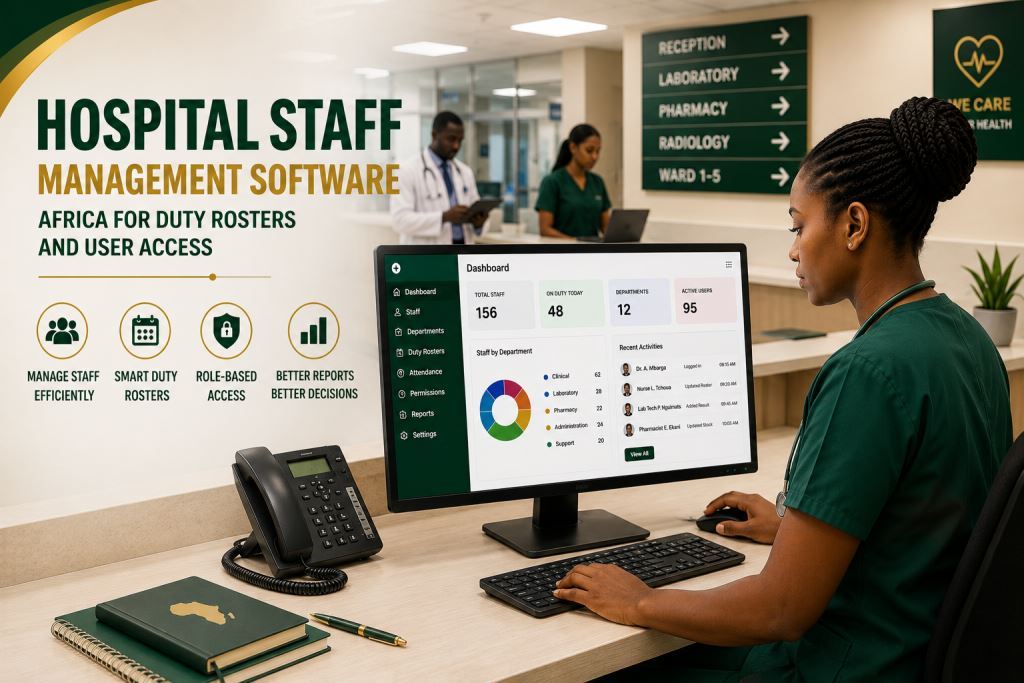
Why Hospital Staff Management Software Africa Matters for Daily Operations
The challenge often begins when patient registration, appointments, consultations, billing, pharmacy services, laboratory results, staff access, and operational reports are managed through different notebooks, mobile phones, spreadsheets, or verbal instructions.
Healthcare facilities may continue operating every day. However, it quickly becomes difficult to determine which record is current, who entered the information, or whether managers are working with accurate and up-to-date data.
Several warning signs appear over time. For example, healthcare facilities may lose patient files, experience long reception queues, generate inaccurate invoices, or encounter pharmacy stock discrepancies. At first, these issues may seem minor. However, they become increasingly costly as the organization grows, staff responsibilities change, or managers require reliable information to make important decisions.
A digital system should reduce confusion without making staff feel overwhelmed. It should not replace professional judgment or local experience. Instead, it should provide a structured workflow for daily operations. As a result, owners and managers gain a clear and reliable overview of everything happening within the healthcare facility.
Across Cameroon and Africa, many healthcare organizations employ staff with different levels of computer experience. Therefore, a good platform should provide an intuitive interface, simple workflows, role-based user permissions, practical training, and continuous support that matches the team’s needs.
Key Features to Look For
1. Staff Profiles
Staff Profiles should be simple for authorized users to manage during normal daily operations. They should not be used only for end-of-month reporting.
In practical terms, Staff Profiles allow healthcare organizations to capture employee information accurately the first time. The software stores every record securely and makes it available whenever managers, accountants, supervisors, or administrators need it.
Furthermore, clinics, hospitals, laboratories, pharmacies, and healthcare centers across Cameroon and Africa reduce duplicate data entry and improve the accuracy of daily staff management.
When healthcare organizations configure Hospital Staff Management Software Africa correctly, employees spend less time searching for information. Consequently, they devote more time to supporting patients, reception teams, nurses, doctors, pharmacists, laboratory staff, cashiers, and administrators.
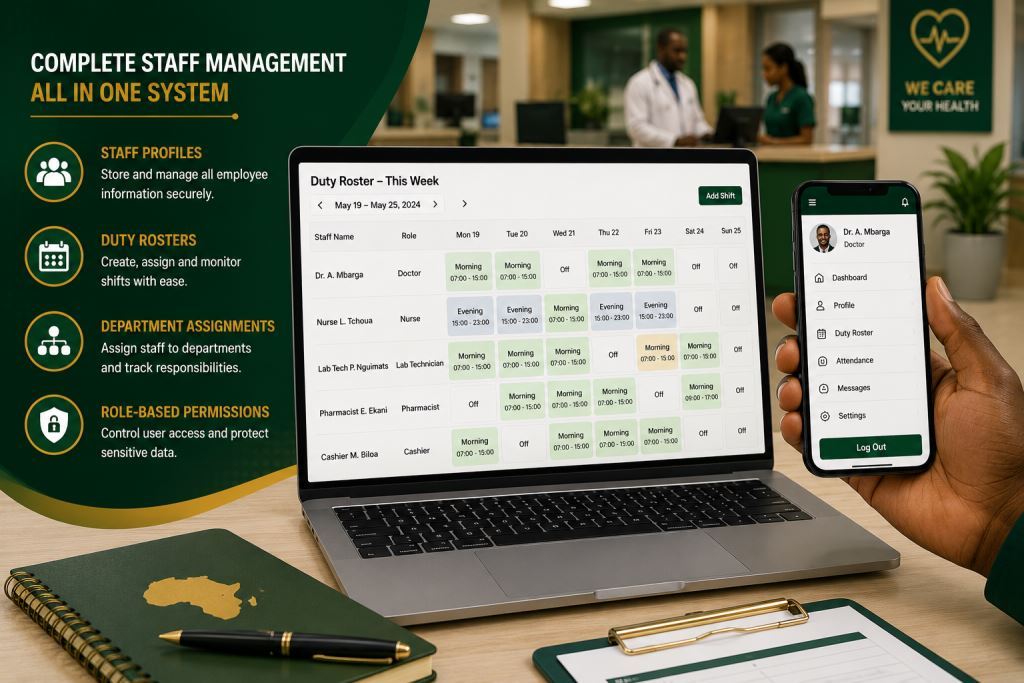
2. Duty Rosters
Duty Rosters should remain easy for authorized users to manage throughout normal daily operations. Staff should update them regularly instead of relying on manual schedules or end-of-month records.
In addition, this feature enables healthcare organizations to assign shifts, monitor staff availability, and maintain organized work schedules across different departments.
Clinics, hospitals, laboratories, pharmacies, and healthcare centers benefit from better workforce coordination and fewer scheduling conflicts. As a result, managers improve productivity, strengthen accountability, and ensure that every department has the right personnel available when needed.
When organizations successfully implement Hospital Staff Management Software Africa, Duty Rosters help managers monitor schedules quickly and accurately. Therefore, healthcare teams operate more efficiently while maintaining high-quality patient care.
3. Department Assignments
Department Assignments should be simple for authorized staff to manage during normal daily operations. They should not be limited to end-of-month reporting.
In practical terms, this feature enables healthcare organizations to assign employees to the appropriate departments while keeping staff records accurate and up to date. The software stores each assignment securely and makes it available whenever managers, supervisors, or administrators need it.
Furthermore, clinics, hospitals, laboratories, pharmacies, and healthcare centers across Cameroon and Africa reduce administrative errors and improve coordination between departments.
When healthcare organizations configure Hospital Staff Management Software Africa correctly, managers spend less time updating staff assignments manually. As a result, they can focus more on patient care, workforce planning, and operational efficiency.
4. Role-Based User Permissions
Role-Based User Permissions are essential for protecting sensitive healthcare information while ensuring that every employee has access to the tools required for their responsibilities.
In addition, administrators can assign different permission levels according to each employee’s role. Doctors, nurses, cashiers, pharmacists, laboratory staff, receptionists, and managers only access the information they need to perform their daily tasks.
Healthcare organizations also strengthen accountability because every user accesses the system through a personal account. Therefore, managers can easily identify who created, edited, or approved each record.
When organizations implement Hospital Staff Management Software Africa, Role-Based User Permissions improve data security, reduce unauthorized access, and support compliance with internal policies.
Role-based permissions are only effective when they are supported by strong patient data protection policies. Read our article Hospital Data Security Cameroon | Patient Confidentiality Guide to discover how healthcare organizations protect confidential medical information through secure user access, privacy controls, audit trails and responsible data management.
5. Attendance Summaries
Attendance Summaries help healthcare organizations monitor staff attendance accurately throughout the working day.
For example, managers can review attendance records, identify absences, monitor punctuality, and generate reports whenever necessary. Staff no longer rely on manual attendance registers or paper records.
Moreover, clinics, hospitals, laboratories, pharmacies, and healthcare centers improve workforce management by maintaining accurate attendance information within one centralized system.
When organizations use Hospital Staff Management Software Africa, Attendance Summaries help managers make informed staffing decisions. Consequently, they improve productivity, strengthen accountability, and reduce scheduling problems.
6. Access Review Routines
Access Review Routines help healthcare organizations regularly evaluate user accounts and system permissions.
In addition, administrators can review user access, remove inactive accounts, update permissions, and ensure that every employee has the appropriate level of access.
Healthcare facilities also reduce security risks because outdated accounts and unnecessary permissions are identified quickly. As a result, organizations improve data protection while maintaining efficient daily operations.
When organizations deploy Hospital Staff Management Software Africa, Access Review Routines strengthen system security, improve compliance, and support responsible user management.
Benefits for Owners, Managers, Staff, and Patients
Better Visibility
The first benefit is improved visibility.
In fact, owners and managers no longer rely solely on verbal updates. Instead, they use structured reports and interactive dashboards to monitor daily operations across the organization.
As a result, they quickly identify completed tasks, pending activities, staffing gaps, and departments that require immediate attention.
Greater Accountability
The second benefit is stronger accountability.
Every user logs into the system with individual credentials and role-based permissions.
Therefore, managers can easily identify who created a record, who modified it, and who approved it.
Furthermore, this process protects the healthcare organization while also protecting honest employees through reliable digital records and complete audit trails.
Faster Daily Operations
The third benefit is greater operational efficiency.
Staff members no longer waste valuable time searching for paper records stored in different offices.
Instead, they use search tools, filters, dashboards, and staff records to locate information within seconds.
Consequently, healthcare facilities improve customer service, reduce waiting times, increase staff productivity, and deliver a better experience for both patients and employees.
Better Planning
The fourth benefit is improved planning.
In addition, accurate staff records help managers identify trends that are difficult to detect manually. They can analyze busy periods, recurring staff shortages, workload distribution, attendance patterns, department performance, and operational challenges.
Therefore, healthcare leaders make better decisions regarding recruitment, staff scheduling, training, resource allocation, and future investments by using Hospital Staff Management Software Africa.
How to Implement Hospital Staff Management Software Africa Without Disrupting Daily Operations
Successful implementation begins with a simple workflow assessment.
First, healthcare organizations should identify the staff records they manage, the reports they need, the employees who require system access, and the operational challenges that currently slow down daily work.
This assessment enables Prosoft Africa to configure Hospital Staff Management Software Africa according to the organization’s actual requirements. As a result, the software supports existing workflows instead of forcing unnecessary changes.
Prepare Existing Staff Records
Next, healthcare organizations should organize their existing staff records before importing them into the new system.
Healthcare facilities do not need to perfect every existing record before starting the digitalization process. However, they should decide which information to import, which records to archive, and which data should be entered as new records.
In addition, many clinics, hospitals, laboratories, pharmacies, and healthcare centers discover duplicate staff records, outdated user accounts, incomplete employee information, and inefficient manual processes during this stage.
Preparing this information in advance makes implementation smoother and significantly improves data quality from the beginning.
Train the Staff
Staff training plays a critical role in the successful implementation of any healthcare management system.
For example, receptionists should learn reception workflows. Cashiers should understand billing procedures. Managers should become familiar with dashboards and reports. Administrators should master user permissions and system settings.
Furthermore, role-based training prevents information overload because every employee learns only the features required for daily responsibilities.
Consequently, healthcare teams adopt Hospital Staff Management Software Africa more quickly and use it with greater confidence.
Provide Post-Implementation Support
Implementation should not end after installation. Instead, managers should monitor data entry, review user activity, and answer staff questions during the first few weeks after deployment. In addition, Prosoft Africa provides continuous technical support after implementation. The support team helps healthcare organizations adjust system settings, resolve operational challenges, and improve daily workflows. As a result, organizations achieve faster user adoption and maximize the value of their investment.
Successful staff management depends on a structured implementation strategy rather than software installation alone. Explore our article Hospital Software Rollout Plan For Multi-Department Clinics In Africa to learn how to prepare your healthcare organization, train users, deploy modules in phases and ensure long-term adoption across every department.
Available Across Cameroon and Africa
Prosoft Africa provides installation, training, and technical support for Hospital Staff Management Software Africa throughout Cameroon. Healthcare organizations in Douala, Yaoundé, Buea, Bamenda, Limbe, Bafoussam, Garoua, Maroua, Ngaoundéré, Bertoua, and many other cities can benefit from these services. However, the objective is not to create separate pages for every city. Instead, Prosoft Africa focuses on solving real operational challenges faced by healthcare organizations across Cameroon.
Furthermore, healthcare organizations outside Cameroon can request online demonstrations, remote installation, staff training, and continuous technical support. Therefore, healthcare providers across Africa benefit from a structured staff management solution supported by a team that understands local challenges, including varying internet connectivity, different computer skill levels, multi-branch operations, and practical reporting requirements.
Decision Checklist Before Requesting a Demo
Before requesting a demonstration, prepare the information your healthcare organization needs. First, identify the staff records that should be managed within the system. Next, determine who should create, edit, approve, or only view each type of record. In addition, prepare examples of the reports you want to generate, such as attendance summaries, staff schedules, department performance reports, user activity logs, and management dashboards.
Furthermore, choose a small implementation team that can test workflows, ask questions, and support other employees after training. Finally, confirm how the system will be supported after installation, especially if your organization plans to open new branches, recruit additional staff, or implement new modules. This preparation helps healthcare organizations implement Hospital Staff Management Software Africa successfully while accelerating user adoption.
Discover our Hospital Management Software and simplify staff scheduling, user access, patient management, billing, and daily operations with Hospital Staff Management Software Africa.
Frequently Asked Questions
Who Should Use Hospital Staff Management Software Africa?
This solution is ideal for clinic owners, hospital administrators, doctors, nurses, receptionists, cashiers, pharmacists, laboratory managers, human resource teams, and healthcare administrators who want better staff organization, improved reporting, and stronger control over daily operations.
Can the Software Support Users with Limited Computer Experience?
Yes. In fact, implementation includes practical role-based training, real-world examples, and continuous follow-up support. As a result, users quickly learn the tasks they perform every day and become comfortable using the software.
Should Every Feature Be Activated on the First Day?
No. Instead, healthcare organizations should begin with their highest-priority workflows. Later, they can activate additional modules as staff become familiar with the system and gain confidence using it.
Conclusion
Choosing Hospital Staff Management Software Africa is more than an IT decision. It is a strategic management decision that improves efficiency across the entire healthcare organization. In fact, the right solution strengthens staff scheduling, user access management, patient registration, appointments, billing, pharmacy operations, laboratory services, and administrative reporting. As a result, healthcare teams work more efficiently, improve collaboration, and deliver better patient care.
Furthermore, Prosoft Africa helps clinics, hospitals, laboratories, pharmacies, and healthcare centers across Cameroon and Africa assess their needs, configure the right modules, train their teams, and provide continuous support after deployment. Finally, request a demonstration today and discover how Hospital Staff Management Software Africa can simplify workforce management, improve operational efficiency, and strengthen healthcare administration throughout your organization.
Explore more expert articles on hospital staff management, hospital digital transformation, and healthcare technology across Cameroon and Africa to discover practical solutions and best practices for modern healthcare facilities.
Follow Prosoft Africa on Facebook, Instagram, LinkedIn, X (Twitter), and TikTok. Discover practical tips, live demonstrations, and Hospital Staff Management Software Africa designed to help healthcare organizations improve workforce management across Cameroon and Africa.
