

School Financial Dashboard, Reporting and Revenue Analysis for Administrators
A school financial dashboard is no longer simply a technical tool reserved for large institutions. Today, schools, colleges, training centers and education groups across Cameroon and Africa rely on financial dashboards to improve decision-making, strengthen financial control and simplify daily administration.
Prosoft Africa helps school owners, principals, bursars, accountants, teachers, IT assistants and administrative teams replace scattered manual processes with a centralized digital management system. The company also provides software installation, staff training and continuous technical support to ensure long-term success.
School leaders should be able to monitor daily collections, analyze outstanding balances, compare expected income with actual revenue and review financial performance in real time. As a result, important decisions become faster and more reliable.
Meanwhile, schools in Yaounde, Douala and other growing cities manage increasing numbers of students, financial transactions and administrative activities. Paper records and disconnected spreadsheets may still work for small institutions. However, they quickly become inefficient as schools expand. A centralized financial dashboard organizes financial information while improving transparency and accountability.
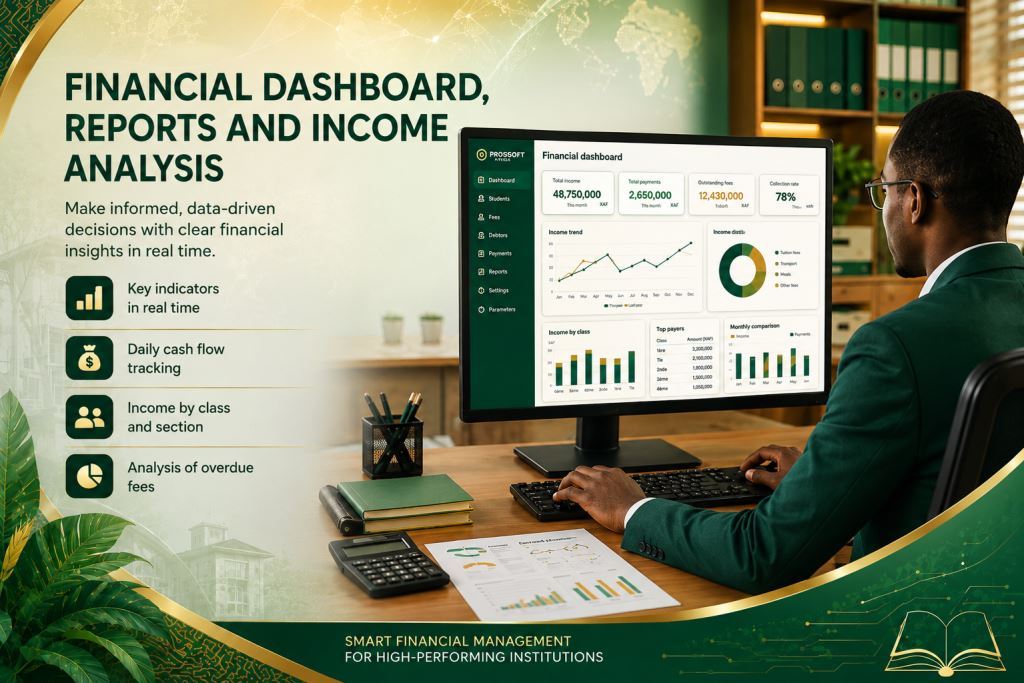
More importantly, dashboards transform raw financial data into meaningful business intelligence. School administrators no longer need to review hundreds of payment records manually. Instead, they can instantly view collection trends, revenue by class or department, outstanding school fees and overall financial performance from a single dashboard.
Why This Topic Matters For Organizations In Cameroon And Africa
Many educational institutions begin searching for school management software because manual financial reporting has become time-consuming and unreliable. Staff spend valuable hours calculating totals, verifying balances, preparing spreadsheets and correcting reporting errors. Consequently, management often receives important financial information too late.
Furthermore, paper receipts, handwritten cashbooks and disconnected Excel files frequently produce inconsistent reports and inaccurate financial statistics. Because financial data is scattered across different departments, school leaders struggle to monitor performance and make confident decisions.
Growth introduces another major challenge. As student enrollment increases, schools process more payments, employ more staff and manage multiple campuses or departments. Without an integrated financial reporting system, each department develops its own reporting methods. As a result, duplicate records, inconsistent statistics and reporting delays become increasingly common.
Finally, institutions must preserve financial knowledge over time. When accountants or bursars leave the organization, financial information should remain complete, secure and accessible. A modern school financial dashboard centralizes financial records, improves reporting accuracy and supports long-term strategic planning for sustainable institutional growth.
Discover how our school management software provides a powerful financial dashboard to monitor revenue, expenses, and school fee collections in real time.
Key Features And Capabilities To Look For
Dashboard KPIs
A modern school financial dashboard should display the most important Key Performance Indicators (KPIs) from the moment users log in. School administrators should immediately see total collections, outstanding balances, expected revenue and payment completion rates.
Because these indicators are updated automatically, decision-makers always work with current financial information. As a result, schools react more quickly to financial challenges and improve day-to-day management.
Daily Collections
Monitoring daily collections is essential for maintaining healthy cash flow. The software should record every payment instantly and present daily summaries through clear charts and financial reports.
Consequently, bursars and school managers can compare daily income with previous periods, identify unusual trends and verify that all payments have been properly recorded.
In addition, real-time monitoring reduces accounting errors and improves financial transparency.
Class And Section Revenue
A complete school financial dashboard should analyze revenue by class, grade level, department or academic section. Instead of reviewing hundreds of payment records manually, administrators can immediately identify which areas generate the highest income.
Furthermore, this information supports better budgeting, resource allocation and strategic planning. As a result, school leaders make informed financial decisions based on reliable data.
Fee Arrears Analysis
Outstanding school fees should never remain hidden inside complex spreadsheets. The software should automatically analyze unpaid balances according to classes, payment periods and individual students.
This allows administrators to identify overdue accounts quickly and organize follow-up activities efficiently. Consequently, schools improve fee recovery while maintaining professional communication with parents.
Exportable Reports
Financial reports should be easy to export whenever required. A professional school management system allows users to generate reports in formats suitable for meetings, audits and accounting reviews.
Because reports are produced automatically, staff save valuable time while reducing manual calculations and reporting errors.
Moreover, reliable reports increase confidence among school owners, accountants and external auditors.
Decision Support Meetings
A school financial dashboard should also support management meetings by presenting clear financial summaries and performance indicators.
Instead of discussing incomplete information, administrators can review accurate statistics, compare financial trends and evaluate school performance using reliable reports.
Ultimately, these insights improve strategic planning, strengthen financial control and help educational institutions achieve sustainable growth.
Practical Benefits For School Owners, Managers, Staff And Parents
The benefits of a modern school financial dashboard become visible throughout the entire institution. Instead of waiting until the end of the month to review financial performance, school leaders can monitor collections, revenue and outstanding balances every day. As a result, important decisions are based on real-time information rather than estimates.
Authorized users also gain instant access to the reports they need. Accountants no longer spend hours preparing manual summaries, while administrators can review financial performance without searching through multiple spreadsheets. Consequently, productivity increases and reporting becomes significantly more accurate.
For school owners and management, the greatest advantages include better visibility into revenue, faster monitoring of fee collections and stronger financial accountability. Accountants benefit from automated calculations, simplified reporting and reduced administrative workload. Parents also appreciate a more transparent payment process because schools provide accurate financial information whenever needed.
Another major benefit is accountability. Every financial transaction is recorded automatically with complete user activity logs. Managers can see who processed a payment, when it was recorded and which changes were made. This transparency strengthens internal controls while protecting both the institution and its employees.
The dashboard also improves collaboration between departments. Finance officers, principals, bursars and administrative staff all work with the same reliable financial information. As a result, communication improves, reporting becomes consistent and important decisions are made more quickly.
Finally, financial dashboards support long-term planning. School owners can analyze revenue trends, compare performance across academic terms, identify departments with outstanding balances and monitor overall financial health. These insights help institutions improve budgeting, strengthen cash flow and make confident strategic decisions that support sustainable growth.
How To Implement A School Financial Dashboard Successfully
Analyze Your School’s Financial Needs
Before implementing a school financial dashboard, the first step is to evaluate the school’s current financial management process. This assessment helps administrators identify reporting challenges, manual tasks and opportunities for improvement.
For example, school leaders should review how they monitor daily collections, prepare financial reports, track outstanding balances and analyze revenue. This evaluation makes it easier to select the features that will deliver the greatest value.
As a result, the dashboard is configured to support the school’s actual financial workflow rather than forcing staff to change effective procedures.
Configure The Dashboard For Your Institution
Every educational institution manages its finances differently. Therefore, the financial dashboard should be customized according to the school’s fee structure, accounting procedures, reporting requirements, departments and user roles.
Prosoft Africa works closely with each institution during the configuration process. The implementation team defines financial indicators, dashboard widgets, reporting formats, user permissions and analytical tools that match the school’s operational needs.
Consequently, administrators begin working with a dashboard that reflects their daily financial activities from the very first day.
Train Staff Using Real Financial Scenarios
Even the most advanced financial dashboard cannot deliver results without proper user training. Every staff member should understand how to interpret financial reports and use dashboard information to support daily decision-making.
Accountants learn how to monitor collections, generate financial statements and analyze revenue trends. School owners and principals discover how to review Key Performance Indicators (KPIs), compare income across departments and monitor outstanding school fees. Administrative staff learn how to access reports and verify financial information quickly.
Because training focuses on practical situations, users become confident, productive and independent in a short period of time.
Monitor Performance After Implementation
Installing the software is only the beginning of the digital transformation process. During the first few weeks, school management should monitor how the dashboard is being used and verify that financial data remains accurate.
Regular review meetings help identify reporting improvements, answer user questions and encourage consistent use of the system. At the same time, administrators can refine dashboard settings based on the school’s evolving needs.
As a result, financial reporting becomes more reliable, decision-making improves and the institution gains greater control over its revenue and overall financial performance.
Available Across Cameroon And Africa
Prosoft Africa supports schools, colleges, universities, training centers and education groups throughout Cameroon, including Yaounde, Douala, Bafoussam, Bamenda, Buea, Limbe, Garoua, Maroua, Ngaoundere and Bertoua.
The company also serves educational institutions across Africa through online demonstrations, remote installation, virtual staff training and continuous technical support. Consequently, schools can implement a modern financial dashboard regardless of their location.
Even institutions located in remote areas receive the same professional assistance. Using secure remote-support technologies, Prosoft Africa configures the dashboard, imports financial data, trains users and provides ongoing support throughout the implementation process.
What To Check Before Choosing A School Financial Dashboard
Before investing in a financial reporting solution, school leaders should evaluate several important criteria.
Consider the following questions:
- Does the dashboard display real-time financial KPIs?
- Can it monitor daily collections and outstanding balances?
- Does it generate detailed financial and revenue reports?
- Can reports be exported for meetings and audits?
- Are user roles and permissions customizable?
- Is professional technical support available after deployment?
Answering these questions helps schools select a solution that supports both current financial operations and future institutional growth.
Frequently Asked Questions
Is A School Financial Dashboard Suitable For Small Schools?
Yes. Small schools benefit from financial dashboards because they gain better visibility into collections, revenue and expenses before financial processes become more complex. In addition, the solution scales easily as enrollment grows.
Does Prosoft Africa Provide Installation And Training?
Yes. Prosoft Africa installs the software, configures the financial dashboard, trains users and provides continuous technical support. This ensures that schools quickly benefit from accurate financial reporting and effective decision-making.
Can The Dashboard Monitor Multiple Campuses?
Absolutely. A single dashboard can consolidate financial information from multiple campuses while allowing each location to maintain its own operational records. Central management can then analyze overall performance from one interface.
Can Reports Be Exported For Audits And Management Meetings?
Yes. The software generates professional financial reports that can be exported for management meetings, accounting reviews and external audits. This improves transparency and saves valuable administrative time.
Is Financial Information Secure?
Yes. Financial records are protected through user authentication, role-based permissions and regular data backups. Consequently, only authorized personnel can access sensitive financial information.
What Is The First Step Before Getting Started?
The first step is to evaluate your school’s current financial reporting process and identify the information management needs. Then, request a personalized demonstration to discover how the dashboard can improve financial visibility, reporting accuracy and strategic decision-making.
Conclusion
A school financial dashboard has become an essential management tool for schools, colleges, universities and training centers across Cameroon and Africa. It transforms financial data into meaningful insights, improves reporting accuracy and gives administrators the information they need to make confident decisions.
Today, educational institutions require more than basic accounting records. They need real-time dashboards, accurate revenue analysis and reliable financial reports to support sustainable growth. Consequently, adopting the right software improves transparency, strengthens financial control and simplifies daily management.
Prosoft Africa provides a complete school financial management solution for educational institutions in Yaounde, Douala, throughout Cameroon and across Africa. From needs assessment and software implementation to staff training and continuous support, the company helps schools modernize their financial operations.
If you want to improve financial reporting and gain complete visibility into your school’s performance, request a personalized demonstration today. You will discover a practical solution that simplifies financial management, strengthens decision-making and supports your institution’s long-term success.
Explore more expert articles on school management, digital transformation, and education technology across Cameroon and Africa to deepen your understanding.
Stay connected with Prosoft Africa on Facebook, Instagram, LinkedIn, X (Twitter), and TikTok to discover innovative school solutions, live demos, success stories, and updates transforming education across Africa.”
