
Restaurant Procurement and Supplier Cost Tracking Software

Restaurant supplier cost tracking software Africa is an essential management solution for restaurants, cafeterias, bakeries, fast-food businesses, catering companies and food-service groups that want cleaner records, faster decisions and stronger accountability. Prosoft Africa creates practical software content based on real restaurant operations across Cameroon and Africa instead of relying on repetitive keywords.

The purpose of this article is to help restaurant owners, managers, cashiers, waiters, kitchen teams, caterers and food-business operators understand what procurement software should organize, which common mistakes to avoid and how to prepare for a successful implementation.

For many organizations, the challenge goes beyond the absence of software. In many cases, important information remains scattered across notebooks, spreadsheets, mobile phones, receipt books and verbal discussions. As a result, managers spend too much time searching for information instead of improving customer service. A well-designed system converts daily activities into structured records that are easy to search, verify and report.

In addition, supplier cost tracking allows restaurants to monitor purchasing trends, compare supplier prices and protect profit margins when ingredient costs increase. Rather than using a standalone application, restaurants should integrate this process into a complete restaurant management software solution that includes POS sales, orders, tables, menus, recipes, inventory, expenses, staff scheduling, customer management and daily profit reports. Consequently, the organization builds a scalable management platform that supports future growth, additional users, multiple branches and stronger reporting.
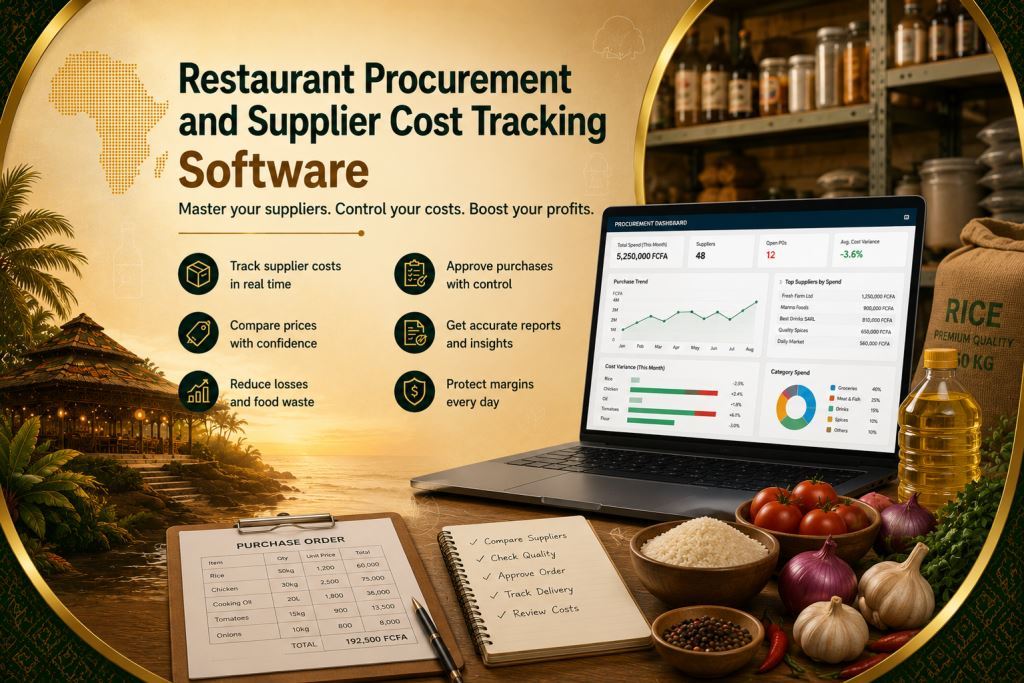
restaurant supplier cost tracking software Africa with Prosoft Africa software in Cameroon and Africa

Why This Topic Matters for Daily Operations

Every working day generates important decisions. Staff record purchases, approve supplier payments, receive deliveries, update inventory and review management reports. However, when these activities are recorded in different places, the organization becomes dependent on memory instead of reliable data. Although this approach may work in a small business, it quickly becomes inefficient as operations expand.

A structured digital workflow helps every employee follow the same procedures, even during busy periods. As a result, each team member knows what information to record, which transactions require approval and which reports must be reviewed. Managers can also distinguish ordinary delays from genuine operational risks. Therefore, software should be viewed as a management improvement rather than simply another computer system.

Furthermore, restaurants in Cameroon and across Africa face different operational conditions. Internet connectivity, staff computer skills, language preferences, available budgets and branch locations often vary from one business to another. For this reason, the software must remain simple, flexible and easy to deploy while supporting continuous operational improvement.

Finally, the clearest sign of a successful implementation is not the number of available features. Instead, success is achieved when employees automatically know where to find the information they need without asking colleagues. That is the level of organization restaurant owners, managers, cashiers, waiters, kitchen teams, caterers and food-service operators should expect from a professional procurement and supplier cost tracking solution.
Key Features to Look For

Supplier Management

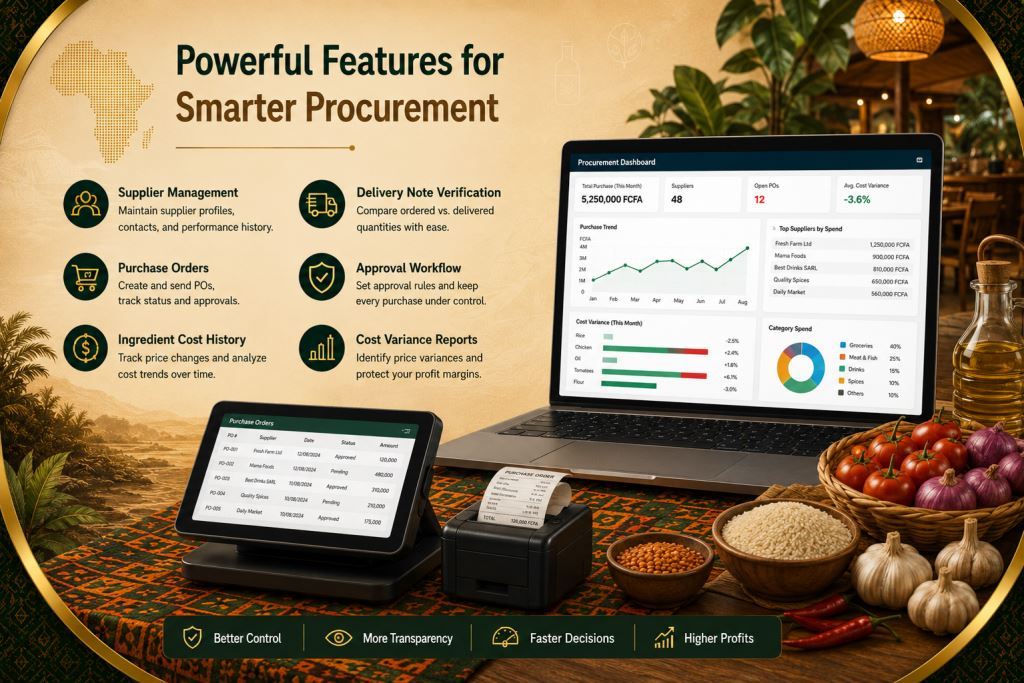
Supplier list: This feature should be simple enough for daily users while providing the control managers need. In practice, it centralizes supplier details, contact information, payment terms and purchasing history. As a result, the organization avoids duplicate records and manages supplier relationships more efficiently. When configured correctly, it also makes supplier comparisons much easier. Finally, it supports better purchasing decisions.

Purchase orders: This feature simplifies the preparation, approval and tracking of supplier orders. Consequently, every purchase follows a clear approval process before goods are ordered. Once approved, the purchase order becomes the reference for deliveries and invoices. In addition, it reduces administrative mistakes and improves purchasing control.

Cost Monitoring and Delivery Control

Ingredient cost history: This feature records every price change over time. Therefore, managers can quickly identify cost increases or decreases and compare supplier pricing. They can then negotiate better purchasing conditions or select more competitive suppliers. As a result, restaurants protect their profit margins more effectively.

Delivery notes: This feature compares delivered quantities with the original purchase orders. Moreover, it highlights shortages, over-deliveries or quality issues before goods are accepted. Managers can therefore resolve supplier disputes using accurate records. Finally, every delivery remains fully documented for future reference. Accurate supplier deliveries should immediately update inventory records to maintain reliable stock levels. Read our article Restaurant Inventory Control Software Cameroon | Stock Management to learn how inventory tracking helps restaurants control stock movements, reduce losses and maintain accurate inventory records after every purchase.

restaurant supplier cost tracking software Africa with Prosoft Africa software in Cameroon and Africa2

Approval and Cost Analysis

Approval workflow: This feature controls each purchasing stage before an order is finalized. As a result, every approval follows predefined authorization levels. Managers maintain better control over purchasing decisions while preventing unauthorized expenses. Consequently, procurement becomes more transparent and accountable.

Cost variance report: This feature provides detailed reports showing how supplier prices change over time. Furthermore, it highlights unusual cost increases, identifies purchasing trends and compares supplier performance. Managers can then adjust purchasing strategies or menu prices before rising costs reduce profitability.

Configure Features According to Business Needs

These features should never be activated without proper planning. The best configuration depends on the size of the restaurant, the number of users, the required management reports and the desired level of control. Before implementation, the existing workflow should be reviewed carefully. Next, each module can be configured to match real operational requirements. Finally, Prosoft Africa helps restaurants map their procurement workflow so every feature supports a practical business process instead of becoming an unused function.

Benefits for Owners, Managers, Staff and Users

Better Visibility

The first benefit is better visibility. Owners and managers no longer need to rely on scattered updates or incomplete reports. Instead, they can access accurate information whenever they need it. As a result, they identify purchasing issues earlier, monitor supplier performance more effectively and make informed decisions based on reliable data. Visibility does not mean monitoring employees excessively. On the contrary, it helps every department work with clear and trustworthy information.

Stronger Accountability

The second benefit is stronger accountability. Every user has a clearly defined role, and every important action is linked to an individual account. Therefore, managers can easily identify who created, approved or modified a purchasing record. Employees also benefit because accurate records protect them from unfair accusations. In addition, managers can distinguish isolated mistakes from recurring process weaknesses.

Faster Daily Operations

The third benefit is greater efficiency. Staff no longer waste time searching through paper files or spreadsheets to find supplier information. Instead, they use search tools, filters, dashboards and record histories to locate data within seconds. This is especially valuable when confirming deliveries, checking purchase orders or responding to supplier inquiries.

Better Cost Control

The fourth benefit is improved cost management. With reliable purchasing data, managers can monitor supplier prices, compare purchasing trends and identify recurring expenses. Furthermore, they can detect unusual price increases before those changes affect profitability. Consequently, restaurants make better purchasing decisions and protect their profit margins.

Purchasing decisions become even more valuable when inventory reports reveal how ingredients are actually used and where waste occurs. Explore our article How Restaurant Inventory Reports Help Reduce Food Waste to discover how inventory reporting helps restaurants reduce spoilage, improve purchasing decisions and increase profitability.

Better Planning and Business Growth

Finally, digital procurement records support long-term planning. Managers can forecast purchasing needs, evaluate supplier performance and prepare inventory more accurately. As a result, emergency purchases become less frequent, stock shortages decrease and financial planning becomes more reliable. This structured approach helps restaurants grow with greater confidence and stronger operational control.

How to Implement the Software Without Confusing the Team

Review Your Current Procurement Process

The first step is to evaluate how purchasing activities are handled today. Identify daily procurement tasks, supplier records, approval procedures, required management reports and the mistakes that occur most often. As a result, the software can be configured around real business operations instead of forcing employees to adopt an unfamiliar workflow.

Prepare Essential Data Before Launch

Next, prepare the most important information before implementation. The system does not need every historical record on the first day. However, active suppliers, user accounts, opening balances, purchasing categories and key inventory items should be reviewed carefully. This preparation reduces implementation problems and helps staff start with accurate data.

Define User Roles and Permissions

Every employee should receive permissions that match their responsibilities. Buyers, cashiers, storekeepers, managers and branch supervisors should not all have the same level of access. Therefore, user permissions improve security while keeping the software simple to manage. They also reduce the risk of unauthorized purchases or accidental changes.

Train Staff with Real Business Scenarios

Training should focus on practical restaurant activities instead of theory. Employees should learn how to create purchase orders, register suppliers, approve purchases, receive deliveries, compare supplier prices and generate reports. In this way, they become confident with the software much faster because every exercise reflects their daily responsibilities.

Monitor Performance After Go-Live

After deployment, managers should review system usage regularly. For example, they should verify that purchasing records are accurate, supplier costs are updated correctly and management reports answer operational questions. Moreover, early follow-up meetings help resolve small issues before they become long-term habits.

Expand Features Gradually

Implementation should remain progressive. It is better to master the essential procurement workflow before activating every available module. Later, once employees are comfortable with the system, the organization can introduce advanced supplier analytics, cost variance reports, purchasing dashboards, branch controls and additional reporting tools. Consequently, adoption becomes smoother and long-term success becomes much more likely.

Available Across Cameroon and Africa

Prosoft Africa provides software installation, staff training and continuous support for restaurants, cafeterias, bakeries, fast-food businesses, catering companies and food-service groups throughout Cameroon. Services are available in Douala, Yaounde, Buea, Bamenda, Limbe, Bafoussam, Garoua, Maroua, Ngaoundere, Bertoua and many other communities. As a result, restaurants receive professional assistance that matches their operational needs.

Organizations in other African countries can also benefit from comprehensive remote support. For example, Prosoft Africa offers online demonstrations, remote installation, virtual staff training and ongoing technical assistance. Consequently, restaurants can deploy the software efficiently without waiting for an on-site visit.

Discover why our restaurant management software is the ideal solution for managing supplier cost tracking in the restaurant industry.

Frequently Asked Questions

Who should use restaurant supplier cost tracking software Africa?

This solution is ideal for restaurant owners, managers, cashiers, purchasing officers, kitchen teams, caterers and food-service operators who want better purchasing control, clearer reports and less dependence on manual records.

Should every feature be activated on the first day?

No. Instead, restaurants should begin with the most important procurement workflow. Once employees become comfortable with the system, additional modules and advanced reporting features can be introduced gradually.

Can Prosoft Africa support teams with limited computer experience?

Yes. Prosoft Africa provides practical, role-based training supported by continuous follow-up. As a result, users learn the exact purchasing and inventory tasks they perform every day without unnecessary technical complexity.

Conclusion

Choosing restaurant supplier cost tracking software Africa should be considered a business management decision rather than simply a software purchase. The right solution helps restaurants organize purchasing activities, monitor supplier costs, protect business records and improve management reporting. Ultimately, the best results are achieved when software, staff training and operational discipline work together.

Prosoft Africa supports restaurants, cafeterias, bakeries, fast-food businesses, catering companies and food-service groups throughout Cameroon and across Africa. The team helps organizations evaluate their procurement workflow, configure the right modules, train employees and provide continuous support after deployment. To get started, request a demonstration, prepare your current procurement questions and discover how the software can be configured to meet your daily operational needs.

Transform the way you manage your restaurant with Prosoft Africa. Explore expert articles on restaurant management software, POS systems, inventory control, order management, billing, and business automation. Visit our blog to discover practical strategies and innovative solutions that help restaurants improve efficiency, increase profitability, and deliver exceptional customer service.

Follow Prosoft Africa on Facebook, Instagram, LinkedIn, X (Twitter), and TikTok  for live demos, expert insights, customer success stories, and the latest innovations transforming restaurant management across Africa.