
Offline Cloud Hybrid School Management Software Africa: Complete Guide for Schools
Offline cloud hybrid school management software Africa is becoming essential for schools, colleges, bilingual institutions, training centers and education groups that want to organize daily operations without relying only on paper records, WhatsApp messages or scattered spreadsheets. Prosoft Africa helps school owners, principals, bursars, accountants, teachers, secretaries and administrative teams use digital tools to maintain accurate records, generate clearer reports and improve accountability across Cameroon and Africa.
Many African schools must balance unreliable internet access with the growing need for modern reporting and efficient administration. As a result, choosing between an offline, cloud or hybrid solution has become an important management decision rather than just a technical one.
This guide explains how offline cloud hybrid school management software Africa fits into a complete school management strategy. It focuses on practical implementation, staff adoption, reporting, system setup and ongoing support. The goal is to help school decision-makers understand what to evaluate before selecting the right platform.
Explore how our School Management Software supports offline cloud hybrid school management software Africa for schools across Cameroon and Africa.
Why Offline Cloud Hybrid School Management Software Africa Matters
Many schools begin experiencing problems when admissions, student records, fee collection, examinations, report cards, attendance, staff activities and parent communication are managed in separate notebooks, spreadsheets, mobile phones or verbal instructions. Although daily work may continue, it becomes difficult to determine which information is correct, who updated a record and whether school managers receive accurate reports on time.
Common warning signs include manual student files, delayed fee reconciliation, slow report card preparation and poor communication with parents. These challenges may seem manageable at first, but they become costly as the institution grows, staff members change responsibilities or administrators need accurate information for important decisions.
A reliable digital system reduces confusion while helping staff work with confidence. Instead of replacing professional experience, it provides a structured process that allows every department to follow the same workflow. School owners and administrators also gain access to reliable reports that support better decision-making.
Across Cameroon and Africa, many schools require software that accommodates different levels of computer experience. For this reason, offline cloud hybrid school management software Africa should offer an intuitive interface, simple navigation, clear user permissions, practical staff training and continuous technical support. These features help schools adopt the system successfully without disrupting daily operations.
Key Features of Offline Cloud Hybrid School Management Software Africa
1. Offline Access Needs
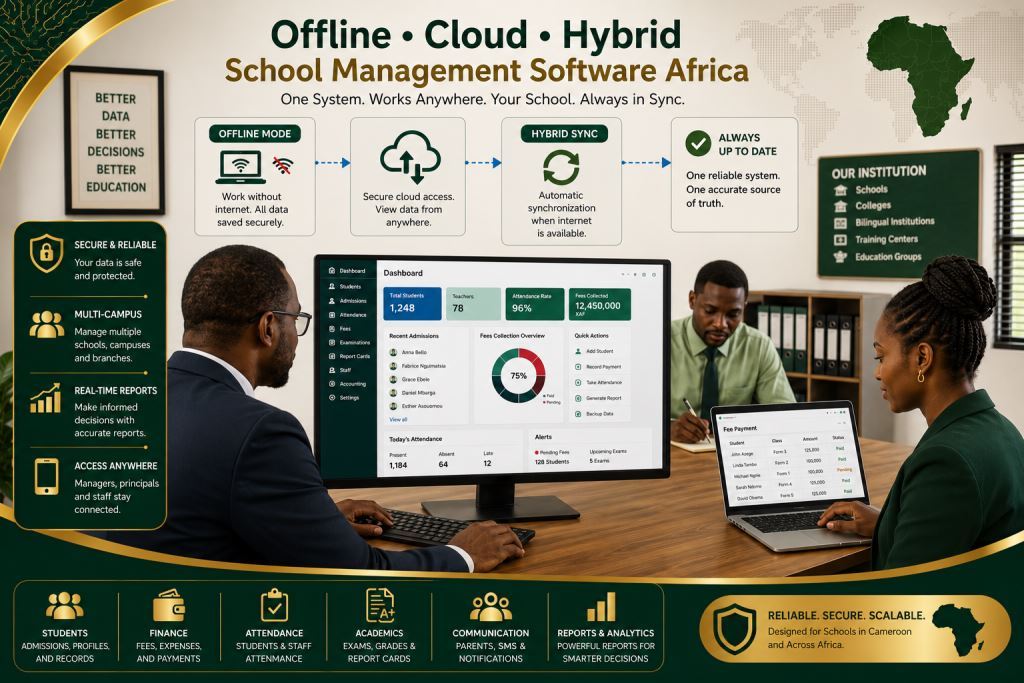
Offline access allows authorized staff to continue working even when internet connectivity is unavailable. Instead of waiting for a connection, users can capture information once, store it securely and access it whenever managers, accountants or supervisors need it.
For schools, colleges, bilingual institutions, training centers and education groups in Cameroon and Africa, this feature reduces duplicate work, improves record accuracy and makes daily administration more reliable. When offline access is properly configured within offline cloud hybrid school management software Africa, staff spend less time searching for information and more time supporting parents, students, teachers, bursars, principals and school owners.
2. Cloud Visibility
Cloud access gives authorized users secure visibility from any location with an internet connection. Managers can review admissions, student records, financial reports, attendance and examinations without being physically present at the school.
When cloud visibility is integrated into offline cloud hybrid school management software Africa, institutions improve communication, strengthen supervision and provide faster access to important information while maintaining secure user permissions.
3. Data Synchronization
Data synchronization ensures that information entered in one location updates correctly across the entire system. This reduces duplicate entries, minimizes errors and keeps every department working with the same records.
For schools operating multiple campuses or departments, offline cloud hybrid school management software Africa uses synchronization to improve consistency, save time and provide accurate reports for administrators and decision-makers.
4. Internet Reliability Planning
Many schools in Cameroon and across Africa experience unstable internet connections. For this reason, internet reliability planning should be part of every software implementation. A well-designed system allows staff to continue working during temporary outages without interrupting admissions, fee collection, attendance or examination management.
With offline cloud hybrid school management software Africa, schools can continue daily operations while protecting important information. Once the internet connection is restored, the system synchronizes the latest updates and keeps records consistent across departments. This approach reduces delays and allows administrative teams to work with greater confidence.
5. Backup Strategy
Every school should protect its records with a reliable backup strategy. Student information, financial records, report cards, attendance registers and examination results represent valuable institutional data that should never be lost because of hardware failure, accidental deletion or unexpected events.
A proper backup strategy within offline cloud hybrid school management software Africa automatically safeguards important information and makes recovery easier when necessary. Schools can continue operating with minimal disruption while maintaining confidence in the accuracy of their records.
6. Remote Support Options
Technical support remains essential after software installation. Staff members may require assistance when new employees join the school, additional modules are introduced or workflows change during the academic year.
With offline cloud hybrid school management software Africa, remote support allows administrators to receive guidance, troubleshooting and software updates without waiting for an on-site visit. This reduces downtime, improves staff confidence and helps schools maintain smooth daily operations.
Benefits of Offline Cloud Hybrid School Management Software Africa
Better Visibility for School Owners and Managers
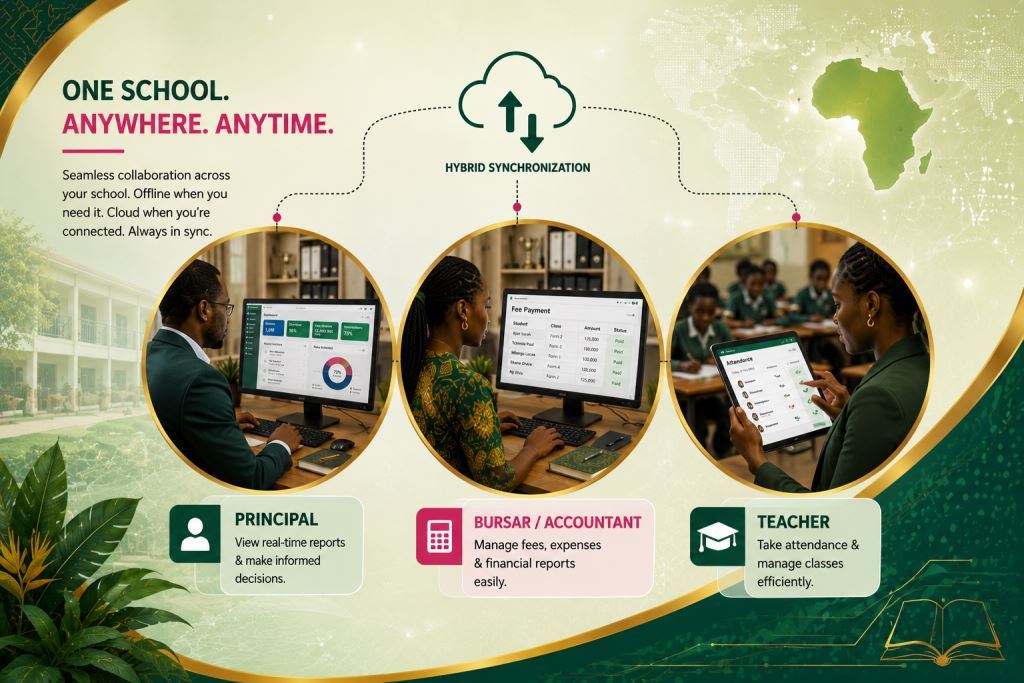
One of the greatest advantages of offline cloud hybrid school management software Africa is improved visibility. School owners, principals and administrators no longer depend only on verbal updates or handwritten reports. Instead, they can review accurate dashboards, financial reports, admissions, attendance records and examination information from a centralized system.
This visibility allows managers to identify completed tasks, delayed activities and areas requiring immediate attention. Better information leads to faster and more informed decisions.
Stronger Accountability Across Departments
Every authorized user works with an individual account and appropriate permissions. As staff members perform their duties, the system records who created, edited or approved each transaction.
This process increases accountability and protects both the institution and its employees. Decisions rely on verified records rather than memory, reducing misunderstandings and improving transparency throughout the school.
Faster Access to Information
Searching through paper files consumes valuable time. Digital records make information available within seconds.
With offline cloud hybrid school management software Africa, authorized staff can quickly locate student records, fee balances, attendance reports, examination results and administrative documents. Faster access improves customer service and reduces waiting time for parents, students and teachers.
Better Planning and Decision-Making
Reliable data allows school leaders to recognize trends that are difficult to identify manually. They can review admission patterns, outstanding school fees, attendance statistics, examination performance and financial reports from one system.
These insights support better planning, improve resource allocation and help administrators make informed decisions for future growth.
How to Implement Offline Cloud Hybrid School Management Software Africa Successfully
Implementation should begin with a workflow assessment. Before configuring the software, the school should identify the records it manages, the reports it requires, the users who need access and the processes that currently consume unnecessary time.
The next step involves preparing existing data. Schools should decide which records need to be imported, which files should remain archived and which information should begin with a fresh database. During this stage, many institutions discover duplicate student records, incomplete balances and outdated administrative practices.
Staff training should follow data preparation. Every employee should receive role-based training that focuses on daily responsibilities. Cashiers should learn financial workflows. Teachers should manage attendance and grades. Administrators should understand reporting and permissions, while principals should focus on dashboards and management reports.
After implementation, schools should monitor user adoption during the first few weeks. Managers should confirm that staff members follow the correct procedures and generate accurate reports. Continuous follow-up from Prosoft Africa helps answer questions, refine system settings and encourage long-term success.
Available Across Cameroon and Africa
Prosoft Africa provides installation, configuration, training and ongoing support for offline cloud hybrid school management software Africa across Cameroon. Schools in Yaounde, Douala, Buea, Bamenda, Limbe, Bafoussam, Garoua, Maroua, Ngaoundere and Bertoua can benefit from solutions that match their operational requirements rather than using a one-size-fits-all approach.
Instead of creating repetitive location pages, schools should focus on choosing software that solves real administrative challenges. The emphasis should remain on improving admissions, fee management, examinations, attendance, report cards and communication rather than simply targeting a city name.
Schools outside Cameroon can also request online demonstrations, remote installation, virtual staff training and continuous technical support. This approach benefits institutions across Africa that need a reliable school management solution designed for local realities, including mixed internet connectivity, varying staff computer skills, multi-campus operations and practical reporting requirements.
Decision Checklist Before Requesting a Demo
Before choosing offline cloud hybrid school management software Africa, every school should prepare a clear implementation plan.
Start by identifying the records that must be managed inside the system. Determine which users should create, edit, approve or only view each type of information. Clear user roles improve security and reduce administrative errors.
Next, prepare examples of the reports you expect to generate. These may include daily financial summaries, student balances, attendance reports, examination statistics, class performance, fee collection reports, staff activity or management dashboards.
It is also helpful to select a small implementation team. These users can test the software, provide feedback during deployment and support other staff members after training. A gradual rollout often produces better long-term adoption than introducing every feature at once.
Finally, confirm how technical support will continue after installation. Schools should understand how software updates, additional training, new users and future modules will be managed as the institution grows. A dependable support plan ensures that offline cloud hybrid school management software Africa continues to deliver value for many years.
Frequently Asked Questions
Who should use Offline Cloud Hybrid School Management Software Africa?
Offline cloud hybrid school management software Africa is suitable for school owners, principals, bursars, accountants, teachers, secretaries and administrative teams that want cleaner records, faster reporting and better control of daily school operations.
Can the software support users with limited computer experience?
Yes. Successful implementation includes practical role-based training, simple workflows and continuous support. Staff members learn only the tasks they perform every day, making the transition easier and improving long-term adoption.
Should every feature be activated on the first day?
No. Many schools achieve better results by implementing the most important modules first. Additional features can be introduced gradually after staff become comfortable with the system. This phased approach reduces confusion and encourages successful adoption.
Conclusion
Choosing offline cloud hybrid school management software Africa is a strategic management decision rather than simply an IT purchase. The right solution helps schools organize admissions, student records, school fees, attendance, examinations, report cards and parent communication within one secure and structured platform.
Instead of relying on paper files, disconnected spreadsheets and manual processes, schools can improve accuracy, strengthen accountability and provide faster access to important information. Managers gain better visibility through real-time reports, while teachers, bursars, accountants and administrative staff work more efficiently using standardized workflows.
A successful implementation also depends on proper planning, practical staff training and continuous technical support. Schools that introduce digital systems gradually often experience smoother adoption and achieve better long-term results.
Prosoft Africa helps schools, colleges, bilingual institutions, training centers and education groups across Cameroon and Africa evaluate their operational needs, configure the appropriate modules, train users and provide ongoing support after deployment.
If your institution is planning to modernize its administration, request a demonstration and prepare a list of the daily challenges you want the software to solve first. A well-planned implementation of offline cloud hybrid school management software Africa can improve efficiency, strengthen reporting and support better decision-making for many years.
Explore more expert articles on school management software, cloud-based education systems and digital transformation solutions for schools across Cameroon and Africa.
Stay connected with Prosoft Africa on Facebook, Instagram, LinkedIn, X (Twitter), and TikTok for the latest updates on school management software, offline, cloud and hybrid solutions, live demos, customer success stories and education technology across Cameroon and Africa.
