
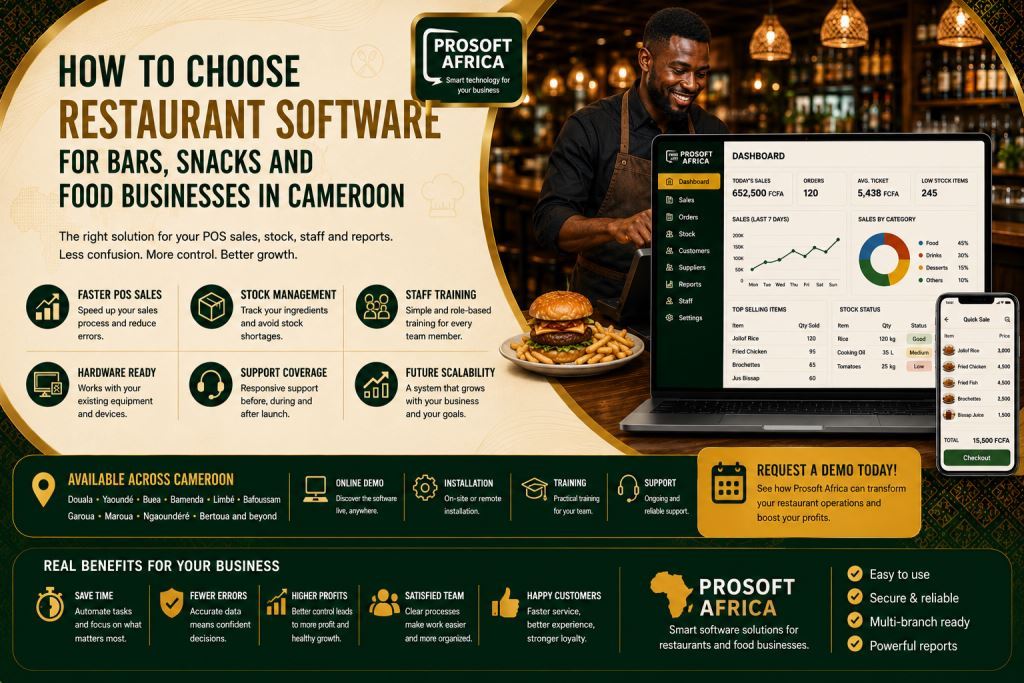
How to Choose Restaurant Software for Bars, Snacks and Food Businesses in Cameroon
How to choose restaurant software Cameroon is no longer only a technical idea for large organizations. Today, restaurants, bars, snacks, bakeries, cafeterias and food businesses across Cameroon and Africa use digital solutions to simplify daily operations. These systems reduce confusion, protect business records and improve overall efficiency. Prosoft Africa helps restaurant owners, bar managers, snack operators, cashiers, waiters, chefs and stock controllers replace scattered manual processes with an organized digital solution. The company also provides setup, training and continuous technical support.
A good system should do more than look modern. Instead, it should solve everyday operational problems. It should help staff find information quickly, reduce repetitive work, simplify reporting and give managers a clear view of business performance.
Across Douala, Yaounde and many other growing cities, customer expectations continue to increase. Service also needs to become faster and more accurate. Although paper records and spreadsheets may work for a small restaurant, they become difficult to manage as transactions, customers or branches increase. Therefore, the right software creates structure while preserving the personal service that customers appreciate.
Moreover, every food business has different requirements. A small snack bar, a busy restaurant and a multi-branch food business rarely operate in the same way. For that reason, restaurant software should match the size, workflow and long-term goals of each business instead of offering a one-size-fits-all solution.
Why This Topic Matters For Organizations In Cameroon And Africa
Many restaurant owners begin searching for restaurant management software because they face daily operational challenges. Staff spend valuable time checking balances, searching for records, confirming payments and preparing reports. As a result, manual work slows operations and increases the risk of mistakes.
Furthermore, common problems affect many food businesses. Teams sometimes forget to record sales correctly. Waiters and kitchen staff may experience communication errors. Stock shortages are also discovered too late. Consequently, managers spend extra time solving problems that proper software could have prevented.
In addition, unreliable information makes decision-making more difficult. A cashier may complete every task correctly, yet proving it becomes difficult without accurate digital records. Likewise, managers cannot make quick decisions when reports are incomplete. Employees also lose valuable time when important information is stored in different notebooks or offices.
Growth creates another challenge. A process that works for one restaurant may fail when the business expands. More customers, more employees and more branches require stronger controls. Without one centralized system, departments often develop different procedures. As a result, duplicate work increases and reporting becomes less reliable.
Finally, continuity is essential for every business. Employees may leave, change positions or take leave unexpectedly. However, the restaurant should never lose important information. A properly configured restaurant management system keeps business records inside the organization. Therefore, digital management supports both daily operations and long-term business stability.
Key Features And Capabilities To Look For
POS Speed
A practical restaurant management software should improve POS speed from the first day of use. Cashiers should complete transactions quickly without unnecessary steps. Clear screens and simple navigation reduce delays during busy periods. As a result, staff can serve more customers with greater accuracy.
In addition, faster POS operations reduce long queues and improve customer satisfaction. Managers also receive reliable sales records in real time instead of waiting for manual updates. Therefore, how to choose restaurant software Cameroon should include evaluating checkout speed before making a final decision.
Stock Needs
Stock management is another essential feature. Good restaurant software helps managers monitor ingredient levels before shortages affect daily operations. Instead of reacting too late, teams can plan purchases based on accurate information.
Moreover, automated stock tracking reduces waste and improves purchasing decisions. Restaurant owners can identify popular items, monitor consumption and avoid unnecessary expenses. Consequently, inventory becomes easier to control while profitability improves.
Staff Training
Even powerful software becomes ineffective if employees cannot use it correctly. For this reason, restaurant software should be simple to learn and supported by practical training.
Training should focus on everyday tasks such as processing sales, managing orders, correcting mistakes and generating reports. Furthermore, real business examples help staff gain confidence more quickly. As employees become comfortable with the system, productivity naturally increases.
Hardware Readiness
Restaurant owners should also verify whether the software works with their existing equipment. Before investing, they should confirm compatibility with receipt printers, barcode scanners, cash drawers, tablets and POS terminals.
Likewise, businesses planning future expansion should choose software that supports additional hardware without major changes. This approach reduces future costs and makes system upgrades much easier.
Support Coverage
Reliable technical support remains one of the most important selection criteria. Even the best software occasionally requires assistance. Therefore, restaurant owners should choose a provider that offers installation, training and continuous customer support.
Quick technical assistance minimizes downtime and allows restaurants to continue serving customers without major interruptions. Ongoing support also helps businesses adopt new features as their operations grow.
Future Expansion
Finally, restaurant software should support future business growth. A restaurant may later open new branches, increase staff or introduce delivery services. The software should grow alongside the business without requiring a complete replacement.
Choosing a scalable solution protects the initial investment. It also reduces future migration costs and keeps business information centralized as operations expand. For that reason, scalability should always be part of the evaluation process when considering how to choose restaurant software Cameroon.
Practical Benefits For Owners, Managers, Staff And Clients
The benefits of choosing the right restaurant software become visible every day. Instead of waiting until the end of the month, managers can monitor business performance daily. They can quickly review sales, expenses and operational reports. As a result, decisions become faster and more accurate.
In addition, authorized employees can access the information they need without depending on one person. This improves teamwork and reduces delays. Rather than debating figures, managers can verify records, user activity and transaction history with confidence.
Restaurant owners also gain stronger operational control. They can monitor POS sales, table activity, customer orders and stock levels from one centralized system. Consequently, they spend less time solving problems and more time improving customer service.
For employees, the advantages are equally important. Clear procedures reduce stress during busy hours. Staff members complete tasks more efficiently because the software guides each step of the workflow. Furthermore, fewer manual processes mean fewer mistakes and less repetitive work.
Customers also benefit from digital restaurant management. Faster service, accurate billing and shorter waiting times create a better dining experience. In addition, consistent service encourages customer loyalty and positive recommendations.
Another important advantage is accountability. Every restaurant needs a reliable way to know who performed each action and when it happened. User permissions allow owners to assign different responsibilities to managers, cashiers, waiters and stock controllers. Therefore, the business protects both its financial information and its employees.
Finally, digital data supports better long-term planning. Restaurant owners can identify busy seasons, slow periods, top-selling products and high-performing branches. They can also monitor purchasing trends, stock movement and operating costs. As a result, management can make informed decisions about hiring, purchasing, marketing and future expansion with greater confidence.
How To Implement The Software Without Disrupting Your Team
Successful implementation begins with careful planning. Before installing restaurant software, business owners should review their current workflow. They should identify the records they keep, the reports they need and the daily challenges their staff face. This preparation helps ensure that the software supports real operations instead of forcing unnecessary changes.
Next, the system should be configured according to the restaurant’s needs. Prosoft Africa helps businesses define user roles, payment methods, menu categories, stock items, departments, branches and reporting formats. Proper configuration saves time later and prevents many operational problems. Consequently, employees can begin using the software with greater confidence.
Staff training is equally important. Employees do not need advanced technical skills to operate the system effectively. Instead, they should learn practical tasks such as processing sales, managing orders, printing receipts, searching records, correcting authorized mistakes and generating reports. Moreover, using real restaurant scenarios during training makes learning easier and improves staff confidence.
After the software goes live, managers should monitor its use during the first few weeks. They should verify that employees enter information correctly and follow the new procedures consistently. Regular reviews also help identify small issues before they become larger problems. Therefore, early follow-up improves long-term success.
Continuous technical support also plays an essential role. Questions often appear after daily operations begin, especially when new employees join the team or when additional features are activated. Reliable support allows restaurants to solve issues quickly without interrupting customer service.
Available Across Cameroon And Africa
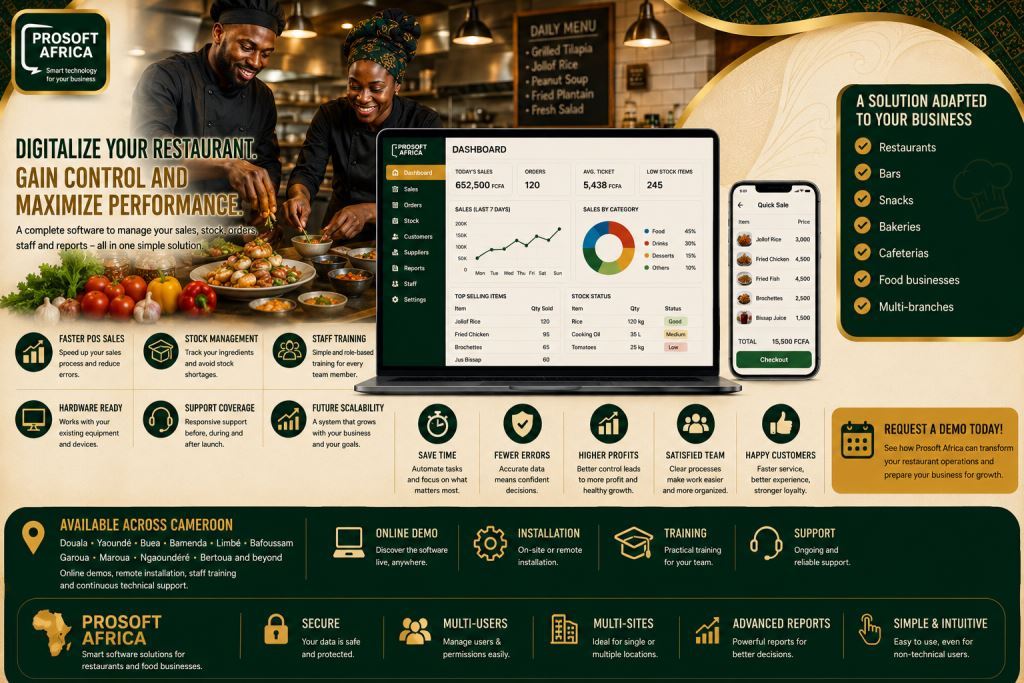
Prosoft Africa supports restaurants, bars, snacks, bakeries, cafeterias and food businesses throughout Cameroon, including Douala, Yaounde, Buea, Bamenda, Limbe, Bafoussam, Garoua, Maroua, Ngaoundere and Bertoua. The company also serves clients across other African countries through online demonstrations, remote installation, staff training and continuous technical assistance.
Furthermore, businesses located outside major cities can still benefit from professional implementation services. Teams can schedule an online demonstration, prepare their business data, receive remote training and launch the software without unnecessary travel. When onsite assistance is required, Prosoft Africa can organize installation according to the client’s location and operational needs.
Overall, this flexible approach allows restaurants of every size to adopt modern restaurant management software while receiving dependable support throughout the implementation process.
Decision Checklist
Choosing restaurant software should begin with a practical evaluation instead of focusing only on price. First, restaurant owners should confirm that the software supports their daily operations. Next, they should verify that reports provide useful business information. They should also check user permissions, technical support and future upgrade options. Finally, they should ensure that the system can grow with the business over time.
In addition, decision makers should compare software based on reliability rather than appearance. A modern interface is helpful, but dependable performance is far more important. Therefore, businesses should request a live demonstration before making a final decision. Testing the software with real restaurant activities often reveals whether it matches daily operational needs.
Moreover, restaurant owners should think beyond their current needs. Software that supports additional branches, delivery services, inventory growth and new employees will remain valuable for many years. Consequently, selecting a scalable solution often saves both time and money in the future.
Discover how to choose restaurant software Cameroon and explore how our restaurant management software simplifies table management, payments, and daily operations.
Frequently Asked Questions
Is how to choose restaurant software Cameroon important for small businesses?
Yes. Small restaurants, bars and snack businesses often benefit the most from choosing the right software early. A properly configured system builds good operating habits before the business grows. It also reduces manual work and improves daily efficiency.
Can Prosoft Africa provide installation and staff training?
Yes. Prosoft Africa offers software installation, staff training and continuous technical support. This complete approach helps businesses implement the system successfully and solve operational challenges more quickly.
Should every city in Cameroon have its own restaurant software page?
Not necessarily. Separate location pages are useful only when they provide unique local information. In most cases, comprehensive articles with naturally written service coverage deliver stronger SEO results and a better user experience.
Can the software manage multiple users and branches?
Yes. A well-designed restaurant management system supports multiple users, access permissions and branch management. Owners can monitor operations from one central dashboard while each branch accesses only the information it needs.
What is the first step before purchasing restaurant software?
The first step is requesting a live demonstration. Business owners should also prepare a list of their biggest operational challenges, review their daily workflow and identify the features they need most. This preparation makes software selection much easier.
Conclusion
Choosing the right restaurant management software is about much more than buying technology. The best solution improves daily operations, reduces errors, strengthens reporting and helps business owners make better decisions. Restaurants, bars, snacks, bakeries, cafeterias and food businesses throughout Cameroon and Africa can all benefit from organized digital management.
Prosoft Africa helps food businesses evaluate their workflow, select the right software modules, train employees and implement a practical deployment plan. By starting with a live demonstration and a clear list of business priorities, restaurant owners can move confidently from manual operations to a modern, efficient and scalable restaurant management system.
Explore our articles on restaurant management software, restaurant operations automation, inventory management, order processing, and financial management for restaurants in Cameroon and across Africa to help grow your business.
Stay connected with Prosoft Africa on Facebook, Instagram, LinkedIn, X (Twitter), et TikTok to discover innovative restaurant management solutions, live demonstrations, customer success stories, and the latest innovations transforming the restaurant industry across Africa.
