

How to Choose Hospital Management Software for Clinics in Cameroon
Choosing hospital management software in Cameroon is no longer a decision reserved for large hospitals. Today, clinics, hospitals, laboratories, pharmacies, and healthcare centers across Cameroon and Africa rely on digital solutions to improve efficiency, protect patient records, and simplify daily administration.
Prosoft Africa helps healthcare organizations replace paper-based processes and disconnected spreadsheets with an integrated Hospital Management Software solution. From implementation and staff training to ongoing technical support, our goal is to help healthcare facilities work more efficiently while delivering better patient care.
A modern hospital management system should do more than look impressive. Instead, it should solve the everyday challenges faced by healthcare professionals. The right software allows staff to find information quickly, reduce repetitive work, prepare accurate reports, and provide managers with real-time operational insights.
Healthcare facilities in Douala, Yaoundé, Bafoussam, Bamenda, Limbe, Garoua, and many other cities are experiencing growing pressure to deliver faster services while maintaining accurate medical records and financial accountability. As healthcare organizations continue to grow, manual registers and disconnected spreadsheets become increasingly difficult to manage. Consequently, an integrated digital platform becomes essential for maintaining efficiency and improving patient care.
Choosing hospital management software is an important investment because healthcare organizations manage sensitive patient information every day. Therefore, decision-makers should evaluate security, usability, reporting capabilities, implementation, training, and long-term support rather than focusing only on software pricing.
Why Hospital Management Software Matters in Cameroon and Africa
Many healthcare organizations begin searching for hospital management software because they experience the limitations of manual administration. Reception staff spend valuable time searching for patient files, accountants verify payments manually, pharmacy personnel struggle to monitor inventory, and administrators often wait several days before receiving complete reports.
As a result, small administrative delays gradually affect the entire organization. Lost patient files, appointment congestion, billing errors, pharmacy stock discrepancies, and incomplete reports reduce efficiency while affecting the quality of patient care.
Growth creates another challenge. A workflow that functions well for one clinic may no longer be effective when the organization expands to multiple departments or locations. Without an integrated system, each department often develops its own procedures, creating duplicated work, inconsistent records, and unreliable reporting.
Furthermore, healthcare organizations should consider long-term continuity. Staff members may change positions, retire, or leave the organization, but institutional knowledge should remain available. A well-configured Hospital Management Software platform protects valuable information by storing it securely within the organization instead of relying on individual notebooks or personal computers.
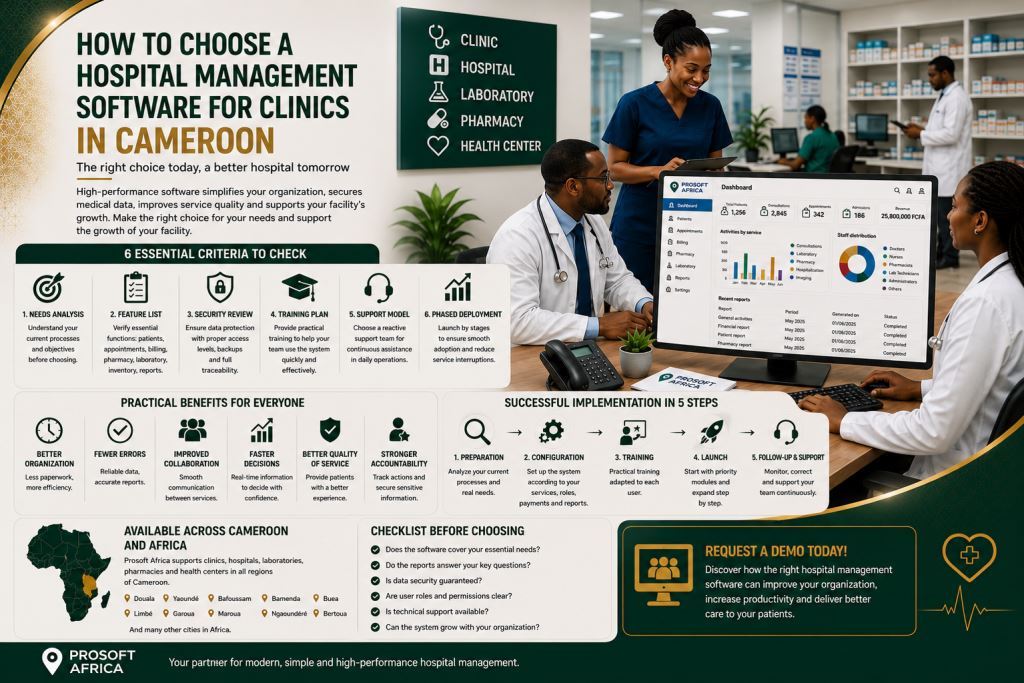
Key Features and Capabilities to Look For
Conduct a Needs Assessment
Before selecting hospital management software, evaluate how your healthcare facility currently operates. Review patient registration procedures, billing processes, pharmacy management, laboratory workflows, reporting requirements, and administrative challenges. This assessment helps you choose software that matches your organization’s actual needs rather than unnecessary complexity.
Review the Essential Features
A reliable Hospital Management Software solution should include patient registration, appointment scheduling, electronic medical records, billing, pharmacy management, laboratory management, inventory control, reporting, and secure user access. By comparing these features carefully, healthcare providers can invest in software that supports both clinical and administrative operations.
Evaluate Security and Data Protection
Healthcare organizations handle confidential patient information every day. For this reason, security should be one of the first factors to evaluate when choosing hospital management software. A reliable system should provide role-based user access, secure electronic medical records, regular data backups, audit trails, and strong data protection measures. As a result, hospitals can protect sensitive information while improving accountability across every department.
Prepare a Practical Staff Training Plan
Even the most advanced software will not deliver results without proper training. Therefore, every department should receive practical instruction based on its daily responsibilities. Reception staff should learn patient registration and appointment scheduling. Cashiers should understand billing and payment management. Pharmacists and laboratory personnel should become familiar with inventory control and laboratory workflows. Meanwhile, hospital administrators should focus on reports, dashboards, and operational monitoring.
Consider the Technical Support Available
Choosing hospital management software also means choosing a long-term technology partner. In addition, healthcare facilities should evaluate the quality of technical support before making a decision. Reliable providers offer remote assistance, software updates, troubleshooting, and continuous guidance after implementation. Ongoing support helps staff solve problems quickly while ensuring the software continues to meet the organization’s needs.
Choose a Solution That Can Grow with Your Organization
Healthcare facilities continue to evolve over time. Instead of replacing software every few years, choose a platform that can expand alongside your organization. Many clinics begin with patient registration, billing, pharmacy, and laboratory management before adding inventory control, human resources, executive dashboards, and multi-branch management. This approach reduces implementation costs while supporting long-term digital transformation.
Practical Benefits for Owners, Managers, Staff, and Patients
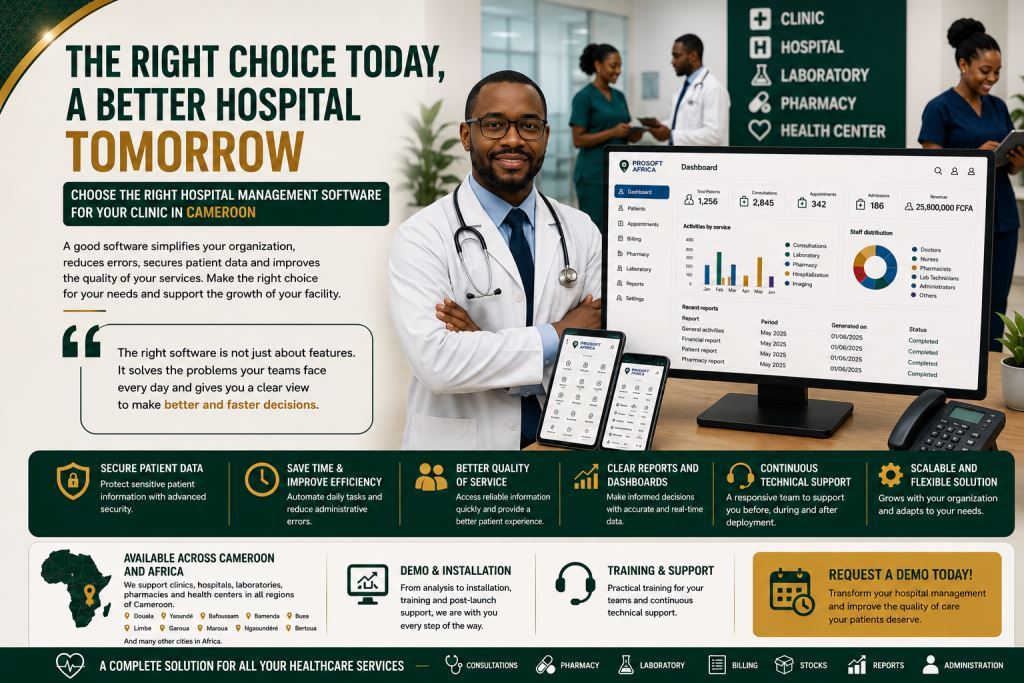
The advantages of a well-designed Hospital Management Software solution become visible almost immediately. Instead of waiting until the end of the month to understand hospital performance, managers can review real-time reports every day. Likewise, authorized staff members can quickly access the information they need without relying on paper files or manual registers.
Better Decision-Making
Accurate reports help hospital directors monitor patient activity, financial performance, pharmacy inventory, laboratory services, and operational efficiency. Consequently, management can make faster and better-informed decisions.
Improved Staff Productivity
Healthcare professionals spend less time searching for information and more time providing quality patient care. As a result, daily operations become smoother while administrative workloads decrease.
Better Patient Experience
Patients benefit from shorter waiting times, faster registration, organized appointments, accurate billing, and quicker access to laboratory results. In addition, improved communication between departments creates a more professional healthcare experience.
Greater Accountability
Every healthcare organization needs clear operational transparency. Therefore, role-based user permissions make it easier to monitor activities, protect sensitive information, and maintain accurate records of every transaction performed within the system.
To discover how an integrated healthcare solution improves hospital operations, explore our Hospital Management Software and see how it simplifies patient management, billing, pharmacy, laboratory services, reporting, and hospital administration from one secure platform.
How to Implement Hospital Management Software Successfully
Implementing Hospital Management Software requires careful planning rather than simply installing a new system. Before deployment, healthcare organizations should review their existing workflows, identify operational challenges, and define clear objectives for digital transformation.
Assess Your Current Processes
Start by evaluating how your clinic or hospital currently manages patient registration, appointments, billing, pharmacy operations, laboratory services, inventory, and reporting. This review helps identify inefficiencies that the new software should address.
Configure the Software for Your Organization
Every healthcare facility operates differently. Therefore, the software should be configured according to your departments, medical services, billing procedures, user roles, pharmacy workflows, laboratory processes, and reporting requirements. A properly configured system improves efficiency and reduces confusion from the first day of use.
Train Every Department
Successful implementation depends on user adoption. For this reason, staff training should focus on real daily tasks rather than technical theory.
Reception staff should learn patient registration and appointment scheduling. Meanwhile, cashiers become familiar with billing and payment processing. Pharmacists manage medicine inventory and dispensing, while laboratory personnel record test requests and results. Hospital administrators learn how to monitor reports, dashboards, and operational performance.
Monitor Progress After Launch
Implementation does not end when the software goes live. Instead, healthcare facilities should review user activity during the first few weeks, verify that reports are accurate, and ensure staff members are following the new digital procedures. Regular follow-up helps resolve small issues before they become larger operational problems.
Benefit from Continuous Technical Support
Reliable technical support is essential after implementation. Furthermore, healthcare providers should work with a software company that offers remote assistance, software updates, troubleshooting, and ongoing customer support. Continuous guidance helps organizations maximize the value of their investment.
Hospital Management Software Available Across Cameroon and Africa
Prosoft Africa provides Hospital Management Software to clinics, hospitals, pharmacies, laboratories, and healthcare centers throughout Cameroon, including Yaoundé, Douala, Bafoussam, Bamenda, Buea, Limbe, Garoua, Maroua, Ngaoundéré, Bertoua, Ebolowa, Dschang, Kribi, Kumba, Nkongsamba, and many other cities.
Beyond Cameroon, we also support healthcare organizations in Nigeria, Ghana, Gabon, Congo, Chad, the Central African Republic, Equatorial Guinea, Côte d’Ivoire, Senegal, Rwanda, Kenya, South Africa, and other African countries through remote implementation, online demonstrations, staff training, and continuous technical support.
Healthcare facilities outside major cities can also benefit from our remote implementation model. First, our specialists conduct an online demonstration and assess your operational requirements. Next, we configure the software, assist with data preparation, train your staff remotely, and provide continuous technical assistance after deployment.
This flexible approach enables healthcare organizations across Africa to adopt reliable Hospital Management Software without delaying their digital transformation projects.
Decision Checklist Before Choosing Hospital Management Software
Before selecting a Hospital Management Software solution, healthcare organizations should ask several important questions.
- Does the software manage patient records, billing, pharmacy, laboratory services, and reporting?
- Can different staff members access only the information relevant to their responsibilities?
- Does the software provide accurate reports for management?
- Is technical support available after implementation?
- Can the software grow as the organization expands?
- Does the provider offer practical staff training?
- Is the solution easy to use for both medical and administrative staff?
Answering these questions helps healthcare organizations select a solution that supports long-term growth instead of simply meeting short-term needs.
Healthcare leaders should also encourage staff to embrace digital transformation. When management actively supports the implementation process, employees adapt more quickly, training becomes more effective, and the organization achieves better long-term results.
If you’re wondering how to choose hospital management software Cameroon, discover how our hospital management software meets the needs of hospitals, clinics, laboratories, and healthcare centers.
Frequently Asked Questions
Is Hospital Management Software suitable for small clinics?
Yes. Small clinics benefit from Hospital Management Software because it helps organize patient records, billing, appointments, pharmacy operations, and reporting before administrative work becomes difficult to manage. As your clinic grows, additional modules can easily be added without replacing the system.
Can Prosoft Africa help with software implementation and staff training?
Yes. Prosoft Africa provides complete implementation services, including software configuration, staff training, remote assistance, and ongoing technical support. As a result, healthcare facilities can adopt the system confidently while minimizing disruption to daily operations.
Can the software support multiple users and departments?
Absolutely. Hospital Management Software allows different users to access the modules that match their responsibilities. For example, receptionists, doctors, nurses, pharmacists, laboratory technicians, accountants, and administrators each receive secure role-based access to the information they need.
Is the software suitable for hospitals with multiple branches?
Yes. Healthcare organizations operating multiple hospitals, clinics, or branches can monitor their operations from one centralized platform. This makes it easier to supervise financial performance, patient services, pharmacy inventory, laboratory activities, and administrative reports across all locations.
How do we get started?
The first step is to request a free demonstration. During the consultation, our specialists evaluate your operational requirements, recommend the appropriate modules, explain the implementation process, and answer your questions before deployment begins.
Conclusion
Choosing the right Hospital Management Software is an investment in the future of your healthcare organization. Rather than focusing only on price, decision-makers should evaluate usability, security, reporting capabilities, technical support, scalability, and long-term value.
A reliable solution helps clinics and hospitals improve patient management, billing, pharmacy operations, laboratory services, inventory control, reporting, and staff productivity. Consequently, healthcare providers can reduce administrative errors, strengthen accountability, and deliver a better patient experience.
Whether you manage a private clinic, medical center, pharmacy, laboratory, or large hospital, Prosoft Africa provides practical Hospital Management Software designed specifically for healthcare facilities in Cameroon and across Africa.
Explore our healthcare blog for practical advice, implementation guides, digital transformation strategies, hospital management best practices, and expert articles covering patient management, pharmacy, laboratory services, billing, reporting, and healthcare technology across Cameroon and Africa.
Stay connected with Prosoft Africa on Facebook, Instagram, LinkedIn, X (Twitter), and TikTok to discover innovative healthcare software solutions, live demonstrations, customer success stories, product updates, and practical tips for improving hospital management across Cameroon and Africa.
