
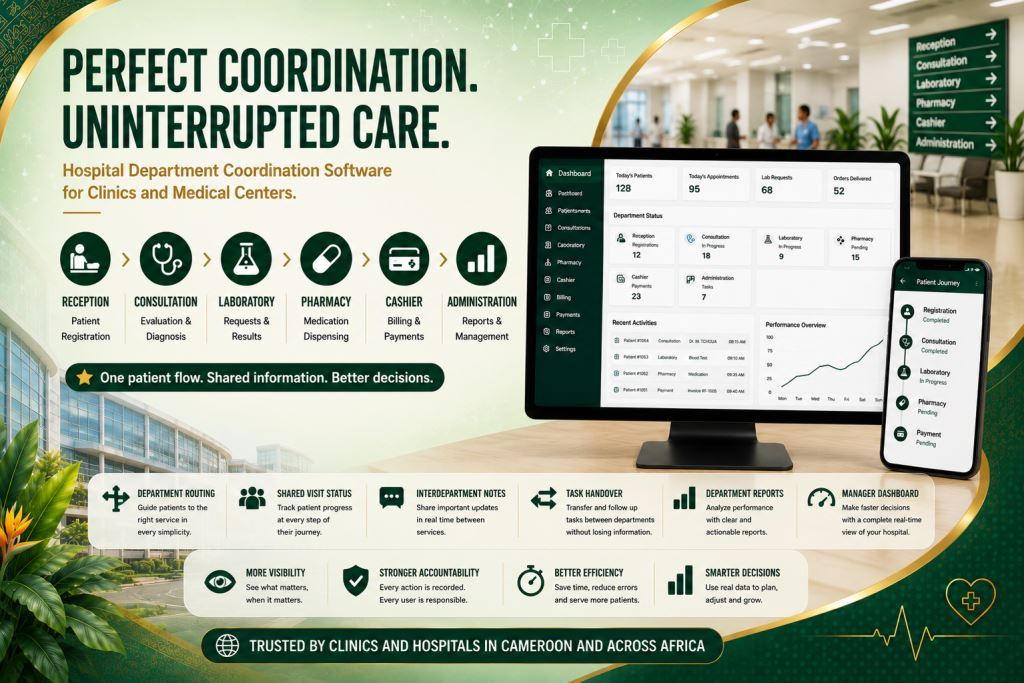
Hospital Department Coordination Software for Clinics and Medical Centers
Hospital department coordination software Africa is a serious management topic for clinics, medical centers, hospitals and healthcare groups that want cleaner records, faster decisions and better accountability. Therefore, the goal of this article is to help clinic owners, hospital administrators, reception teams, cashiers, nurses, doctors, laboratory staff and pharmacy managers understand what the software should organize, which mistakes to avoid and how to prepare a practical deployment.
For many organizations, the challenge is not only the absence of software. Instead, the deeper challenge is that important information is scattered across notebooks, spreadsheets, phones, receipt books and verbal updates. As a result, managers spend too much time asking for explanations when teams depend on separate records. They spend far less time improving service quality. A good system turns daily work into structured records. It also makes those records easy to search, verify and report.
In this context, department coordination software helps reception, consultation, laboratory, pharmacy, cashier and administration work from the same patient flow. The best approach is to connect the topic to a complete hospital management software strategy. This strategy includes patient registration, appointments, billing, payments, pharmacy stock, laboratory requests, staff activity and management reports. Consequently, the organization does not buy a single isolated tool. Instead, it builds a management foundation that supports growth, new users, additional branches and stronger reporting over time.
Why This Topic Matters For Daily Operations
Daily operations create small decisions every hour. Staff record who entered a file, which payment was accepted, which stock item moved, which patient needs follow-up, which report requires review and which manager must approve a correction. When these decisions are not captured in one system, the organization depends on memory. That approach may work for a small team. However, it becomes unreliable as activity increases.
A strong digital workflow helps staff follow the same steps, even during busy periods. It reduces confusion because every role knows what to enter, what to approve and what to review. In addition, owners and administrators can distinguish a normal delay from a genuine operational risk. Therefore, software should be viewed as a management improvement rather than simply a computer purchase.
Organizations in Cameroon and other African markets also need practical deployment. Internet availability, staff computer experience, language requirements, hardware budgets and branch locations often differ. For that reason, a useful system should be clear, easy to learn and adaptable. It should support existing work practices while gradually improving discipline and record quality.
Finally, the strongest sign of a successful implementation is not a long feature list. It is the moment when users stop asking where information is stored because the workflow naturally directs them to the correct record. That is the level of organization clinic owners, hospital administrators, reception teams, cashiers, nurses, doctors, laboratory staff and pharmacy managers should expect when evaluating this type of software.
Common Problems This Software Should Solve
Departments Work Separately
One common problem is that departments work like separate islands. At first, the issue may seem minor, especially if a trusted staff member knows the details. However, when the same issue appears every week, it becomes a management weakness. The software should make every record visible. It should also connect each record to the right person or transaction. Finally, it should keep enough history to explain what happened.
Patients Carry Verbal Instructions
Another common problem is that patients carry verbal instructions from room to room. At first, the issue may seem minor, especially if a trusted staff member knows the details. Nevertheless, when the same issue appears every week, it becomes a management weakness. The software should make every record visible. It should also connect each record to the right person or transaction. Finally, it should keep enough history to explain what happened.
Laboratory And Pharmacy Requests Are Hidden
Another common problem is that laboratory and pharmacy requests are not visible to administration. At first, the issue may seem minor, especially if a trusted staff member knows the details. In reality, when the same issue appears every week, it becomes a management weakness. The software should make every record visible. It should also connect each record to the right person or transaction. Finally, it should keep enough history to explain what happened.
Managers Learn About Delays Too Late
Another common problem is that managers hear about delays only after complaints. At first, the issue may seem minor, especially if a trusted staff member knows the details. Even so, when the same issue appears every week, it becomes a management weakness. The software should make every record visible. It should also connect each record to the right person or transaction. Finally, it should keep enough history to explain what happened.
Reports Cannot Identify Bottlenecks
Another common problem is that reports cannot show where bottlenecks happen. At first, the issue may seem minor, especially if a trusted staff member knows the details. Still, when the same issue appears every week, it becomes a management weakness. The software should make every record visible. It should also connect each record to the right person or transaction. Finally, it should keep enough history to explain what happened.
Another problem is that managers often receive summaries without supporting details. A total may appear correct. However, its source may remain unclear. Reliable software should allow an administrator to move from a summary to the supporting records. These records may include receipts, orders, attendance, invoices, balances, stock movements or service notes, depending on the organization.
A third problem is that corrections are made informally. Every serious organization needs the ability to correct mistakes. However, every correction should be controlled. The system should show who made the change. It should also explain why the change was needed. Finally, it should confirm whether a supervisor approved it. As a result, both the organization and honest staff members are protected.
Key Features To Look For
Department Routing
This feature should be simple enough for daily users. It should also be strong enough for managers. In practice, it connects patient registration, appointments, billing, payments, pharmacy stock, laboratory requests, staff activity and management reports. As a result, the organization avoids creating another isolated record. When configured correctly, staff enter information once. Then they verify it quickly. Finally, they reuse it in reports, receipts, dashboards and follow-up actions.
Effective coordination between departments begins with centralized patient records and appointment management. Read our article Patient Records And Appointment Management Software For African Clinics to discover how shared patient information, appointment tracking and centralized medical records improve communication between reception, consultation, laboratory, pharmacy and billing departments.
Shared Visit Status
This feature should be simple enough for daily users. It should also be strong enough for managers. In practice, it connects patient registration, appointments, billing, payments, pharmacy stock, laboratory requests, staff activity and management reports. As a result, the organization avoids creating another isolated record. When configured correctly, staff enter information once. Then they verify it quickly. Finally, they reuse it in reports, receipts, dashboards and follow-up actions.
Interdepartment Notes
This feature should be simple enough for daily users. It should also be strong enough for managers. In practice, it connects patient registration, appointments, billing, payments, pharmacy stock, laboratory requests, staff activity and management reports. As a result, the organization avoids creating another isolated record. When configured correctly, staff enter information once. Then they verify it quickly. Finally, they reuse it in reports, receipts, dashboards and follow-up actions.
Task Handover
This feature should be simple enough for daily users. It should also be strong enough for managers. In practice, it connects patient registration, appointments, billing, payments, pharmacy stock, laboratory requests, staff activity and management reports. As a result, the organization avoids creating another isolated record. When configured correctly, staff enter information once. Then they verify it quickly. Finally, they reuse it in reports, receipts, dashboards and follow-up actions.
Department Reports
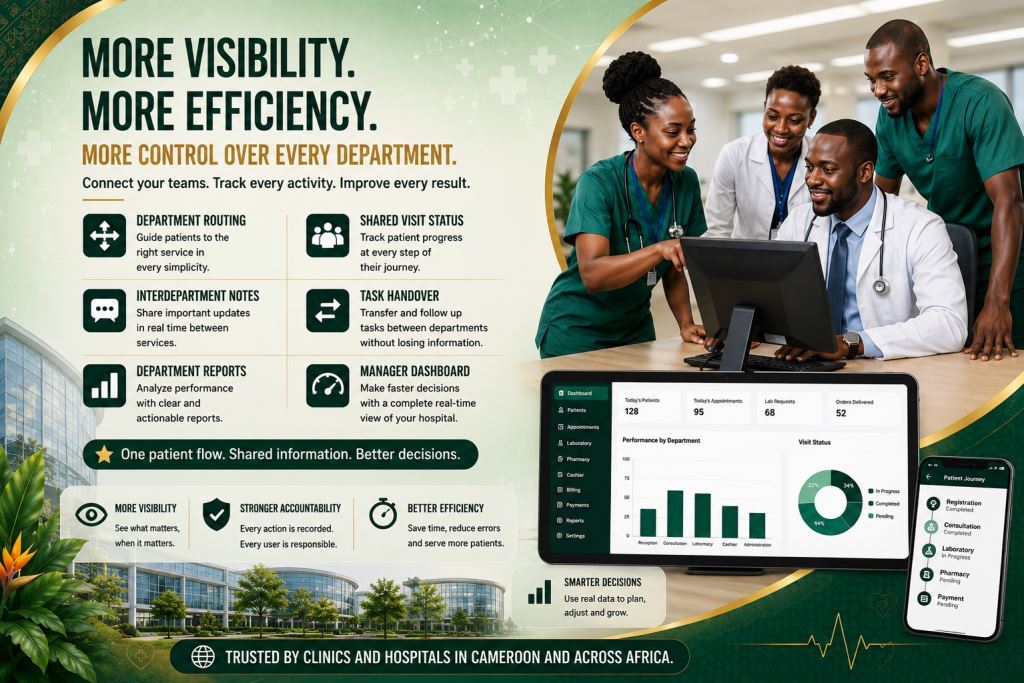
This feature should be simple enough for daily users. It should also be strong enough for managers. In practice, it connects patient registration, appointments, billing, payments, pharmacy stock, laboratory requests, staff activity and management reports. As a result, the organization avoids creating another isolated record. When configured correctly, staff enter information once. Then they verify it quickly. Finally, they reuse it in reports, receipts, dashboards and follow-up actions.
Department reports become even more valuable when they provide hospital leaders with meaningful operational insights. Explore our article Hospital Reporting Software For Directors And Healthcare Administrators to learn how comprehensive reports, performance dashboards and management analytics help healthcare executives monitor every department and make faster, data-driven decisions.
Manager Dashboard
This feature should be simple enough for daily users. It should also be strong enough for managers. In practice, it connects patient registration, appointments, billing, payments, pharmacy stock, laboratory requests, staff activity and management reports. As a result, the organization avoids creating another isolated record. When configured correctly, staff enter information once. Then they verify it quickly. Finally, they reuse it in reports, receipts, dashboards and follow-up actions.
These features should not be activated blindly. Instead, the right configuration depends on the size of the organization, the number of users, the reports required by management and the level of control needed. Therefore, Prosoft Africa can help map the workflow before implementation. As a result, every feature supports a real task instead of becoming unused decoration.
Benefits For Owners, Managers, Staff And Users
Better Visibility
The first benefit is visibility. Owners and managers no longer need to wait for scattered verbal updates. Instead, they can review structured information. Visibility does not mean spying on staff. Rather, it gives leaders the information they need to detect issues early, support departments properly and make decisions based on reliable records.
Better Accountability
The second benefit is accountability. Every user has a defined role, and every important action is linked to a user account. As a result, the organization understands responsibility more fairly. Staff members are protected from accusations that cannot be verified. Likewise, managers can separate honest mistakes from repeated process problems.
Greater Speed
The third benefit is speed. A user who needs a record should not move from office to office searching for paper files. Instead, search tools, filters, dashboards and record histories make information easier to find. This matters when parents are waiting, patients are being served, customers request receipts or owners ask for daily performance.
Better Planning
The fourth benefit is better planning. Reliable data helps managers identify trends. They can see busy periods, slow-moving items, recurring balances, staff workload, branch performance and revenue movements. Consequently, the organization can prepare before problems become urgent.
How To Implement It Without Confusing The Team
Start With A Workflow Audit
Begin with a workflow audit. List the tasks people perform today. Then identify the records they create, the reports managers need and the points where errors happen most often.
Clean Important Data Before Launch
Clean the most important data before launch. The system does not need every historical file on the first day. However, active records, user names, opening balances and key categories should be prepared carefully.
Define User Roles
Define user roles before deployment. A cashier, teacher, receptionist, manager, stock keeper or branch supervisor should not receive the same permissions. Therefore, good access control keeps the system simple and more secure.
Train With Real Examples
Train staff with real examples. Use sample payments, orders, visits, stock movements or invoices that match daily work. As a result, users learn faster because the training reflects their actual responsibilities.
Review The First Weeks
Review the first weeks after launch. Managers should verify that reports are accurate. They should also confirm that staff enter data correctly. Finally, they should identify any old manual habits that still create duplicate work.
Expand The System Gradually
The implementation should remain progressive. It is better to launch the essential workflow successfully than to activate every module at once and confuse the team. Once users become comfortable, the organization can add advanced reports, branch controls, parent or customer communication, inventory analysis, dashboards and other modules.
Available Across Cameroon And Africa
Prosoft Africa provides setup, training and support for clinics, medical centers, hospitals and healthcare groups across Cameroon. This includes Douala, Yaounde, Buea, Bamenda, Limbe, Bafoussam, Garoua, Maroua, Ngaoundere, Bertoua and many other communities. The wording remains natural because the goal is to describe the service area without repeating city names unnecessarily.
Organizations outside Cameroon can also request online demonstrations, remote installation guidance, staff training and continuous support. This approach is useful for healthcare teams across Africa that want structured management software together with guidance during configuration, adoption and reporting.
With our hospital management software, ensure smooth collaboration between medical, administrative, and financial departments.
Frequently Asked Questions
Who Should Use Hospital Department Coordination Software Africa?
It is useful for clinic owners, hospital administrators, reception teams, cashiers, nurses, doctors, laboratory staff and pharmacy managers. These users benefit from better organization, clearer reporting and less dependence on manual records.
Should Every Feature Be Used On The First Day?
No. Most organizations achieve better results by starting with the most important workflow. After that, they can introduce additional modules when users become confident.
Can Prosoft Africa Support Teams With Limited Computer Experience?
Yes. Training should be practical, role-based and supported with follow-up. Therefore, users learn the exact tasks they perform every day.
Conclusion
Choosing hospital department coordination software Africa should be treated as a management decision. The right system helps organizations organize daily work, protect records, improve reporting and support staff instead of creating confusion. The best results appear when software, training and management discipline work together.
Finally, Prosoft Africa helps clinics, medical centers, hospitals and healthcare groups across Cameroon and Africa review their needs, configure the right modules, train users and support adoption after deployment. To move forward, request a demonstration, prepare questions about your current workflow and discover how the system can be adapted to your real operations.
Discover how Prosoft Africa’s hospital management software simplifies patient management, billing, laboratory operations, pharmacy management, and electronic medical records. Explore our other healthcare solutions and find the one that best meets the needs of your hospital, clinic, or medical center.
Follow Prosoft Africa on Facebook, Instagram, LinkedIn, X (Twitter) and TikTok for live demos, customer success stories, expert insights, and the latest innovations transforming hospitals, clinics, and healthcare facilities across Africa.
