
Hospital Asset and Equipment Maintenance Tracking Software
Hospital Asset and Equipment Maintenance Tracking Software is an important topic for clinics, health centers, medical laboratories and hospitals that want stronger control, cleaner records and more reliable daily management in Cameroon and across Africa. Prosoft Africa approaches hospital equipment maintenance tracking software as part of a complete management system, not as a small isolated feature that creates another disconnected file for staff to maintain.
Many organizations already have hardworking teams, but the teams often operate with scattered notebooks, spreadsheets, phone messages, handwritten approvals and reports that arrive late. When clinic owners, hospital administrators, reception teams, doctors, nurses, cashiers, pharmacists and laboratory staff search for hospital equipment maintenance tracking software, they are usually trying to solve a real operational problem: they want dependable records that remain useful after the busy day is over.
This article explains why this workflow matters, the common problems it solves, the features to request, how to prepare staff for adoption and how Prosoft Africa can support implementation.
Why this topic matters for growing organizations
A growing organization can look active and successful while its internal information is difficult to trust. A cashier may know one version of the truth, a manager may have another version, and an owner may only see a summary days later. The result is confusion around records, approvals, balances, stock, payments or reports. Hospital Asset and Equipment Maintenance Tracking Software helps reduce that confusion by bringing the workflow into a structured digital process.
The value of hospital equipment maintenance tracking software is not only that it saves time. It also protects decisions. If management wants to know what happened yesterday, which user changed a record, which customer or student is affected, which item moved, or which report should be reviewed, the system should provide a clear path. That path is hard to maintain when records are spread across paper files and personal devices.
For Cameroon and other African markets, the system should be practical. It should respect mixed internet quality, different staff skill levels, bilingual communication needs, local payment habits, and the fact that many teams are moving gradually from manual work to digital work. A good platform must be powerful enough for management and simple enough for everyday users.
Common Problems This Workflow Helps Solve
Poor Equipment Tracking Between Departments
One common issue is that departments move equipment without keeping clear records. As a result, teams may lose visibility on equipment location and usage.
During busy periods, this problem becomes more serious. It can affect stock counting, branch reconciliation, month-end reporting, and management reviews.
Therefore, a digital workflow helps organizations track equipment movements and make decisions using accurate information instead of assumptions.
Delayed Equipment Maintenance
Another common issue is that teams remember maintenance only when a machine stops working. Consequently, unexpected failures can interrupt daily activities and increase repair costs.
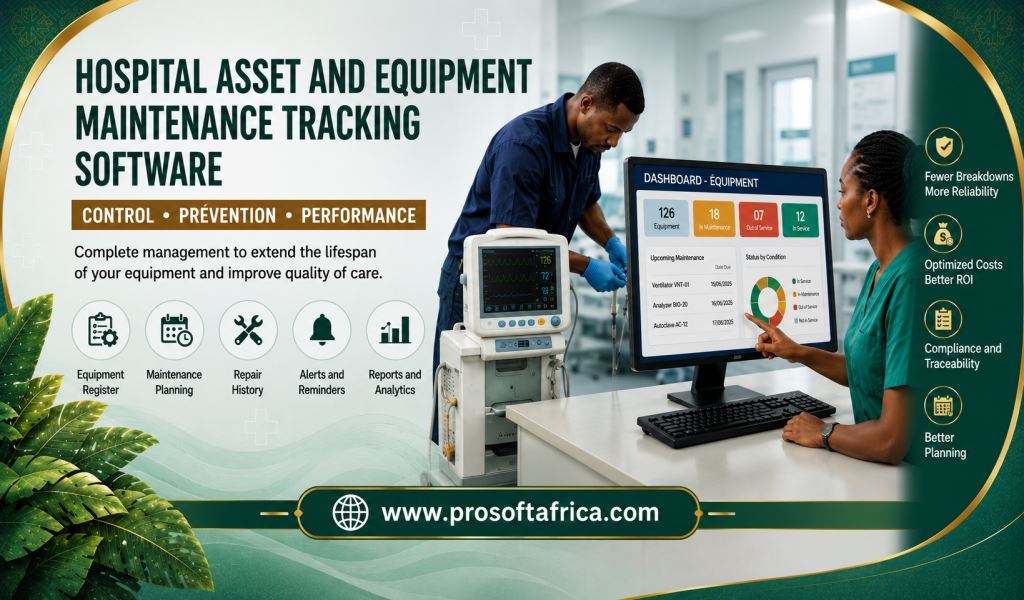
With a structured workflow, organizations can schedule maintenance tasks, receive reminders, and reduce equipment downtime.
Poor Repair Cost Monitoring
Some organizations do not connect repair expenses with specific equipment. As a result, managers may find it difficult to analyze maintenance costs and plan future budgets.
Moreover, a digital system helps link repairs to assets and provides better visibility into equipment performance.
Difficult Replacement And Servicing Planning
Administrators often need better tools to plan equipment replacement and servicing. Therefore, a centralized workflow helps them monitor asset conditions and prepare future actions.
In addition, managers can use reliable reports to make better investment decisions.
Dependence On Individual Knowledge
Another challenge occurs when employees depend on one person who remembers every process. Although this person may be experienced and reliable, the organization can face risks when information remains only in personal memory.
With a structured system, the team shares the same reference point. Thus, knowledge belongs to the organization and not only to one desk, one phone, or one notebook.
Key software features to request
1. Asset register for equipment and devices
This feature should be configured around the way the team actually works. It should reduce repeated entry, keep important records connected and make it easy for authorized users to review what happened. In a complete Prosoft Africa setup, asset register for equipment and devices should support the wider modules around patient records, appointments, billing, pharmacy, laboratory, stock, departments, staff access and reports so the organization does not create a new island of data.
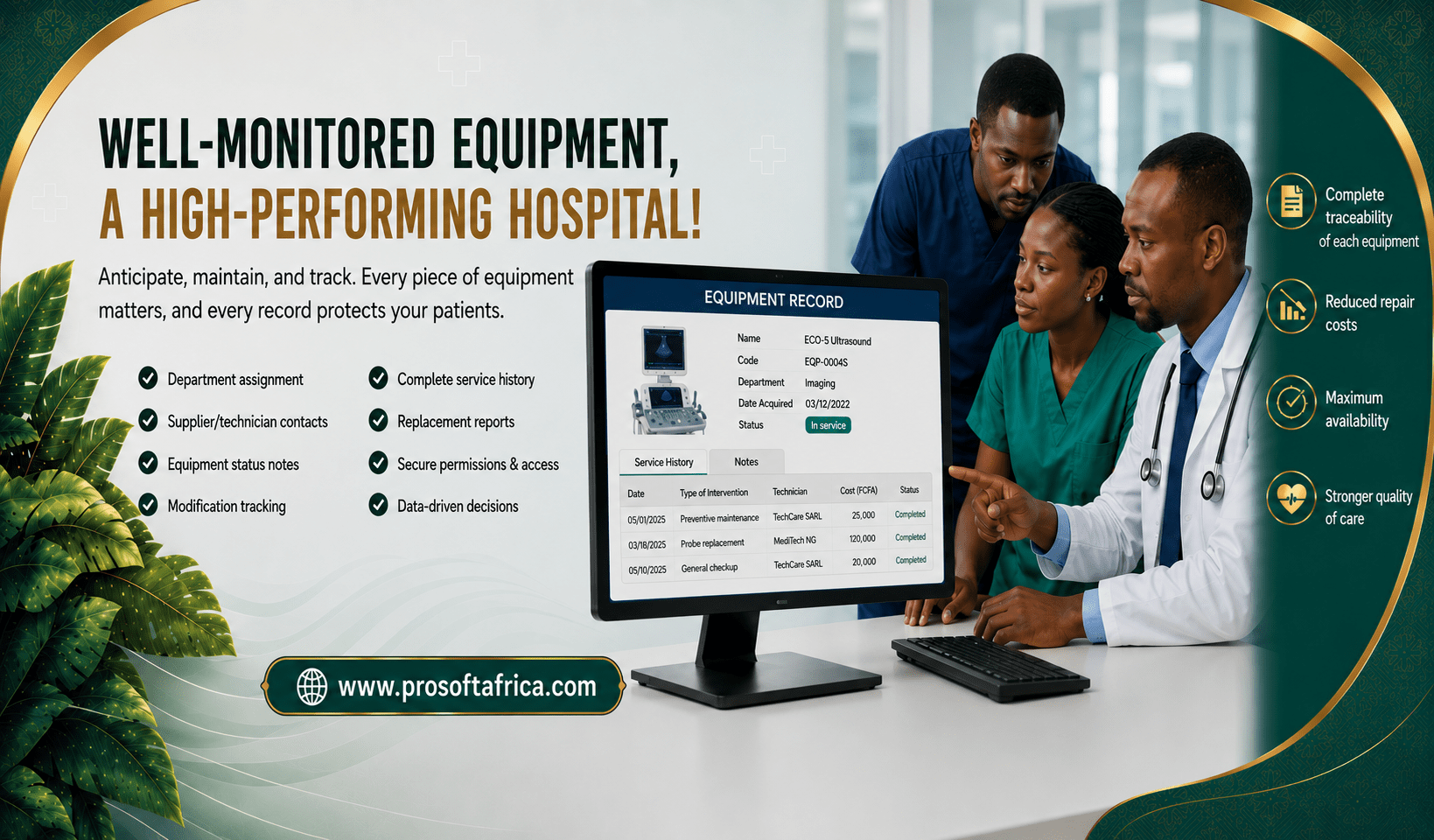
2. Department assignment of assets
This feature should be configured around the way the team actually works. It should reduce repeated entry, keep important records connected and make it easy for authorized users to review what happened. In a complete Prosoft Africa setup, department assignment of assets should support the wider modules around patient records, appointments, billing, pharmacy, laboratory, stock, departments, staff access and reports so the organization does not create a new island of data.
To complement equipment management, explore our Hospital Pharmacy Inventory Software Cameroon. Learn how healthcare facilities can manage medicines, medical consumables, and inventory levels alongside critical hospital equipment to ensure uninterrupted patient care and better operational efficiency.
3. Maintenance schedule reminders
This feature should be configured around the way the team actually works. It should reduce repeated entry, keep important records connected and make it easy for authorized users to review what happened. In a complete Prosoft Africa setup, maintenance schedule reminders should support the wider modules around patient records, appointments, billing, pharmacy, laboratory, stock, departments, staff access and reports so the organization does not create a new island of data.
4. Repair and service history
This feature should be configured around the way the team actually works. It should reduce repeated entry, keep important records connected and make it easy for authorized users to review what happened. In a complete Prosoft Africa setup, repair and service history should support the wider modules around patient records, appointments, billing, pharmacy, laboratory, stock, departments, staff access and reports so the organization does not create a new island of data.
5. Supplier or technician contact records
This feature should be configured around the way the team actually works. It should reduce repeated entry, keep important records connected and make it easy for authorized users to review what happened. In a complete Prosoft Africa setup, supplier or technician contact records should support the wider modules around patient records, appointments, billing, pharmacy, laboratory, stock, departments, staff access and reports so the organization does not create a new island of data.
6. Asset condition notes
This feature should be configured around the way the team actually works. It should reduce repeated entry, keep important records connected and make it easy for authorized users to review what happened. In a complete Prosoft Africa setup, asset condition notes should support the wider modules around patient records, appointments, billing, pharmacy, laboratory, stock, departments, staff access and reports so the organization does not create a new island of data.
7. Replacement planning reports
This feature should be configured around the way the team actually works. It should reduce repeated entry, keep important records connected and make it easy for authorized users to review what happened. In a complete Prosoft Africa setup, replacement planning reports should support the wider modules around patient records, appointments, billing, pharmacy, laboratory, stock, departments, staff access and reports so the organization does not create a new island of data.
To improve maintenance planning even further, explore our Hospital Stock Reorder and Minimum Level Tracking Software. This solution helps healthcare organizations monitor spare parts, maintenance supplies, and minimum stock levels, ensuring replacement materials are available before critical equipment requires servicing or repair.
8. Permission control for asset changes
This feature should be configured around the way the team actually works. It should reduce repeated entry, keep important records connected and make it easy for authorized users to review what happened. In a complete Prosoft Africa setup, permission control for asset changes should support the wider modules around patient records, appointments, billing, pharmacy, laboratory, stock, departments, staff access and reports so the organization does not create a new island of data.
The best implementation does not activate every possible option on the first day. The first phase should cover the workflows that create the most confusion or financial risk. After staff become comfortable, management can add more advanced controls, reports, reminders, branches or approval levels.
How the workflow should run in daily operations
A strong workflow begins with clean master data. For clinics, health centers, medical laboratories and hospitals, this may include people records, item lists, prices, branches, departments, classes, services, tables, suppliers, user accounts and report categories. When the starting data is clean, daily actions become easier to understand and reports become more trustworthy.
The second step is controlled entry. Staff should know where a transaction begins, which fields are required, what proof is needed, which user has permission, and when a supervisor must approve an exception. Clear entry rules reduce duplicate work and prevent staff from inventing their own unofficial process when pressure increases.
The third step is review. Managers should not wait until the end of the month to discover problems. Daily and weekly summaries help them see unusual balances, missing records, slow-moving stock, unconfirmed payments, delayed tasks or repeated corrections. A dashboard is most valuable when it shows what needs attention, not only what looks good.
Benefits for managers, staff and customers
Visibility improves because managers can review current records instead of waiting for verbal updates, late spreadsheets or end-of-month surprises.
Accountability improves because sensitive actions can be tied to a role, a user, a date, a reason and a clear approval path.
Speed improves because staff can search, filter, print, update and report from one system instead of moving between notebooks and disconnected files.
Decision making improves because reports show patterns that are difficult to see manually, including delays, losses, weak collections, slow stock movement and busy periods.
Trust improves because clients, parents, patients, customers or managers receive clearer information, cleaner receipts and more professional responses.
For staff, the benefit is also emotional. When the system is clear, employees do not have to defend themselves with memory alone. They can point to a record, a receipt, a status, a note or an approval. This reduces conflict and helps new employees learn the standard process faster.
For owners and senior managers, hospital equipment maintenance tracking software creates a foundation for growth. A small organization can survive with informal methods for a while, but expansion exposes weak systems. Multiple branches, more customers, more students, more patients, more stock items or more employees all require stronger reporting and access control.
Discover how our hospital management software enables hospital equipment maintenance tracking to improve reliability and reduce equipment downtime.
Implementation steps with Prosoft Africa
Start with a discovery discussion where the team explains current workflows, pain points, reports and approval rules.
Prepare data before setup by cleaning names, item lists, account categories, services, prices, contacts and old balances where relevant.
Configure modules in a practical order so the first launch solves priority problems instead of overwhelming staff.
Train users by role, because cashiers, accountants, reception staff, teachers, waiters, pharmacists, stock officers and owners do not need the same screens every day.
Run a pilot period where common mistakes are corrected, report formats are reviewed and management confirms that the workflow matches real operations.
Continue support after launch so the organization can add reports, adjust permissions, improve data quality and strengthen adoption over time.
Prosoft Africa supports clinics, health centers and hospitals across Cameroon, including Douala, Yaounde, Buea, Bamenda, Limbe, Bafoussam, Garoua, Maroua, Ngaoundere, Bertoua and other communities. Healthcare organizations outside Cameroon can request online demonstrations, remote setup assistance, staff training and continuing technical support for administrative workflows.
Frequently asked questions
Is hospital equipment maintenance tracking software only for large organizations?
No. A smaller organization can benefit if the workflow is causing repeated errors, delayed reports or weak accountability. The setup can begin simply and grow over time.
Should we replace every manual process immediately?
Not always. A phased rollout is usually safer. Start with the records and reports that matter most, then add more controls when staff understand the system.
Can staff with limited computer skills use the system?
Yes, if training is practical and role-based. Users should practice the exact tasks they perform daily instead of receiving only a general lecture.
What should we prepare before requesting a demo?
Prepare sample records, the current report format, common problems, user roles and the decisions management wants to make from the dashboard.
How does Prosoft Africa support clients after setup?
Support can include remote assistance, staff guidance, configuration review, report improvements and advice as the organization grows into more modules.
Conclusion
Hospital Asset and Equipment Maintenance Tracking Software should be seen as an operational improvement, not only as a software purchase. The real goal is to reduce confusion, protect records, improve accountability and help staff serve people faster with better information. When the workflow is clear, management gets better reports and the team works with more confidence.
Prosoft Africa can help clinics, health centers, medical laboratories and hospitals in Cameroon and across Africa plan the right setup, train users and support adoption. Organizations that want to move from scattered records to structured digital management can request a demo and use this topic as one step in a practical transformation plan.
Discover how Prosoft Africa Hospital Management Software simplifies patient management, appointments, consultations, admissions, billing, pharmacy management, laboratory operations, medical inventory, staff management, and daily hospital operations. Explore our other healthcare management solutions to find the best fit for your hospital, clinic, medical center, laboratory, or pharmacy.
Follow Prosoft Africa on Facebook, Instagram, LinkedIn, X (Twitter) and TikTok for live demos, customer success stories, and expert insights. Discover the latest innovations helping hospitals, clinics, medical centers, laboratories, and pharmacies across Cameroon and Africa improve their daily operations.
