

Employee Permissions and Branch-Level Access Control Software for SMEs
Employee access control software SMEs Africa is an important management solution for shops, SMEs, distributors, service companies, branches and growing businesses that need stronger security, cleaner records and better accountability.Prosoft Africa develops content based on real business operations across Cameroon and Africa. This guide helps SME owners, shop managers, distributors, accountants, cashiers, sales teams and branch supervisors understand how access control software improves daily management, prevents common mistakes and supports successful implementation.
Many organizations believe that their biggest challenge is the lack of software. In reality, the bigger issue is that important information is scattered across notebooks, spreadsheets, mobile phones, receipt books and verbal communication. As a result, managers spend valuable time searching for information instead of improving business performance. A well-designed system centralizes daily activities into structured records that are easy to search, verify and report.
Access control also protects company information by assigning each employee only the permissions required for their position and branch. In addition, it supports a complete business management strategy that connects sales, invoices, receipts, inventory, purchases, suppliers, customers, expenses, employee access and dashboards. Consequently, businesses avoid isolated tools and build a management platform that grows with new users, additional branches and expanding operations.
Why this topic matters for daily operations
Every working day generates dozens of important decisions. Employees record transactions, accept payments, move inventory, follow customers, review reports and approve corrections. However, when these activities are stored in different places, the organization begins to depend on memory. Although memory may work in a small business, it quickly becomes unreliable as operations expand.
A structured digital workflow allows every employee to follow the same process, even during busy periods. Furthermore, each role clearly understands which information to enter, which actions require approval and which records should be reviewed. Therefore, owners and administrators can identify operational risks much earlier instead of reacting after problems appear.
Businesses in Cameroon and across Africa also require practical deployment. For example, internet connectivity, computer experience, available hardware, language preferences and branch locations often vary from one organization to another. Because of these differences, the software should remain simple to learn, flexible to configure and practical for daily work while steadily improving data quality and administrative discipline.
A successful implementation is not measured by the number of available features. Instead, success is achieved when employees no longer ask where information is stored because the workflow naturally guides them to the correct record. That level of organization is exactly what SME owners, shop managers, distributors, accountants, cashiers, sales teams and branch supervisors should expect from employee access control software.
Common problems this software should solve
One common problem is that every employee can access sensitive reports. Initially, this may seem harmless because trusted staff members know the business. However, repeated unrestricted access eventually creates security risks. Therefore, the software should clearly record permissions, connect every action to the correct user and maintain a complete history for future verification.
Another common problem is that former employee accounts remain active after staff leave the organization. At first, managers may overlook this issue. Nevertheless, inactive accounts can become a serious security weakness. A reliable system should allow administrators to deactivate accounts immediately while preserving historical records.
Cashiers sometimes modify transactions without supervisor approval. Although this may begin as a simple correction, repeated unauthorized changes reduce accountability over time. Consequently, the software should record every modification, identify the responsible employee and require approval whenever necessary.
Branch managers may also gain access to information belonging to other branches. While this can happen accidentally, it creates unnecessary exposure of confidential business data. Proper branch-level permissions ensure that employees view only the information related to their assigned location.
Finally, business owners sometimes struggle to identify who modified an important transaction. Without a reliable audit trail, investigations become slow and responsibilities remain unclear. For this reason, the software should automatically record every important action together with the responsible user and the exact time of the change.
Another challenge appears when managers receive summary reports without supporting details. Although totals may seem correct, the source of those figures often remains unclear. Therefore, reliable software should allow users to open the supporting receipts, invoices, stock movements, orders or other related records directly from the summary.
A final challenge involves informal corrections. Every organization occasionally needs to correct mistakes. Even so, corrections should always remain controlled. The system should record who made the change, explain why it was necessary and indicate whether a supervisor approved it. This process protects both the organization and honest employees.
Key features to look for
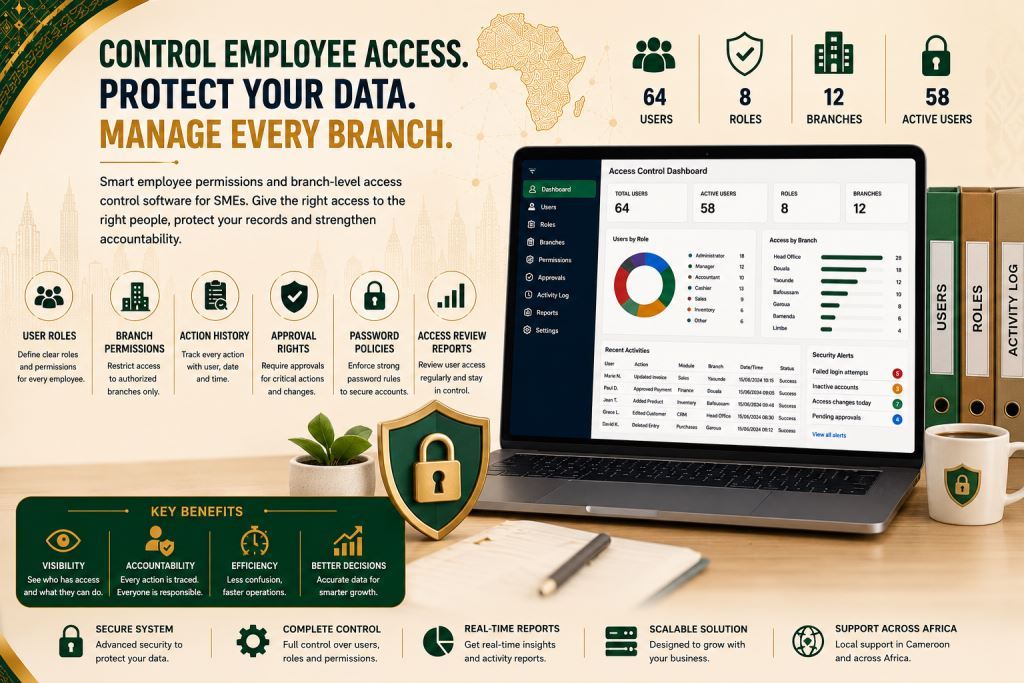
User roles
User roles should remain simple for daily users while providing enough control for managers. In practice, this feature connects employee permissions with sales, invoices, receipts, stock, purchases, suppliers, customers, expenses and dashboards. As a result, organizations avoid creating isolated records. When configured correctly, staff enter information once, verify it quickly and reuse it throughout the system.
Branch permissions
Branch permissions should allow employees to access only the information related to their assigned location. Consequently, confidential records remain protected while managers maintain operational control. A well-configured system also simplifies reporting because each branch works with its own authorized data.
Action history
Action history helps organizations identify who created, modified or approved every important transaction. Furthermore, it creates a complete audit trail for future reviews. Managers can therefore investigate issues more quickly and verify responsibilities using reliable system records instead of verbal explanations.
User permissions become even more effective when every action is automatically recorded and traceable. Read our article Digital Records And Audit Trail Software For Growing African Businesses to discover how audit trails improve transparency, simplify investigations, and strengthen accountability across growing businesses.
Approval rights
Approval rights define which employees can validate corrections, transactions or sensitive operations. In addition, they reduce unauthorized changes by ensuring that important actions require supervisor approval. This process improves accountability while protecting business records.
Password rules
Password rules strengthen account security without making daily work difficult. For example, organizations can require strong passwords, regular password updates and secure login practices. As a result, unauthorized access becomes less likely and employee accounts remain better protected.
Access review reports
Access review reports help managers verify employee permissions on a regular basis. Likewise, they make it easier to identify inactive accounts, excessive permissions or unusual access patterns. Regular reviews improve security while keeping user permissions aligned with current responsibilities.
These features should never be activated without planning. Instead, organizations should configure them according to their size, number of users, reporting requirements and security policies. Therefore, Prosoft Africa recommends mapping the workflow before deployment so every feature supports a real business process rather than becoming an unused option.
Benefits for owners, managers, staff and users
The first benefit is better visibility. Owners and managers no longer depend on scattered verbal updates. Instead, they access structured information directly from the system. As a result, decisions become faster and more reliable.
The second benefit is stronger accountability. Every employee works with assigned permissions, and every important action is linked to a specific user account. Consequently, organizations can identify responsibilities fairly while protecting honest staff members.
The third benefit is improved efficiency. Employees spend less time searching for documents because records remain available through search tools, filters, dashboards and activity history. Therefore, customer service becomes faster and daily operations run more smoothly.
Another important benefit is stronger planning. Managers can monitor branch performance, employee activity, recurring issues, operational trends and business results from centralized reports. In addition, these insights help organizations solve problems before they become more serious.
How to implement it without confusing the team
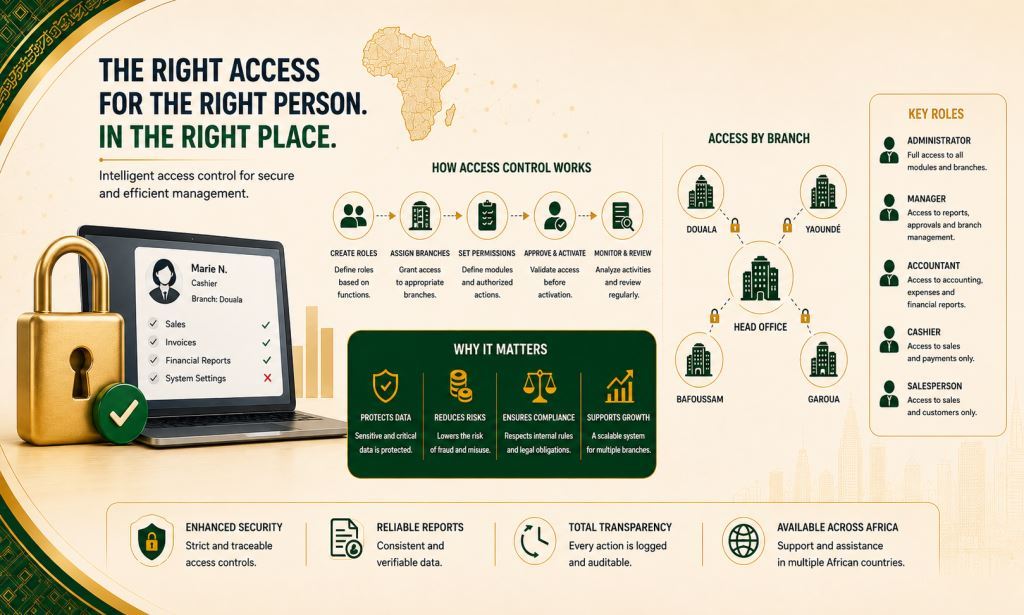
Begin with a workflow review. Identify current tasks, existing records, required reports and the processes that generate the most frequent errors.
Next, prepare essential data before deployment. Active users, opening balances, branch information and key business categories should be verified carefully before the system goes live.
After that, define user permissions according to each role. Cashiers, receptionists, managers, warehouse staff and branch supervisors should receive only the access required for their daily responsibilities.
Then, train employees using practical examples. Real invoices, payments, stock movements and business transactions help users understand the software much faster than theoretical demonstrations.
Finally, review system usage during the first weeks. Managers should verify data quality, monitor reports and ensure that old manual practices gradually disappear.
Implementation should always remain progressive. Rather than enabling every module immediately, organizations should master the essential workflow first. Afterwards, they can activate advanced reports, branch monitoring, customer communication tools, inventory analysis, dashboards and additional management modules.
Available Across Cameroon and Africa
Prosoft Africa provides installation, training and technical support for shops, SMEs, distributors, service companies, branches and growing businesses throughout Cameroon. Services are available in Douala, Yaounde, Buea, Bamenda, Limbe, Bafoussam, Garoua, Maroua, Ngaoundere, Bertoua and many other communities. As a result, businesses receive reliable assistance wherever they operate.
Organizations outside Cameroon can also request online demonstrations, remote installation, practical staff training and continuous technical support. In addition, businesses across Africa benefit from expert guidance during software configuration, user adoption and reporting.
Frequently Asked Questions
Who should use employee access control software SMEs Africa?
This software is suitable for SME owners, shop managers, distributors, accountants, cashiers, sales teams and branch supervisors. It helps organizations strengthen security, improve accountability and simplify daily operations.
Should every feature be activated on the first day?
No. Instead, organizations should begin with the most important workflow. Afterwards, additional modules can be introduced as employees become familiar with the system.
Can Prosoft Africa support teams with limited computer experience?
Yes. Prosoft Africa provides practical, role-based training followed by continuous support. Therefore, employees quickly learn the tasks they perform every day.
Discover how our business management software simplifies employee access control for SMEs across Africa and strengthens operational security.
Conclusion
Choosing employee access control software SMEs Africa should be viewed as an important management decision. The right solution protects business records, strengthens employee accountability and improves reporting. At the same time, it keeps daily operations organized without making work more complicated. Furthermore, the best results are achieved when software, staff training and management discipline develop together.
Prosoft Africa helps shops, SMEs, distributors, service companies, branches and growing businesses across Cameroon and Africa evaluate their requirements, configure suitable modules, train employees and provide continuous support after deployment. Finally, request a demonstration, discuss your current workflow and discover how the software can be adapted to your business operations.
Effective access control delivers even greater value when managers can monitor user activity, branch performance and operational trends through centralized dashboards. Explore our article Business Dashboards, Reports And Multi-Branch Management For Growing Companies to learn how integrated reporting supports better decisions, stronger oversight and more efficient business management.
Explore more expert articles on business management software, business process automation, digital transformation, and enterprise technology across Cameroon and Africa to deepen your understanding.
Stay connected with Prosoft Africa on Facebook, Instagram, LinkedIn, X (Twitter) and TikTok to discover innovative business management solutions, live demos, customer success stories, and the latest updates helping businesses across Africa improve productivity, streamline operations, and accelerate growth.
