Emergency Department Management Software In Cameroon: A Powerful Digital Solution To Save Time And Save Lives

Emergency departments are among the busiest and most critical units in every hospital. Every minute counts when treating trauma victims, accident cases, cardiac emergencies, respiratory distress, and other life-threatening conditions. In Cameroon, particularly in rapidly growing cities such as Douala, Yaoundé, Bafoussam, Garoua, Maroua, Limbe, Buea, Bertoua, Bamenda, Ngaoundéré and Ebolowa, emergency departments face increasing pressure due to rising patient volumes, limited resources and the need for rapid medical decisions. Consequently, hospitals require modern digital solutions that improve efficiency without compromising the quality of patient care.

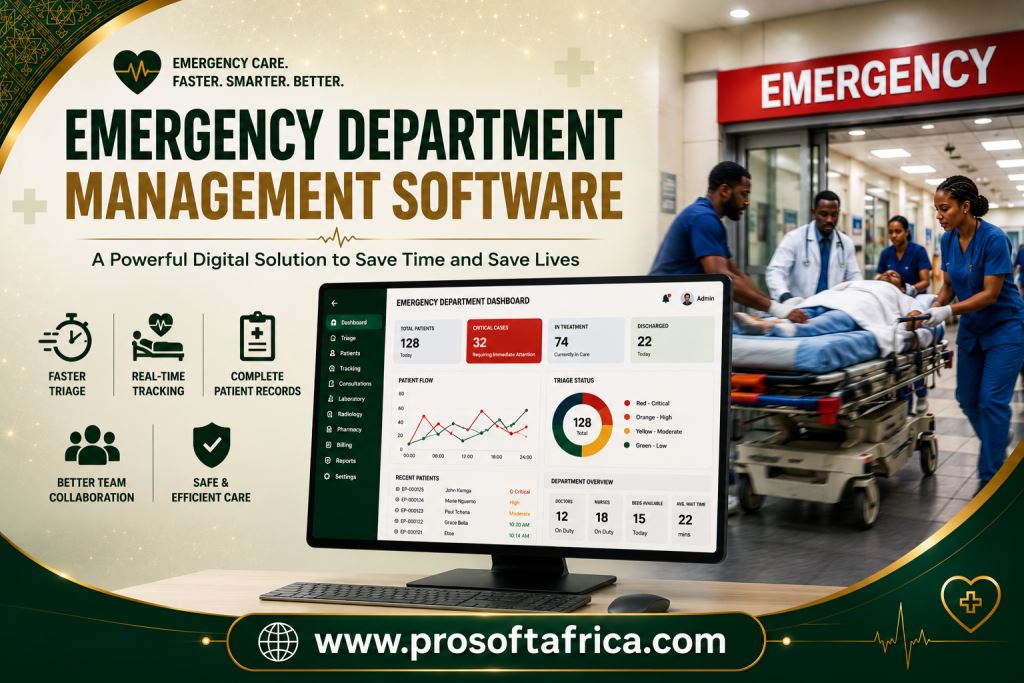
To address these challenges, Prosoft Africa has developed a modern Emergency Department Management Software specifically designed for hospitals and healthcare facilities across Cameroon and Africa. The solution streamlines emergency workflows, accelerates patient triage, strengthens collaboration between healthcare professionals and provides real-time access to critical patient information. As a result, medical teams respond faster, coordinate more effectively and deliver safer emergency care.
Emergency Department Management Software in Cameroon

Why Emergency Department Management Matters For Hospitals In Cameroon And Africa

Managing an emergency department is far more complex than handling routine outpatient consultations. Patients arrive without appointments, medical conditions vary significantly, and life-saving decisions often need to be made within minutes. Therefore, hospitals require a system capable of organizing emergency operations while maintaining speed, accuracy and patient safety.

Many healthcare facilities throughout Cameroon still rely on paper records, manual coordination and disconnected information systems. Consequently, emergency departments frequently experience long waiting times, communication delays and incomplete patient information. These challenges become even more serious during periods of high patient demand or mass casualty incidents.

Common challenges include:

  • Long queues during patient admission
  • Slow or inaccurate patient triage
  • Missing or incomplete medical information
  • Poor communication between nurses and physicians
  • Delays in laboratory and radiology requests
  • Difficulty tracking patient movement
  • Limited visibility into critical cases
  • Medical information scattered across different departments

In major cities such as Douala and Yaoundé, these operational challenges can quickly affect patient outcomes. Delays of only a few minutes may significantly impact emergency treatment. For this reason, hospitals increasingly rely on Emergency Department Management Software to improve coordination, reduce waiting times and support faster clinical decision-making.

Prosoft Africa developed its solution specifically for African healthcare environments. Unlike generic hospital software, it addresses the realities faced by hospitals across Cameroon. The software performs efficiently even with unstable internet connections, supports both English and French users, adapts to hospitals of different sizes and remains affordable for healthcare institutions throughout Africa. Whether serving a regional hospital in Garoua, a district hospital in Maroua or a major medical center in Douala, the software provides the flexibility required for efficient emergency care.

Essential Features To Look For In Emergency Department Management Software

Intelligent Triage System

An effective Emergency Department Management Software begins with a reliable triage system. As soon as patients arrive, healthcare professionals classify them according to the severity of their condition. Critical cases receive immediate priority, while less urgent patients follow an organized treatment pathway. Consequently, life-threatening emergencies receive rapid attention and waiting times become more manageable.

Fast Patient Registration

Emergency admissions should never be delayed by lengthy administrative procedures. Emergency Department Management Software enables reception staff to register patients within seconds using a streamlined digital workflow. As a result, congestion at emergency entrances decreases and healthcare professionals begin treatment much sooner.

Real-Time Patient Tracking

Hospitals must always know where every emergency patient is located. Emergency Department Management Software continuously tracks patient movement throughout the emergency department. Healthcare teams immediately see each patient’s current location, completed procedures, pending laboratory or imaging requests and the time elapsed since admission. Therefore, emergency staff coordinate care more efficiently and reduce unnecessary delays.

Instant Access To Medical History

Rapid access to accurate medical information plays a vital role during emergencies. Emergency Department Management Software allows physicians to immediately review allergies, chronic illnesses, previous hospitalizations, medications and earlier treatments before making clinical decisions. Consequently, healthcare professionals reduce medical risks while improving treatment accuracy.

Integration With Laboratory And Radiology
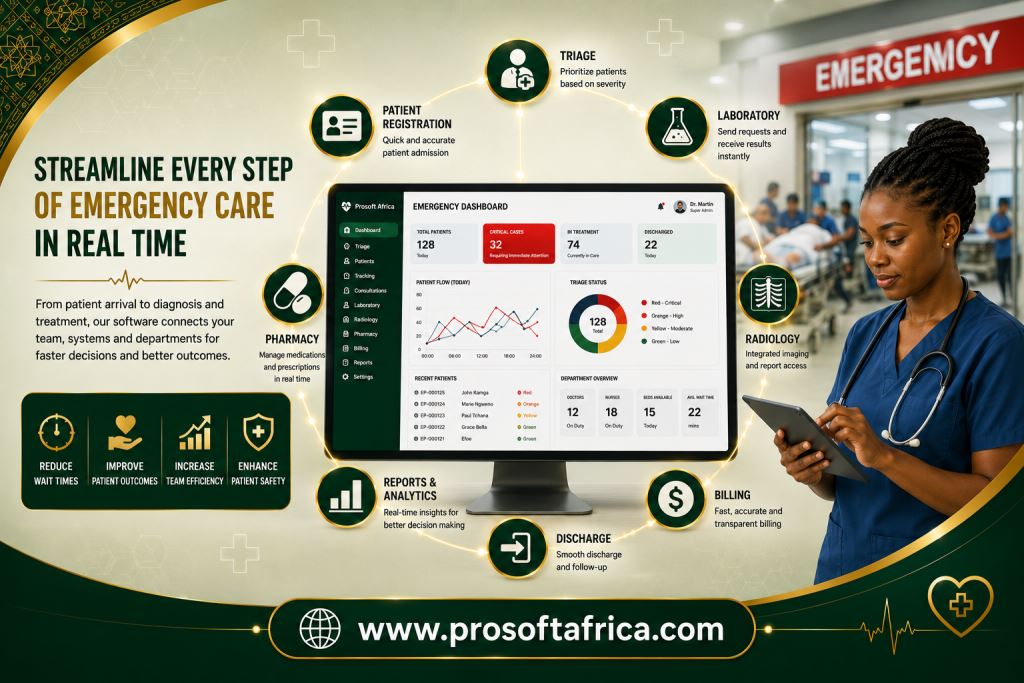
Fast diagnosis is essential during medical emergencies. Emergency Department Management Software sends laboratory and radiology requests electronically as soon as physicians order them. Once examinations are completed, results automatically appear in the patient’s emergency record. Consequently, healthcare professionals receive critical diagnostic information more quickly and begin appropriate treatment without unnecessary delays.

Emergency Department Management Software also works seamlessly with Medical Laboratory Management Software. Laboratory requests are transmitted electronically, while test results are automatically returned to the patient’s emergency record. This integration enables healthcare professionals to receive critical diagnostic information more quickly and accelerate emergency treatment.

Team Coordination On A Single Platform

Emergency care requires constant collaboration between physicians, nurses, laboratory technicians, radiologists and administrative staff. Emergency Department Management Software provides a centralized platform where every authorized healthcare professional accesses the same real-time information. As a result, communication improves, duplicate tasks decrease and patient care becomes more coordinated throughout the emergency department.

Full Traceability Of Critical Interventions

Every emergency procedure should be properly documented. Emergency Department Management Software automatically records cardiac arrests, trauma cases, respiratory emergencies, emergency medications, surgical interventions and other critical events. Therefore, hospitals maintain complete medical documentation for quality assurance, clinical reviews and regulatory reporting.

Advanced Reporting And Analytics

Hospital administrators need reliable information to improve emergency services. Emergency Department Management Software generates comprehensive reports on patient volumes, peak admission periods, waiting times, treatment durations, staff performance and emergency case categories. Consequently, hospital management identifies operational challenges, allocates resources more effectively and continuously improves emergency department performance.

High-Level Security

Patient information must remain secure at all times. Emergency Department Management Software protects sensitive medical records through encrypted data storage, role-based user permissions and comprehensive activity logs. As a result, only authorized healthcare professionals access confidential information while hospitals maintain compliance with healthcare data protection standards.

Emergency Department Management Software in Cameroon

Benefits For Hospital Administrators, Medical Teams And Patients

Implementing Emergency Department Management Software creates measurable benefits for every department within the hospital. First, patients receive faster triage and shorter waiting times because emergency cases are automatically prioritized according to their level of urgency. As a result, critically ill patients receive immediate medical attention when every second matters.

Healthcare professionals also benefit from improved coordination. Doctors, nurses, laboratory technicians and radiologists work with synchronized information throughout the patient’s emergency journey. Consequently, communication becomes faster, duplicate procedures are reduced and clinical decisions are made with greater confidence.

Hospital administrators gain complete visibility into emergency department operations through real-time dashboards and performance reports. They monitor patient flow, staff productivity, waiting times and resource utilization from a centralized platform. Therefore, hospital leadership makes informed decisions that improve both operational efficiency and patient outcomes.

At the same time, automated workflows significantly reduce documentation errors, missed laboratory requests and communication gaps between departments. Patients experience smoother admissions, faster diagnosis and more coordinated treatment, leading to higher satisfaction and improved quality of care.

Better Accountability Through Digital Emergency Management

Accountability plays a critical role in emergency medicine. Emergency Department Management Software records every action performed during the patient’s emergency journey, including registration, triage, consultations, laboratory requests, treatments, prescriptions and patient transfers. Consequently, hospitals maintain a complete digital history of every emergency case.

The software also records user activities, timestamps and clinical updates in real time. As a result, hospital administrators easily monitor staff performance, review emergency procedures and investigate incidents whenever necessary. These detailed audit trails strengthen transparency while supporting continuous quality improvement.

Furthermore, comprehensive reports help hospitals evaluate emergency department performance over time. Managers analyze response times, treatment efficiency, patient outcomes and resource utilization to identify opportunities for improvement. Therefore, healthcare facilities strengthen patient safety, improve accountability and maintain higher standards of emergency medical care.

Healthcare organizations operating multiple facilities can further enhance emergency services by combining Emergency Department Management Software with Multi-Branch Hospital Management Software. Together, these solutions allow emergency departments across different hospital branches to share patient information, coordinate referrals, monitor emergency capacity and deliver consistent emergency care throughout the entire healthcare network.

How To Successfully Implement Emergency Department Management Software

Successfully implementing Emergency Department Management Software begins with careful planning. Hospitals should first evaluate their current emergency workflows, patient admission procedures, triage processes, laboratory coordination and communication between departments. This assessment helps identify operational challenges and ensures that the software is configured to meet the specific needs of the emergency department. As a result, the transition becomes smoother and more efficient.

Configure The System According To Hospital Workflows

Every hospital operates differently. For this reason, Prosoft Africa customizes Emergency Department Management Software according to each healthcare facility’s emergency procedures. Patient triage categories, user permissions, emergency treatment protocols, laboratory workflows, radiology services and reporting dashboards are configured before deployment. Consequently, emergency teams begin using a system that reflects their daily operations from the very first day.

Train Emergency Teams With Practical Scenarios

Comprehensive staff training is essential for successful adoption. Reception staff learn how to register emergency patients quickly, while nurses become familiar with digital triage procedures and patient monitoring tools. Physicians learn to access medical histories, record consultations and request laboratory or radiology examinations electronically. Likewise, laboratory technicians and radiologists process requests digitally and return results directly to the patient’s emergency record. Therefore, every member of the emergency team gains the confidence to use the software efficiently during high-pressure situations.

Continuous Technical Support And System Improvement

Implementing the software is only the beginning of the digital transformation process. After deployment, hospitals should continuously monitor system performance, review emergency workflows and evaluate user feedback. Prosoft Africa provides ongoing technical support, software updates and professional assistance to ensure that Emergency Department Management Software continues to improve emergency care while adapting to the evolving needs of healthcare facilities.

Available Across Cameroon And Africa

Prosoft Africa provides Emergency Department Management Software to hospitals, medical clinics and healthcare institutions throughout Cameroon and across Africa. Healthcare facilities in Douala, Yaoundé, Bafoussam, Garoua, Maroua, Limbe, Buea, Bertoua, Bamenda, Ngaoundéré, Ebolowa, Kumba and many other cities benefit from professional installation, comprehensive staff training and continuous technical support.

The software performs efficiently even in regions with unstable or limited internet connectivity. Hospitals located in rural communities or remote healthcare centers can continue managing emergency services without compromising speed or reliability. In addition, the bilingual English and French interface makes the solution suitable for healthcare professionals throughout both Anglophone and Francophone regions of Cameroon.

Designed in Africa for African healthcare environments, the software combines affordability, flexibility and ease of use. Its intuitive interface requires minimal training, while its modular architecture allows hospitals to expand functionality as their needs evolve. Consequently, healthcare institutions of every size can modernize emergency care without excessive investment.

As healthcare facilities continue their digital transformation, Emergency Department Management Software becomes even more powerful when integrated with Hospital Management Software. Together, these solutions centralize emergency care, patient records, laboratory services, pharmacy management, billing and hospital administration within one intelligent platform.

Frequently Asked Questions

Is Emergency Department Management Software suitable for small hospitals?

Yes. Hospitals, medical clinics and emergency care centers of all sizes can benefit from Emergency Department Management Software. The solution scales according to the size and operational needs of each healthcare facility.

Can the software operate with limited internet connectivity?

Yes. Emergency Department Management Software is optimized for healthcare environments where internet connectivity may be unstable. Hospitals can continue managing emergency operations efficiently while maintaining secure access to patient information.

Does the software support both English and French?

Yes. The software includes a fully bilingual interface, allowing healthcare professionals in both English-speaking and French-speaking regions of Cameroon to use the system comfortably.

Does Prosoft Africa provide installation and staff training?

Yes. Prosoft Africa provides software installation, system configuration, user training, technical support and continuous assistance to ensure successful implementation.

Can the software integrate with other hospital modules?

Yes. Emergency Department Management Software integrates with patient records, laboratory management, radiology, pharmacy, billing and other hospital management modules to create a fully connected healthcare environment.

Conclusion

Modern emergency departments require more than experienced medical professionals. They also need intelligent digital tools that improve coordination, accelerate clinical decisions and provide immediate access to critical patient information. Emergency Department Management Software from Prosoft Africa helps hospitals reduce waiting times, strengthen emergency response and improve the quality of patient care.

Developed specifically for African healthcare environments, the solution supports hospitals throughout Cameroon by combining intelligent triage, real-time patient tracking, laboratory integration, secure medical records and comprehensive reporting within one centralized platform. As a result, healthcare professionals work more efficiently while patients receive faster and safer emergency treatment.

Discover more articles about hospital management, emergency care, patient records, laboratory management and healthcare digital transformation to learn how Prosoft Africa helps hospitals across Cameroon and Africa improve operational efficiency and deliver better patient outcomes.

Follow Prosoft Africa on Facebook, Instagram, LinkedIn, X (Twitter), and TikTok to discover our latest healthcare software solutions, product demonstrations, customer success stories and expert insights into digital hospital management.