

Business Automation and Digital Transformation for African Companies
Business automation and digital transformation in Africa is no longer a concept reserved for large enterprises. Today, SMEs, shops, distributors, service businesses, agencies and growing companies in Cameroon and across Africa are adopting digital solutions to improve efficiency, reduce errors and organize their operations more effectively.
Prosoft Africa supports business owners, shop managers, wholesalers, accountants, sales teams and inventory managers in their transition from manual processes to structured digital systems. This support includes software installation, staff training and continuous technical assistance.
The main goal of this article is to help decision makers understand the real value of digital transformation. A good system should not only look modern. Instead, it must solve real daily business problems.
It should allow users to access information quickly. It should also reduce repetitive tasks, simplify reporting and improve decision-making. As a result, businesses operate in a more efficient and structured way.
In cities such as Douala and Yaounde, businesses are growing rapidly. Customer demand, transactions and operational activities continue to increase every day. Therefore, manual tools like paper records and Excel files are no longer sufficient.
When multiple employees manage the same data, errors become more frequent. A digital system helps centralize information and improves accuracy across all departments.
Digital transformation is not only about technology. It is also about improving how people work. For this reason, implementation must be gradual, practical and aligned with real business needs.
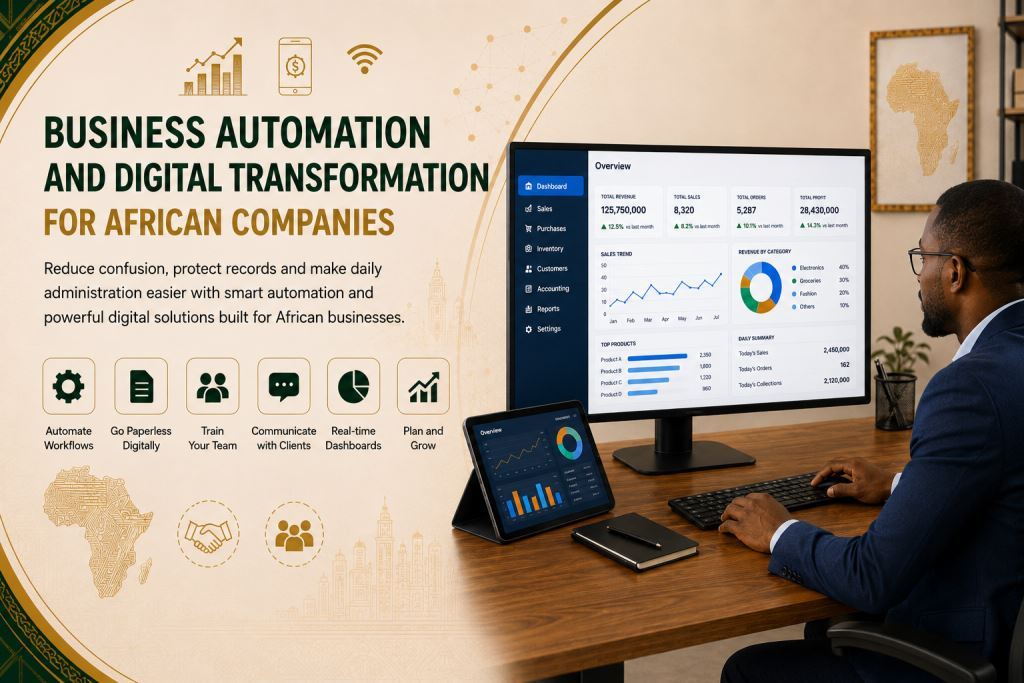
Why this topic matters for African businesses
Business automation and digital transformation are becoming essential for companies in Cameroon and across Africa. Many organizations now focus on improving efficiency and reducing operational delays.
First, teams often spend too much time searching for information. They also prepare reports manually and verify data across different documents. As a result, daily operations become slower and less efficient.
In addition, communication between departments is often weak. Information does not always flow correctly. This leads to delays and errors in decision-making.
Furthermore, many managers do not receive real-time reports. This reduces visibility and makes it harder to understand business performance.
As businesses grow, these challenges increase. A system that works for a small shop becomes inefficient when the company expands into multiple branches.
Therefore, without a centralized system, each department uses its own method. This creates inconsistencies, duplicated work and unreliable reporting.
Finally, companies need structured systems to support growth. Digital tools help centralize information and improve control over operations.
Key features and capabilities to look for
A strong business automation system must include tools that improve visibility, control and decision-making. These features are essential for growing companies in Africa.
1. Workflow Audit
Workflow audit helps businesses track daily operations more clearly. Instead of relying on manual follow-ups, managers can monitor processes in real time. This improves transparency and reduces errors in operations.
2. Paper-to-Digital Migration
Many companies still rely on paper records. However, this method slows down productivity and increases risks. Digital migration solves this problem by converting all data into a structured system that is easy to access and update.
3. Staff Training
Proper training ensures that employees use the system correctly. When staff understand the tools, they make fewer mistakes and work more efficiently. As a result, adoption becomes faster and smoother.
4. Customer Communication
Good systems improve communication with customers. For example, businesses can send updates, track interactions and respond faster to requests. This leads to better customer satisfaction.
5. Management Dashboards
Management dashboards give leaders a clear view of performance. They show key indicators such as sales, expenses and operational results. Therefore, managers can make faster and more informed decisions.
6. Growth Planning
Growth planning tools help companies prepare for expansion. They allow managers to analyze trends and predict future needs. In this way, businesses can scale more effectively.
Practical benefits for businesses, teams and customers
When companies adopt automation and digital transformation, the benefits appear quickly in daily operations. Instead of waiting for monthly reports, managers can monitor performance in real time. In addition, teams can access accurate information without delays.
For management, the most important results include better stock control, accurate invoices and improved financial tracking. As a result, decision-making becomes faster and more reliable.
For employees, the system reduces pressure. They follow clear processes, and they spend less time searching for information. Consequently, productivity increases and errors decrease.
For customers, the experience improves significantly. They receive faster service, clearer billing and more professional communication. In many cases, this builds stronger trust between the business and its clients.
Another key benefit is accountability. With role-based access, each employee has a defined responsibility. For example, cashiers handle payments, while managers oversee reports. This structure improves control without reducing efficiency.
Finally, digital systems support long-term planning. When data is organized, managers can identify trends such as peak sales periods, slow seasons and high-performing branches. Therefore, they can plan hiring, purchasing and expansion more effectively.
How to implement automation without disrupting your team
Successful implementation always starts with a clear understanding of the current workflow. First, companies should analyze how they currently manage data, reports and daily operations. This step helps identify gaps and inefficiencies.
Next, businesses should configure the system based on real operational needs. Prosoft Africa supports companies in setting up user roles, departments, branches and reporting structures. As a result, the system matches how the business actually works.

Training plays a critical role in adoption. Employees do not need technical skills. Instead, they need practical guidance on how to record data, generate reports and access information. Therefore, training should focus on real tasks rather than theory.
After deployment, companies must monitor usage closely. For example, managers should verify data accuracy and ensure that staff follow the new processes. In addition, regular follow-up meetings help resolve issues early and prevent resistance.
Finally, continuous support ensures long-term success. Digital transformation is not a one-time action; it is an ongoing process that evolves with the company.
Available across Cameroon and Africa
Prosoft Africa supports businesses across Cameroon, including Douala, Yaounde, Buea, Bamenda, Limbe, Bafoussam, Garoua, Maroua, Ngaoundere and Bertoua. In addition, the company provides services to other African countries through remote setup and online support.
For companies outside major cities, remote assistance becomes especially useful. Teams can start with online demonstrations, then proceed with configuration and training. When necessary, on-site support can also be arranged depending on location and urgency.
Decision checklist Before selecting a system
Before selecting a system, decision makers should evaluate key factors carefully. For example, they should check whether the software supports reporting, user roles and scalability.
In addition, it is important to ensure that the system can grow with the business. Many companies fail because they choose tools that cannot scale over time.
Finally, leadership involvement is essential. When managers actively support the system, employees adapt faster and the transformation becomes more successful.
Discover how our business management software supports business automation and digital transformation across Africa.
Frequently asked questions
Is business automation useful for small businesses?
Yes. Small businesses benefit quickly because automation reduces manual errors and improves efficiency.
Does Prosoft Africa provide training and support?
Yes. The company provides installation, training and continuous support to ensure smooth adoption.
Can the system support multiple branches?
Yes. Multi-branch management is designed to centralize control while allowing local operations.
What is the first step to start?
The first step is to request a demo and identify key business challenges before implementation.
Conclusion
In conclusion, business automation and digital transformation are essential for modern companies in Africa. They help organizations improve efficiency, reduce errors and make better decisions.
Prosoft Africa supports businesses throughout this journey by offering practical tools, training and long-term assistance. Therefore, companies can move from manual processes to a more structured and scalable digital system with confidence.
Explore more expert articleson business management software, business process automation, digital transformation, and enterprise technology across Cameroon and Africa to deepen your understanding.
Stay connected with Prosoft Africa on Facebook, Instagram, LinkedIn, X (Twitter), and TikTok to discover innovative business management solutions, live demos, customer success stories, and the latest updates helping businesses across Africa improve productivity, streamline operations, and accelerate growth.
